Vertical or Horizontal Nail Ridges: Causes Explained
Quick Answer
Vertical nail ridges usually develop with age and can become more visible when nails are dry or brittle. Horizontal nail ridges, especially deep grooves called Beau’s lines, may appear when nail growth temporarily slows or stops because of illness, injury, or another health condition. Fine vertical ridges are often harmless, but new, deep, or unexplained horizontal grooves deserve medical attention. Gentle nail care can improve comfort and appearance, but identifying the underlying cause is essential.
Have you ever removed your nail polish and noticed tiny lines running across your natural nails? Some travel from your cuticles toward the tips, while others stretch sideways across the nail plate.
These changes can seem surprising, especially when your nails previously looked smooth. Fortunately, many nail ridges are harmless. Others may provide clues about your nail growth, recent illnesses, or health conditions.
Understanding what causes vertical or horizontal nail ridges helps you recognize normal changes, avoid unnecessary treatments, and know when to ask a dermatologist for advice.


What Is the Difference Between Vertical and Horizontal Nail Ridges?
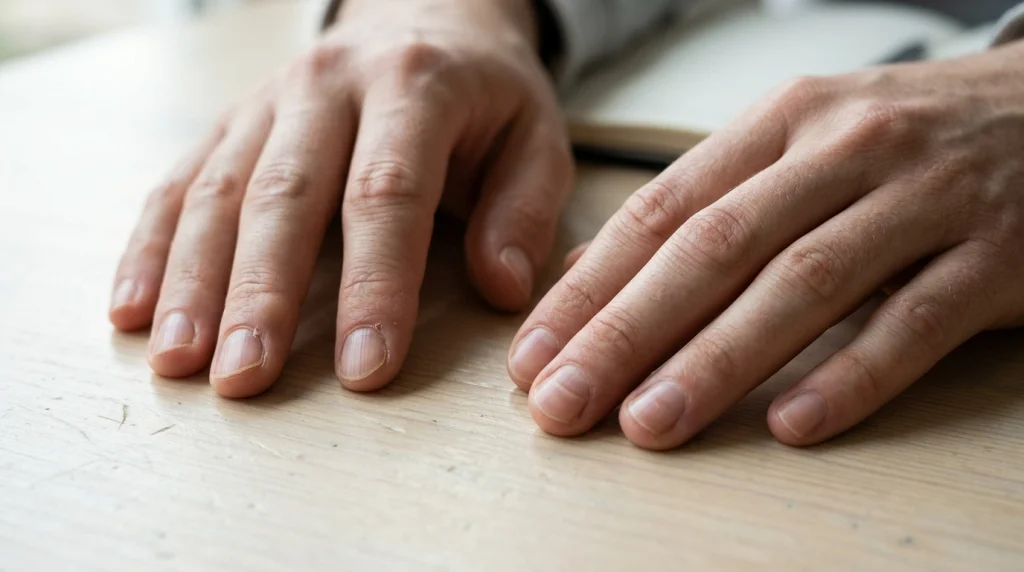
The most important difference is the direction of the lines and the process that produces them.
Your nails grow from specialized tissue called the nail matrix, located near the base of each nail. New nail cells gradually push the existing nail plate forward. Changes in nail formation can leave visible ridges, grooves, or irregularities.
Vertical Nail Ridges
Vertical ridges, also called longitudinal ridges, run from the cuticle toward the nail tip.
They may look like:
- Thin raised lines along the nail surface.
- Shallow grooves running lengthwise.
- Slightly uneven nail texture.
- Parallel lines affecting several fingernails.
Fine vertical ridges are commonly associated with normal aging. They don’t automatically indicate a vitamin deficiency or disease.
Horizontal Nail Ridges
Horizontal ridges extend across the width of your nail, from one side to the other.
Deep horizontal depressions are commonly called Beau’s lines. They occur when nail growth temporarily slows or stops.
Unlike many fine vertical ridges, Beau’s lines can reflect a previous illness, nail injury, medication effect, or health problem.
A single affected nail may suggest local damage, while similar grooves appearing across several nails may point toward a broader interruption in nail growth. Neither pattern establishes a diagnosis on its own.
What Causes Vertical Nail Ridges?
Several factors can contribute to vertical ridges. Their significance depends on your age, the appearance of the ridges, other symptoms, and whether the change is new.
1. Normal Aging
Aging is one of the most common explanations for fine vertical lines.
As you get older, your nails may grow more slowly and develop a more noticeable longitudinal texture.
These ridges often become easier to see under bright lighting or glossy polish.
If your ridges have developed gradually, affect multiple nails, and aren’t accompanied by pain or unusual color changes, they may simply represent a normal variation in nail appearance.
For more context, explore how nail health changes over time.
2. Dry Skin and Nail Brittleness
Dryness doesn’t explain every vertical ridge, but it can make nail texture more noticeable and contribute to splitting or breakage.
Your nails and surrounding skin are regularly exposed to water, soap, sanitizers, and household cleaning products.
Frequent wetting and drying can leave nails brittle, particularly if they are already thin or fragile.
You may notice:
- Rough nail surfaces.
- Peeling or splitting at the tips.
- Dry cuticles and surrounding skin.
- Nails that snag on clothing.
Daily moisturizing and protection during wet chores can reduce dryness-related damage, although they won’t necessarily eliminate natural ridges.
3. Skin Conditions Such as Eczema
Some inflammatory skin conditions can affect your nail texture.
Eczema may be associated with dryness and changes in the nails, especially when inflammation involves the surrounding nail folds.
Other skin conditions, including psoriasis and lichen planus, can also cause nail abnormalities. Their effects may include pitting, splitting, ridging, or other changes rather than simple fine vertical lines alone.
If you have persistent nail changes alongside itching, inflamed skin, or unusual nail splitting, a dermatologist can assess whether an underlying skin condition is involved.
4. Iron Deficiency or Other Nutritional Problems
Nutritional deficiencies can sometimes affect nail health, but vertical ridges alone aren’t a reliable sign that you lack a particular vitamin or mineral.
Iron deficiency may be associated with brittle nails, longitudinal ridging, or spoon-shaped nails, a condition called koilonychia.
Other nutritional problems can interfere with normal nail growth.
However, taking supplements simply because you notice ridges isn’t recommended. Excessive amounts of certain nutrients can cause harm.
If you also experience unusual fatigue, weakness, or other concerning symptoms, ask a healthcare professional whether testing is appropriate.
5. Thyroid Disorders
Thyroid conditions can sometimes produce changes in nail growth and appearance.
For example, hypothyroidism may contribute to dry, brittle nails that break easily or develop visible ridges.
That doesn’t mean ridged nails are evidence of thyroid disease.
Instead, your clinician will consider the complete picture, including symptoms such as fatigue, dry skin, temperature sensitivity, or changes in hair texture.
6. Repeated Nail Trauma
Frequent picking, aggressive manicures, or repeated irritation near your nail base may affect how your nails grow.
Some injuries produce temporary irregularities, while significant damage to the nail matrix can cause more persistent changes.
If one nail develops a new pronounced ridge or repeatedly splits along the same line, have it examined rather than repeatedly buffing the area.
What Causes Horizontal Nail Ridges?
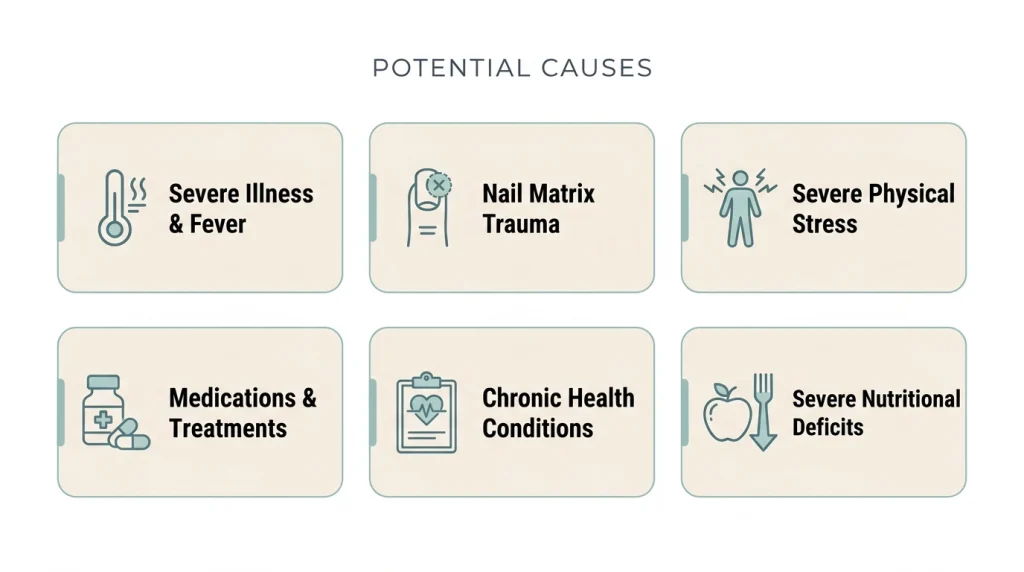
Horizontal ridges deserve a closer look because deep transverse grooves can indicate that nail production was interrupted.
1. Severe Illness or High Fever
One recognized cause of Beau’s lines is a significant illness.
During a serious illness, nail growth may slow temporarily. When normal growth resumes, a groove can become visible and gradually move outward as the nail grows.
Reported triggers include severe infections and illnesses involving high fever, including some cases of pneumonia and COVID-19.
These grooves may not become noticeable until weeks after the triggering event.
If you’ve recently recovered from a significant illness, that history may help your healthcare provider interpret the changes.
2. Physical Injury to the Nail Matrix
An injury near the nail base can interrupt the production of new nail cells.
Examples include:
- Slamming a finger in a door.
- Crushing a fingertip.
- Damaging the nail during a manicure.
- Repeated pressure from poorly fitting footwear.
- Trauma during artificial nail application or removal.
When an injury affects only one nail, the resulting horizontal groove may appear on that nail alone.
Learn more about the tissue involved in nail growth in our guide to what the nail matrix is and how it works.
3. Significant Physical or Emotional Stress
Severe physical stress can interrupt normal nail production, especially when it accompanies serious illness or another major health event.
Intense emotional stress has also been reported as a possible trigger for Beau’s lines.
However, a horizontal groove doesn’t prove that stress was responsible. Avoid automatically attributing unexplained nail changes to a busy schedule or a difficult week.
4. Certain Medications and Medical Treatments
Some medications and treatments can change nail growth.
Chemotherapy is a recognized cause of nail changes, including transverse grooves.
The appearance and severity depend on the treatment and individual response.
If you notice new nail abnormalities while taking prescribed medication, discuss them with your treating clinician. Don’t stop medication on your own.
5. Chronic Medical Conditions
Some underlying health conditions may interfere with healthy nail growth.
Potential contributors include diabetes, peripheral artery disease, thyroid disorders, and conditions affecting circulation or the nail matrix.
These associations don’t mean every horizontal ridge represents serious disease.
Nevertheless, unexplained or recurring grooves should be assessed, particularly if you already have a condition that affects circulation or wound healing.
6. Significant Nutritional Deficiency
Severe deficiencies in nutrients such as zinc or inadequate protein intake may disrupt nail growth enough to produce Beau’s lines.
This is different from claiming that every ridge means you need a multivitamin.
A balanced diet supports healthy nail formation, but supplements should be selected according to your actual nutritional needs and medical guidance.
Are All Horizontal Lines Beau’s Lines?
No. A horizontal mark isn’t necessarily a true groove in the nail plate.
Some lines are changes in color rather than texture.
For example, certain white transverse nail bands may represent different medical findings and require a different assessment.
A useful first observation is whether the line feels like a depression when you gently run a fingertip over the nail.
Beau’s lines are physical grooves. Other nail lines may be flat and appear only as discoloration.
Don’t rely on this simple observation to diagnose the cause. A clinician may need to examine the nails and consider your medical history.
How Can You Tell Whether Nail Ridges Are Serious?
Consider the direction, depth, timing, and associated symptoms rather than focusing only on whether a line is visible.
Fine vertical ridges that have developed gradually are often less concerning than a sudden, marked change.
Warning signs include:
- New deep horizontal grooves with no clear explanation.
- Multiple new grooves affecting several nails.
- A new or changing dark brown or black streak.
- Persistent nail splitting or distortion.
- Nails lifting away from the underlying skin.
- Redness, swelling, warmth, or pain around a nail.
- Unusual changes in nail thickness, shape, or color.
- Ridges appearing alongside concerning general health symptoms.
When to Seek Medical Care
Arrange a professional assessment for new, unexplained, deep, or recurring ridges. Seek prompt medical attention for a new or changing dark nail streak, significant injury, severe pain, spreading redness, or pus. A dark streak can occasionally indicate nail melanoma and should never be dismissed as an ordinary ridge.
You can learn about additional warning signs in our article on the signs of unhealthy nails.
How Can You Improve the Appearance of Nail Ridges?
There isn’t one treatment that removes every type of nail ridge.
Fine age-related vertical ridges may remain visible. Beau’s lines often move toward the tip as the nail grows, provided the underlying interruption has resolved.
For nails that have been assessed and don’t need medical treatment, these gentle care habits may help.
Moisturize Your Nails and Cuticles Daily
Apply a fragrance-free hand cream to your fingertips, nails, and surrounding skin after washing your hands and before bed.
A product containing glycerin or petrolatum can help reduce moisture loss.
Cuticle oil can also condition dry skin around your nails, but it won’t repair the underlying cause of a medically significant ridge.
Protect Your Hands During Wet Chores
Wear appropriate protective gloves when washing dishes or using household cleaners.
Repeated soaking, detergent exposure, and drying can contribute to brittle nails.
If your hands become sweaty inside gloves, take breaks and dry them when appropriate. Keeping skin wet for extended periods can cause additional irritation.
Keep Your Nails at a Comfortable Length
Trim your fingernails regularly and gently smooth rough edges with a fine nail file.
Shorter nails may be less likely to catch on clothing or split along an existing ridge.
Never dig into the grooves or try to cut away a ridge.
Consider a Ridge-Filling Base Coat
If a healthcare professional has ruled out concerning causes, a ridge-filling base coat may temporarily make shallow surface irregularities less visible.
Unlike aggressive buffing, a cosmetic filler can create a smoother-looking manicure without intentionally removing layers of your natural nail.
Stop using a product if it causes irritation or worsens nail peeling.
Avoid Aggressive Nail Buffing
Buffing can temporarily smooth the appearance of ridges, but excessive buffing makes the nail plate thinner.
That may increase splitting, sensitivity, and breakage.
If your nails are already thin, brittle, or damaged, skip surface buffing and focus on protective care instead.
Pro Tip
Take a clear photograph of your natural nails when you first notice a new ridge. Repeat the photograph several weeks later under similar lighting. This can help you explain changes to your dermatologist and see whether a groove is moving outward with nail growth.
Which Nail-Care Products May Help?
You don’t need an expensive nail-repair system to manage harmless surface ridges.
Choose products based on the actual problem, such as dryness, brittleness, or the desire for a smoother-looking manicure.
Fragrance-Free Hand Cream
A basic moisturizing cream is useful if your nails and surrounding skin are dry.
Apply it consistently rather than expecting one overnight treatment to change your nail structure.
Explore fragrance-free hand creams on Amazon.
Cuticle Oil
Cuticle oil can soften dry skin around your nails and make routine nail care more comfortable.
It isn’t a substitute for treating an underlying illness or nail matrix disorder.
Explore jojoba cuticle oils on Amazon.
Ridge-Filling Base Coat
A ridge-filling base coat is a cosmetic option for temporarily reducing the appearance of fine surface lines.
Select a formula compatible with your nail polish and follow its application instructions.
Explore nail ridge-filling base coats on Amazon.
Affiliate disclosure: As an Amazon Associate, we earn from qualifying purchases.
How Long Does It Take for Nail Ridges to Grow Out?
The timeline depends on the type of ridge and the rate of nail growth.
Fingernails generally take approximately four to six months to replace most or all of the visible nail plate, although individual growth rates vary.
Toenails grow more slowly and may take around 12 to 18 months to replace completely.
If a horizontal groove formed after an isolated illness or injury, it may gradually travel toward the nail tip as new nail grows behind it.
However, repeated interruptions in nail growth can produce additional grooves.
Fine vertical ridges associated with normal aging may not disappear completely, even after months of careful nail maintenance.
The most realistic goal is healthy, comfortable nails rather than perfectly flat nail surfaces.
What Should You Do If Nail Ridges Keep Coming Back?
Recurring nail changes deserve more attention than a stable, long-standing texture.
Try to identify when you first noticed the ridges and whether they appeared after an injury, illness, or major change in your routine.
Problem: New horizontal grooves keep appearing
Arrange a medical evaluation to identify possible recurring interruptions in nail growth. Avoid repeatedly hiding the changes without understanding their cause.
Problem: Vertical ridges are accompanied by splitting
Keep the nails short, moisturize regularly, and reduce unnecessary filing and product removal. If splitting persists or affects the same location repeatedly, consult a dermatologist.
Problem: Nails become rough after manicures
Take a break from damaging manicure practices, avoid picking off enhancements, and use gentle removal methods. Seek advice if the nail develops persistent grooves, lifting, or inflammation.
How Can You Prevent Unnecessary Nail Damage?

You can’t prevent every natural ridge, but you can reduce avoidable nail trauma and brittleness.
Do
- Moisturize daily.
- Use gloves for wet chores.
- File nail edges gently.
- Protect the nail base.
- Eat a balanced diet.
- Monitor unusual changes.
Don’t
- Over-buff ridges.
- Pick off gel polish.
- Cut healthy cuticle tissue.
- Ignore painful changes.
- Take supplements blindly.
- Use harsh products on irritated skin.
If your nails also peel, crack, or break easily, our guide to what causes brittle nails explains common contributors and protective habits.
Frequently Asked Questions About Nail Ridges
Q: Are vertical ridges in fingernails normal?
A: Yes. Fine vertical ridges are common, especially as you age. If they develop gradually without other symptoms, they are often harmless. New, deep, or changing ridges should still be evaluated.
Q: What deficiency causes ridges in nails?
A: Iron deficiency can sometimes contribute to nail changes, while severe zinc deficiency may be associated with Beau’s lines. However, ridges alone cannot confirm a deficiency. Testing and treatment should be guided by a healthcare professional.
Q: Can stress cause horizontal nail ridges?
A: Severe physical or emotional stress can sometimes interrupt nail growth and contribute to Beau’s lines. However, unexplained horizontal grooves may have other causes, so stress shouldn’t be assumed to be the explanation.
Q: Can vertical nail ridges disappear?
A: Some ridges related to temporary nail problems may improve as healthy nail grows. Age-related longitudinal ridges often persist. Moisturizers and ridge-filling products may improve appearance without removing the underlying texture.
Q: Should I worry about horizontal ridges on several nails?
A: Horizontal grooves affecting several nails can indicate that nail growth was interrupted by an illness, treatment, or another health issue. Arrange an assessment if the grooves are new, deep, unexplained, or recurring.
What Should You Remember About Nail Ridges?
The answer to what causes vertical or horizontal nail ridges depends on the pattern and the underlying reason your nail texture has changed.
Fine vertical ridges are often a normal part of aging, while deep horizontal grooves may reflect an interruption in nail growth. Protect your nails with gentle daily care, and have unusual or unexplained changes examined rather than trying to buff them away.
Save this guide to Pinterest so you’ll have a simple reference for understanding nail ridges and recognizing when a change deserves professional attention.

Hi, I’m Jessica, the creator behind Unique Lash & Nails Katy.
I created this website for anyone who loves beautiful nails as much as I do. Here, I share trendy nail designs, seasonal manicure ideas, easy nail care tips, honest product recommendations, and step-by-step guides to help you create salon-worthy nails at home. Whether you’re looking for everyday inspiration or your next favorite nail trend, I hope you’ll find something you love.