Yellow Fingernails vs Yellow Toenails: Key Differences
Quick Answer
Yellow fingernails and yellow toenails can have similar causes, but the most likely explanations often differ. Fingernails commonly develop yellow stains from dark polish or repeated product exposure. Toenails are more likely to develop fungal infections, particularly when they become thick, brittle, or crumbly. Either type of nail can discolor because of injury, infection, or a medical condition. The color alone cannot confirm the cause.
You remove your favorite manicure and notice that your fingernails look yellow. Or perhaps your big toenail has slowly developed a yellow patch that will not disappear. Should you be worried?
The difference between yellow fingernails and yellow toenails matters because your hands and feet experience different conditions. Your fingers encounter nail products, soaps, and frequent washing, while your toes spend hours inside shoes where moisture and pressure can affect nail health.
This guide explains the most important differences, how to recognize possible causes, what you can safely do at home, and when you should see a healthcare professional.


Yellow Fingernails vs Yellow Toenails: What Is the Main Difference?
The main difference is not the shade of yellow. It is the combination of location, nail texture, exposure history, and associated symptoms.
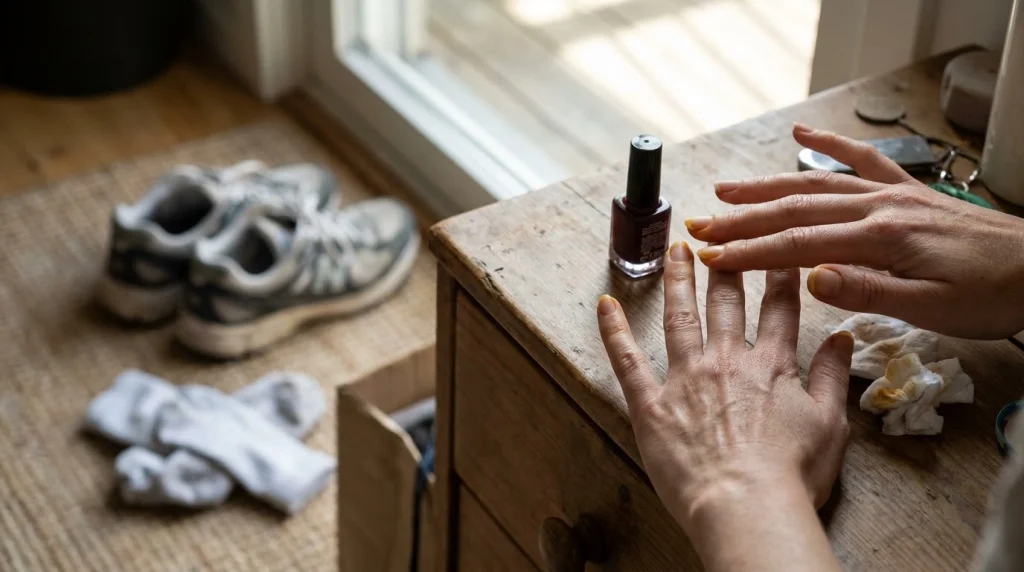
A yellow fingernail that remains smooth after removing burgundy polish may simply be stained. A yellow toenail that becomes increasingly thick and develops debris underneath deserves evaluation for a possible fungal infection.
| Feature | Yellow Fingernails | Yellow Toenails |
|---|---|---|
| Common causes | Polish staining, tobacco exposure, fungal infection, nail disorders | Fungal infection, shoe pressure, injury, polish staining |
| Fungal infection | Possible, but less common | More common |
| Typical environmental exposure | Manicure products, frequent washing, chemicals | Sweaty footwear, damp environments, repeated pressure |
| Nail growth | Generally faster | Generally slower |
| Cosmetic staining | Often noticed after removing dark polish | Possible after long-lasting pedicures |
| When to be concerned | Unexplained, persistent, painful, thickened, or lifting nails | Progressive thickening, crumbling, lifting, pain, or spreading discoloration |
These differences are useful clues, not diagnostic rules. A fungal infection can affect fingernails, and a toenail can be yellow simply because of nail polish.
Why Do Fingernails Turn Yellow?
Yellow fingernails can develop for several reasons. Looking at what happened before the color change often provides the most useful starting point.
1. Dark Nail Polish Staining
Highly pigmented nail polish is a frequent cosmetic reason for yellow-looking fingernails.
Deep red, orange, burgundy, and other intense shades can leave pigments in the upper layers of the nail plate, especially when applied without a protective base coat.
You might notice:
- Light yellow or orange discoloration after polish removal.
- Several nails changing color at the same time.
- A smooth nail surface without unusual thickening.
- No pain, swelling, or debris beneath the nail.
These features favor cosmetic staining, although they do not prove it.
If you have recently removed dark polish, see our guide to removing yellow nail stains safely before attempting aggressive whitening methods.
2. Exposure to Tobacco or Pigmented Products
Tobacco smoke and direct contact with certain pigments can discolor fingernails, particularly on fingers that repeatedly encounter the substance.
Hair dye, self-tanning products, and household substances may also temporarily affect the appearance of your nails.
A useful clue is the distribution. If the staining is concentrated on the fingers most exposed to a product, external contact becomes a more plausible explanation.
However, you should not automatically attribute unexplained yellowing to staining when other nail changes are present.
3. Fungal Nail Infections
Fungal infections can affect fingernails, although they are more common in toenails.
A fungal nail infection, medically called onychomycosis, may cause yellow, white, or brown discoloration. Some infected nails also become thick, brittle, distorted, or separated from the nail bed.
Signs that deserve attention include:
- Yellowing that spreads across the nail.
- Progressive thickening or irregular shape.
- Crumbly or splitting nail edges.
- Material collecting underneath the nail.
- The nail lifting away from the skin beneath it.
Other conditions can produce similar symptoms, so a healthcare professional may need to examine or test the nail before prescribing treatment.
4. Nail Psoriasis and Other Nail Disorders
Psoriasis can affect your nails even when the surrounding skin does not have obvious patches.
Possible signs include small pits, lifting, thickening, and yellowish or salmon-colored areas beneath the nail.
Repeated manicure trauma or damage to the nail matrix can also change how a fingernail grows and looks.
If you notice multiple unexplained changes, professional evaluation is more useful than repeatedly changing cosmetic products.
Why Do Toenails Turn Yellow?
Yellow toenails frequently develop because of problems that affect the nail over a long period. Moisture, fungal exposure, repetitive pressure, and slower nail growth all influence how toenail discoloration develops.
1. Toenail Fungus
Fungal infection is an important cause to consider when a toenail turns yellow, especially if its texture changes.
Fungi can enter through tiny openings around the nail or damaged nail tissue. Warm, damp environments can favor their growth.
You may notice:
- A yellow or whitish patch near the nail tip or side.
- Thickening that develops gradually.
- A rough or crumbly free edge.
- Debris beneath the affected nail.
- Partial separation from the nail bed.
The big toe and second toe are commonly affected.
Fungal infections may persist and spread without appropriate treatment. If you suspect one, arrange an examination rather than relying on cosmetic whitening products.
2. Tight Shoes and Repeated Pressure
Your toenails experience pressure whenever you walk, run, or wear restrictive footwear.
Shoes with a narrow toe box can repeatedly press against your nails. Over time, this may cause trauma, changes in growth, thickening, or discoloration.
Runners, dancers, and people who spend long periods standing may experience repeated toenail stress.
Trauma and fungus can also occur together, so the presence of tight footwear does not exclude infection.
3. Nail Polish and Long-Lasting Pedicures
Toenails can develop cosmetic staining just like fingernails.
When you regularly wear highly pigmented polish, the nail underneath may appear yellow after removal.
This is particularly easy to overlook when your toenails remain painted for extended periods.
If the surface is smooth, the nail is firmly attached, and the discoloration appeared after polish removal, staining is one possibility.
Persistent thickening, crumbling, or spreading discoloration should not be dismissed as a pedicure stain.
4. Aging and Nail Growth Changes
Toenails often become thicker or grow more slowly with age. Longstanding pressure and accumulated injuries can also affect their shape and color.
However, yellow toenails should not automatically be labeled a normal part of aging.
If the appearance is changing, especially in one nail, it is reasonable to have the cause checked.
For additional information about nail texture, explore our guide on how to care for brittle toenails.
How Can You Tell Whether Yellow Nails Are Stained or Infected?
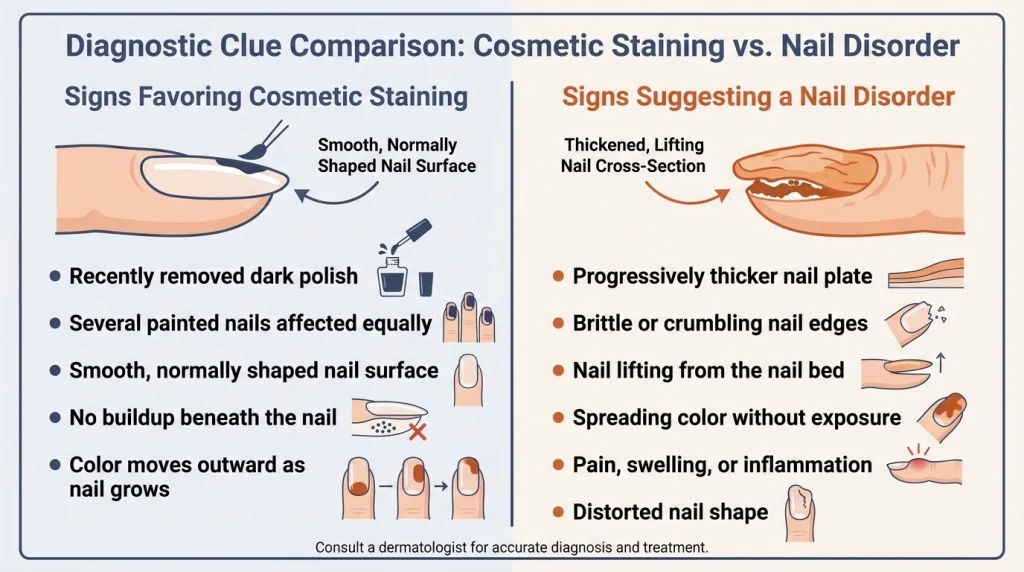
The most useful clues are nail texture, the pattern of discoloration, and whether the change progresses.
Signs That Favor Cosmetic Staining
- You recently removed dark or highly pigmented polish.
- Several painted nails have similar discoloration.
- Your nails remain smooth and normally shaped.
- There is no unusual buildup beneath the nails.
- The yellow color gradually moves outward as your nails grow.
Signs That Suggest a Nail Disorder
- The nail gets progressively thicker.
- The edges become brittle or crumble.
- The nail begins lifting from the nail bed.
- The discoloration spreads without an obvious exposure.
- There is pain, swelling, or inflammation.
- The nail develops a distorted shape.
Warning
You cannot reliably diagnose nail fungus by appearance alone. Nail psoriasis, repeated injury, and other conditions can resemble fungal infections. A clinician may recommend a nail clipping or laboratory test to confirm the cause.
Can Yellow Fingernails and Yellow Toenails Indicate a Health Problem?
Sometimes. Most cases of yellow nail discoloration are not evidence of a serious systemic illness, but persistent nail changes can occasionally reflect an underlying medical condition.
Yellow Nail Syndrome
Yellow nail syndrome is a rare disorder associated with characteristic nail changes, respiratory problems, and swelling caused by impaired lymphatic drainage.
Possible features include:
- Yellow or yellow-green nails.
- Unusually thick or curved nail plates.
- Very slow nail growth.
- Separation of nails from the nail bed.
- Swelling of the legs or ankles.
- Persistent cough or recurring respiratory problems.
The condition can involve fingernails, toenails, or both. Not everyone experiences all of its features.
Yellow nail syndrome is uncommon, and having yellow nails alone does not mean you have it.
Other Medical Conditions
Some inflammatory and medical conditions can affect nail growth or appearance. Nail psoriasis is one example. Certain medications and systemic illnesses can also produce changes that need professional assessment.
It is important not to assume that yellow nails prove a vitamin deficiency, liver disorder, or another particular disease. Nail appearance alone is not specific enough to establish those diagnoses.
For a broader explanation of nail appearance, see our article about what unhealthy nail colors may mean.
How Should You Treat Yellow Fingernails?
The correct approach depends on why your fingernails became yellow.
If Your Nails Have Cosmetic Stains
Start by removing polish gently and examining your bare nails in good lighting.
- Remove remaining polish: Use a suitable nail polish remover without scraping the nail surface.
- Clean gently: Wash your hands with mild soap and lukewarm water.
- Moisturize: Apply hand cream and cuticle oil to protect dry skin around the nails.
- Reduce repeated staining: Use a proper base coat before applying pigmented polish.
- Monitor nail growth: Check whether the discolored area gradually moves toward the free edge.
Do not try to remove deep stains by aggressively filing the nail surface. Excessive buffing can thin and weaken the nail plate.
Minor surface staining may improve with gentle care, while pigment embedded within the nail may need to grow out.
If Your Fingernails May Be Infected
Arrange an evaluation if your nails become thick, crumbly, painful, or progressively discolored.
A clinician may recommend an antifungal treatment when testing or examination supports that diagnosis.
Prescription topical treatments and oral medications are possible options, depending on the severity and other health considerations.
Home whitening products cannot reliably clear a fungal infection beneath the nail.
How Should You Treat Yellow Toenails?
Toenail treatment requires special attention because toenails grow slowly and can remain exposed to pressure and moisture.
Address Footwear and Moisture
Choose shoes that allow enough room for your toes. Keep your feet clean and dry, especially between your toes.
Change damp socks promptly and allow footwear to dry between uses when possible.
These habits help protect your nails and can reduce conditions that favor fungal growth, but they do not cure an established nail infection.
Get a Suspected Fungal Infection Checked
If your toenail is progressively thickening, crumbling, or lifting, a dermatologist, podiatrist, or other qualified healthcare professional can determine whether a fungal infection is present.
Treatment may involve prescription medicine applied directly to the nail or taken by mouth.
Oral antifungal drugs may be more effective for certain infections, but they require consideration of medication interactions, liver health, and other individual factors.
Even after an infection is successfully treated, the damaged nail must grow out before the appearance fully improves.
Be Careful With Toenail Trimming
Trim toenails straight across rather than cutting deeply into their corners.
Avoid digging beneath an attached nail or attempting to cut away thickened tissue aggressively.
If a nail is unusually thick or difficult to trim safely, professional nail care may be appropriate.
How Long Does Yellow Nail Discoloration Take to Disappear?
Recovery depends on the underlying cause and the rate of nail growth.
Fingernails generally grow faster than toenails, which is why a cosmetic fingernail stain may disappear sooner than an equivalent toenail stain.
| Situation | Approximate Timeline |
|---|---|
| Complete fingernail replacement | Often around 4–6 months |
| Complete toenail replacement | Often around 12–18 months |
| Superficial polish stain | May fade sooner or gradually grow out |
| Fungal nail discoloration | May take months of treatment and healthy nail growth |
These are general estimates, not guaranteed recovery times. Age, injury, infection severity, and individual nail growth can affect the results.
A useful way to monitor progress is to photograph your bare nail every few weeks under similar lighting.
If a clear, healthy-looking nail is gradually growing from the base after a known stain, that can be reassuring. A nail that becomes more distorted, painful, or detached needs medical assessment.
What Should You Avoid When Your Nails Are Yellow?
Several popular nail-whitening habits can make damaged nails worse or delay proper treatment.
Do
- Inspect bare nails regularly.
- Keep nail tools clean.
- Use base coat under dark polish.
- Keep feet dry.
- Seek help for unexplained changes.
Don’t
- Scrape aggressively beneath nails.
- Repeatedly buff away discoloration.
- Apply household bleach.
- Hide suspicious changes with extensions.
- Assume every yellow nail has fungus.
Lemon juice, baking soda, and peroxide are frequently promoted as quick whitening solutions. However, they can irritate skin or damage the nail surface when used improperly, and they do not treat infections inside the nail.
If your nails are discolored because of polish, prevention and natural nail growth are usually more useful than repeated aggressive whitening.
How Can You Prevent Yellow Fingernails and Toenails?

Prevention involves different habits for your hands and feet, although both benefit from careful nail hygiene.
Protect Your Fingernails From Staining
- Apply a thin base coat before dark polish.
- Remove old polish carefully rather than peeling it.
- Wear protective gloves when handling strong cleaning products.
- Moisturize the skin around your nails regularly.
- Inspect your natural nails between manicures.
Base coat may reduce pigment transfer, although it cannot guarantee that staining will never occur.
For additional advice, explore our guide to preventing yellow nails.
Reduce the Risk of Yellow Toenails
- Wear breathable shoes that fit comfortably.
- Replace socks when they become sweaty.
- Dry your feet carefully after bathing.
- Wear protective footwear in public showers and locker rooms.
- Avoid sharing nail clippers and other personal grooming tools.
- Address athlete’s foot promptly if it develops.
Good foot hygiene reduces exposure and moisture, but no preventive routine eliminates every risk.
Pro Tip
Keep separate nail tools for your hands and feet, particularly if you suspect a toenail infection. Clean and disinfect reusable tools according to their instructions. This helps reduce the risk of transferring infectious organisms between nails.
Which Nail Care Products Are Actually Worth Using?
You do not need an expensive collection of products to maintain healthy-looking nails. A few practical tools can help with routine care, stain prevention, and hygiene.
1. Protective Base Coat
A base coat is particularly useful if you frequently wear red, burgundy, or other highly pigmented nail polish.
It forms a layer between the natural nail and the colored polish, potentially reducing pigment transfer.
Shop protective nail base coats on Amazon.
2. Gentle Nail Clippers and Files
Well-maintained clippers and a suitable nail file help prevent accidental splitting and rough edges.
Choose tools that are easy to clean, and avoid aggressively filing discolored or thickened nails.
Explore stainless steel nail clipper sets on Amazon.
3. Cuticle Oil
Cuticle oil can help moisturize dry skin around your nails. It is useful for general grooming, but it will not cure fungus or remove discoloration caused by a medical condition.
Apply a small amount to the cuticle area and surrounding skin when needed.
Find jojoba cuticle oils on Amazon.
4. Moisture-Wicking Socks
If your feet regularly become sweaty, moisture-wicking socks can help keep them more comfortable and reduce prolonged dampness.
They are especially useful for exercising or spending long hours in closed footwear.
Browse moisture-wicking socks on Amazon.
Affiliate disclosure: As an Amazon Associate, we earn from qualifying purchases.
When Should You See a Doctor About Yellow Nails?
You should arrange a medical evaluation when nail discoloration is unexplained, persistent, progressive, or accompanied by changes suggesting infection or another nail disorder.
Important warning signs include:
- A nail that becomes increasingly thick or crumbly.
- Yellowing accompanied by lifting from the nail bed.
- Persistent pain, redness, swelling, or drainage.
- Discoloration appearing in one nail without an obvious cause.
- Multiple nails changing alongside other unexplained symptoms.
- A new or changing dark streak.
- Yellow, thickened, slow-growing nails accompanied by leg swelling or respiratory symptoms.
If you have diabetes, poor circulation, or a weakened immune system, seek professional advice sooner for a suspected nail infection or injury.
Sudden or severe shortness of breath requires urgent medical attention rather than waiting for a nail appointment.
A healthcare professional can examine your nails, review your medical history, and decide whether fungal testing or other investigations are needed.
Frequently Asked Questions About Yellow Fingernails vs Yellow Toenails
Q: Are yellow toenails more serious than yellow fingernails?
A: Not necessarily. Yellow toenails are more likely to involve fungal infection, but either type of nail can develop harmless staining or a condition requiring treatment. Texture, symptoms, and progression matter more than location alone.
Q: Does having yellow nails always mean you have a fungal infection?
A: No. Nail polish, tobacco exposure, injury, psoriasis, and other conditions can cause yellow discoloration. Fungus becomes more concerning when a nail thickens, crumbles, develops debris, or lifts from its nail bed.
Q: Can yellow nails become normal again?
A: Yes, depending on the cause. Cosmetic discoloration may disappear as healthy nail grows. Fungal infections may improve with appropriate treatment, although severely damaged nails can take considerable time to regain a normal appearance.
Q: Why is only one toenail yellow?
A: One yellow toenail may result from localized pressure, previous injury, or a fungal infection affecting that nail. Because several conditions look similar, unexplained or progressive discoloration of one nail should be assessed professionally.
Q: Should you cover yellow nails with nail polish?
A: Covering a known cosmetic stain may be reasonable when the nail is otherwise healthy. Avoid covering unexplained discoloration, painful nails, or suspected infections because polish can make it harder to monitor changes.
Final Thoughts: Yellow Fingernails vs Yellow Toenails
Yellow fingernails and yellow toenails may look alike, but their causes are not always the same. Fingernails often develop cosmetic stains from nail products, while toenails are more frequently affected by fungal infections, moisture, and repetitive pressure.
Your best next step is to look beyond the color. Check the nail’s texture, growth, shape, and any associated symptoms. Gentle nail care can help prevent staining, but persistent or worsening changes deserve professional attention.
Save this guide on Pinterest so you can revisit the differences between yellow fingernails and yellow toenails whenever you need a quick nail health reference.

Hi, I’m Jessica, the creator behind Unique Lash & Nails Katy.
I created this website for anyone who loves beautiful nails as much as I do. Here, I share trendy nail designs, seasonal manicure ideas, easy nail care tips, honest product recommendations, and step-by-step guides to help you create salon-worthy nails at home. Whether you’re looking for everyday inspiration or your next favorite nail trend, I hope you’ll find something you love.