Should You Buff Ridged Nails? Safer Ways to Smooth Them
Quick Answer
Should you buff ridged nails? Usually, it’s better to leave the ridges alone. Very light, occasional buffing may be tolerated by healthy nails with mild vertical ridges, but it removes nail material and can cause thinning, splitting, and sensitivity. A ridge-filling base coat is generally a safer way to create a smooth-looking manicure. Never buff deep horizontal grooves, painful nails, or nails that are already thin or peeling.
You notice tiny lines running across your freshly cleaned nails, and suddenly your dream of a perfectly smooth Pinterest manicure feels a little harder to achieve. A nail buffer seems like the obvious solution, right?
Not necessarily. Those little ridges aren’t always imperfections that need removing. Some are completely normal, while others deserve more attention than a manicure tool can provide.
Here’s how to decide whether buffing is worth the risk, what different nail ridges mean, and how to make your nails look smoother without sacrificing their strength.


Is It Safe to Buff Ridged Nails?
Buffing ridged nails isn’t automatically dangerous, but it isn’t necessary for healthy nails either. The important distinction is between gently polishing a healthy nail surface and repeatedly grinding away visible ridges.
Your natural nail plate consists of layers of keratin. These layers provide strength and flexibility. Every time you use an abrasive buffer, you remove a little of that protective material.
Once those layers are removed, they can’t grow back in the same location. Your nail must grow forward from its base before the thinned portion can eventually be trimmed away.
That means even a beautiful, glossy finish isn’t worth creating weak or sensitive nails.
When Might Light Buffing Be Acceptable?
If your nails are healthy, relatively thick, comfortable, and have only mild vertical ridges, a brief pass with a very fine polishing surface may be tolerated. However, there’s no medically established buffing frequency or grit that guarantees safety.
Keep any buffing minimal. Use almost no pressure, avoid trying to flatten deep ridges, and stop immediately if you notice warmth, tenderness, or thinning.
For most people, skipping surface buffing and using a cosmetic ridge filler is the more protective choice.
When Should You Avoid Buffing Completely?
- Your nails are thin, flexible, or easily bent.
- You notice peeling or splitting at the tips.
- Your nail plate feels tender or unusually sensitive.
- You recently removed gel polish or acrylic nails and have visible damage.
- You have new horizontal grooves or unexplained nail changes.
- Your nails are lifting, discolored, inflamed, or possibly infected.
Important Nail Safety Warning
Never try to buff away deep horizontal ridges or unexplained changes in your nails. These can sometimes reflect previous illness, injury, or another medical condition. A dermatologist can help determine the cause.
What Causes Ridges in Your Fingernails?

Before deciding how to smooth your nails, look at the direction and appearance of the ridges. Vertical and horizontal nail ridges can have very different explanations.
Vertical Nail Ridges: Usually Harmless
Vertical ridges run from your cuticle toward your fingertip. They’re also called longitudinal ridges and often become more noticeable as you get older.
These ridges can appear because of natural changes in nail growth. Genetics, nail texture, and certain nail conditions can also influence how visible they become.
Mild vertical ridges without other symptoms are common and generally don’t need treatment.
Dryness can make rough nail surfaces feel more noticeable, while repeated exposure to water and irritating products may contribute to brittle nails. However, moisturizing doesn’t necessarily eliminate ridges caused by normal growth patterns.
If your nails are otherwise healthy, consider vertical ridges part of your natural nail texture rather than something you must remove.
Horizontal Nail Ridges: Look More Closely
Horizontal ridges run across the nail from one side to the other. Deep transverse grooves are sometimes called Beau’s lines.
These can develop when something temporarily disrupts nail growth. Possible triggers include an injury, a significant illness, or another physical stress.
Unlike ordinary vertical ridges, new or pronounced horizontal grooves deserve medical assessment, especially when they affect several nails or appear alongside other symptoms.
Buffing won’t address the underlying cause and could weaken the nail surface further.
Can Vitamin Deficiencies Cause Nail Ridges?
Some nutritional deficiencies can affect nail health, but visible ridges alone don’t establish that you’re deficient in a particular vitamin or mineral.
Iron deficiency and certain medical conditions can be associated with specific nail abnormalities. Normal vertical ridges, however, aren’t reliable evidence that you need supplements.
A balanced diet supports normal nail growth. If you also experience unusual fatigue, significant nail changes, or other symptoms, ask a healthcare professional whether evaluation is appropriate.
What Happens If You Buff Nail Ridges Too Much?
Over-buffing may make your nails look smoother immediately, but repeated abrasion can gradually reduce nail thickness.
1. Your Nails Become Thinner
To flatten a ridge, you have to remove material from the raised portions of the nail plate. Repeating that process can leave the surrounding nail increasingly thin.
Thin nails bend more easily under everyday pressure, especially when they’re long enough to catch on clothing or household objects.
2. Peeling and Splitting Become More Likely
When the nail plate is weakened, its layers can separate near the free edge. This may lead to peeling, chipping, or splitting.
If you already struggle with these problems, surface buffing can make matters worse. Explore our guide to common weak nail care mistakes to identify other habits that may be contributing to the damage.
3. Your Nails May Become Sensitive
The nail plate protects the sensitive tissue underneath. Excessive thinning can reduce that protection, making pressure or contact uncomfortable.
If a manicure leaves your nails feeling hot, sore, or unusually tender, stop filing and buffing immediately.
4. The Damage Takes Time to Grow Out
Unlike skin, the visible nail plate can’t repair removed layers in place. Fingernails generally take several months to grow from the base to the tip.
Consequently, a few minutes of aggressive buffing could create a cosmetic problem that takes months to grow out completely.
Pro Tip
If you’re tempted to buff the same ridges before every manicure, use a ridge-filling base coat instead. It can help create a smoother-looking surface without repeatedly removing natural nail material.
How Can You Smooth Ridged Nails Without Damaging Them?
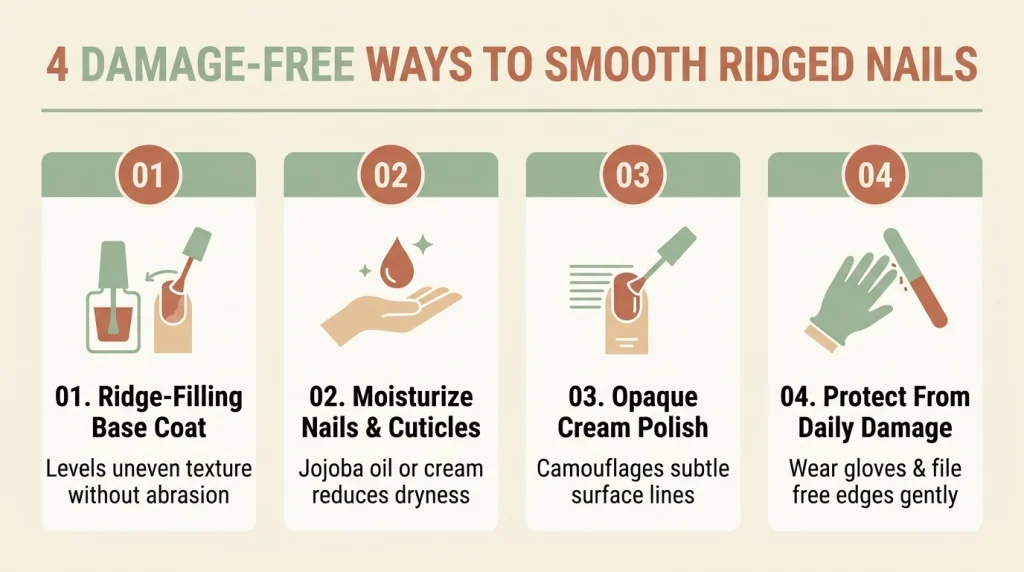
You don’t need to erase your nail’s natural texture to achieve a polished look. Several gentler approaches can make ridges less visible.
Method 1: Use a Ridge-Filling Base Coat
Best for: Healthy nails with mild to moderate visible vertical ridges.
A ridge-filling base coat contains ingredients designed to create a more even cosmetic surface. Instead of physically removing raised areas, the coating helps visually disguise unevenness.
Start with clean, completely dry nails. Apply one thin layer of ridge filler according to its instructions, let it dry, and finish with your preferred nail polish.
You can also wear certain ridge-filling formulas alone if you prefer a natural-looking manicure.
Advantages: No surface abrasion, easy application, and a smoother appearance under polish.
Limitations: The effect is temporary and doesn’t eliminate the underlying ridge.
Recommended Product Type
Ridge-Filling Nail Base Coat
A ridge-filling base coat helps disguise uneven nail texture without the material removal involved in abrasive buffing. Choose a formula compatible with your usual polish.
Find Ridge-Filling Base Coats on Amazon
As an Amazon Associate, we earn from qualifying purchases.
Method 2: Moisturize Your Nails and Cuticles
Best for: Nails that feel dry, rough, or prone to peeling.
A simple moisturizer can help condition the skin around your nails and reduce dryness-related brittleness.
Massage a little cuticle oil or fragrance-free hand cream into your nails and surrounding skin after washing your hands and before bedtime.
Jojoba-based cuticle oils are convenient, but you don’t need an expensive treatment. Ordinary petroleum jelly or a fragrance-free cream can also help reduce moisture loss.
For more everyday habits, follow our healthy nail care routine.
Advantages: Affordable, simple, and useful for maintaining comfortable nails and cuticles.
Limitations: Moisturizing won’t permanently remove structural nail ridges.
Recommended Product Type
Jojoba-Based Cuticle Oil
A basic cuticle oil is useful for conditioning dry nails and surrounding skin. Select a fragrance-free option if you’re sensitive to scented products.
As an Amazon Associate, we earn from qualifying purchases.
Method 3: Choose a Nail Polish That Disguises Texture
Best for: Anyone who wants a smoother-looking manicure without surface buffing.
Very sheer or reflective nail polishes may make surface irregularities more noticeable under certain lighting.
A more opaque cream polish can help visually camouflage subtle unevenness. Pair it with a compatible smoothing base coat for a more uniform-looking finish.
Apply thin, controlled layers rather than flooding the nail with polish. Allow adequate drying time between coats and finish with a suitable top coat.
Advantages: Lots of color options and no abrasive surface preparation required.
Limitations: Results vary depending on ridge depth, polish formula, and application technique.
Method 4: Protect Your Natural Nails From Daily Damage
Best for: Nails that frequently split, peel, or become brittle.
Wear protective gloves when washing dishes or using household cleaning products. Avoid repeatedly soaking your hands in water, and moisturize after washing.
Keep your nail tips reasonably short and smooth sharp edges with a fine nail file. File the free edge rather than grinding the top surface.
You can learn more about moisturizing and cuticle care for weak nails to build a consistent protective routine.
Advantages: Helps reduce avoidable breakage and surface damage.
Limitations: Won’t erase ridges related to age or underlying nail growth patterns.
Should You Use a Nail Buffer If You Have Vertical Ridges?
If your nails have ordinary vertical ridges, the safest default is not to buff them away.
However, if your nails are healthy and you still choose occasional cosmetic polishing, consider the following precautions:
- Inspect your nails first. Don’t buff nails that are thin, damaged, painful, or peeling.
- Choose a gentle polishing surface. Avoid coarse files, aggressive drill bits, and products intended to remove substantial nail material.
- Use minimal pressure. Never scrub repeatedly to completely flatten a visible ridge.
- Stop early. The goal shouldn’t be a perfectly flat nail plate.
- Watch for changes. If your nails become softer, thinner, or sensitive, discontinue buffing.
There is no universal number of strokes or weekly schedule proven safe for everyone. Nail thickness, previous manicure damage, and the buffer’s abrasiveness all influence the risk.
Avoid This Common Mistake
Don’t use an electric nail drill to remove ridges from natural nails at home. These tools can remove nail material rapidly, making accidental thinning more likely.
Which Nail Buffer Is Best for Ridged Nails?
When choosing nail care tools, distinguish between a file for shaping the free edge and an abrasive buffer used on the nail’s surface.
A fine nail file is useful for smoothing rough tips. A polishing block may give healthy nails temporary shine, but it still creates friction and can remove surface material.
Look for clearly labeled, gentle tools and avoid coarse grit products intended for acrylic shaping or heavy product removal.
Don’t assume that a buffer advertised as “natural,” “professional,” or “damage-free” is harmless. How much material it removes matters more than its marketing language.
Recommended Product Type
Fine-Grit Natural Nail File
A fine-grit file is useful for shaping and smoothing your nail tips without having to abrade the ridged upper surface. Use gentle pressure and work on the free edge only.
Find Fine-Grit Nail Files on Amazon
As an Amazon Associate, we earn from qualifying purchases.
Can Ridge Fillers Really Make Nails Look Smooth?
Yes. A ridge-filling base coat can create a visibly smoother finish, particularly beneath regular nail polish.
Many ridge fillers work by depositing a coating that helps visually level small surface irregularities. Their effectiveness depends on the formula and how deep your ridges are.
For mild vertical ridges, you may be able to achieve the look you want without buffing at all.
Deep grooves may remain visible even beneath multiple cosmetic layers. Rather than applying increasingly thick coatings, allow the nail to retain its natural texture and investigate any unusual changes.
Remember that a cosmetic coating doesn’t treat a disease, repair lost nail thickness, or change how your nail grows.
What Should You Do If You Already Over-Buffed Your Nails?
If your nails feel weak after buffing, your first priority should be preventing more damage rather than trying another treatment immediately.
Stop Abrasive Nail Treatments
Put away buffers, electric files, and coarse abrasive tools. Avoid enhancements that require additional filing or aggressive removal while your nails remain fragile.
Keep Your Nails Short
Shorter nails are less likely to catch, bend, or tear during daily activities. Use a gentle file only when the edges become rough.
Moisturize Consistently
Apply fragrance-free hand cream, petroleum jelly, or cuticle oil regularly. This won’t replace missing nail layers, but it can reduce dryness and support more comfortable nail maintenance.
Allow New Nail Material to Grow
The damaged section has to move outward as new nail grows from the base. Complete replacement of a fingernail often takes approximately four to six months, although individual growth rates vary.
For additional guidance, read our detailed article on recovering weak nails after over-buffing.
When Should You Seek Professional Help?
Consult a dermatologist if your nails become significantly painful, inflamed, discolored, separated from the nail bed, or increasingly abnormal.
These changes aren’t always caused by buffing and may require medical evaluation.
What Are the Best Daily Habits for Ridged Nails?
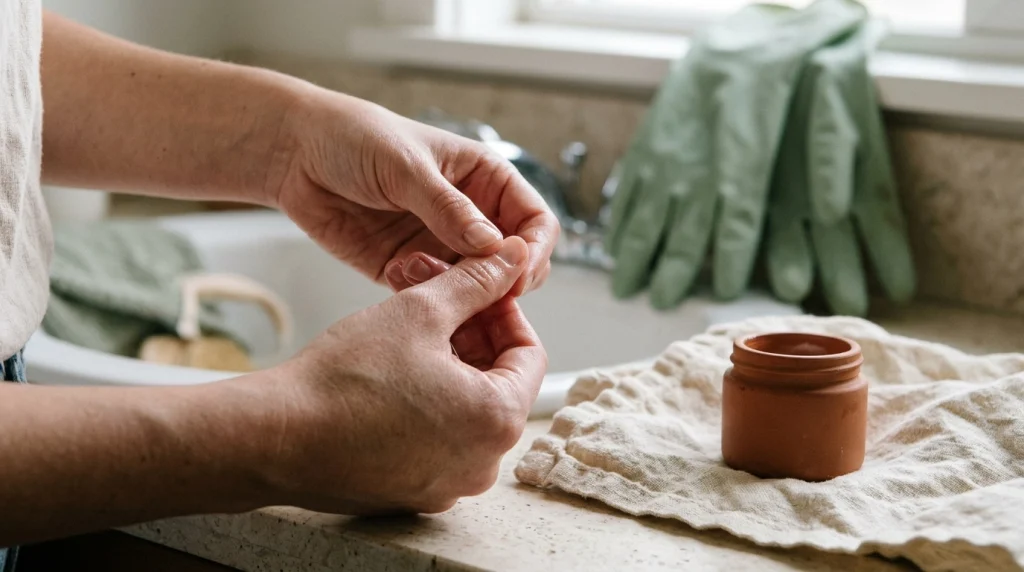
A simple, gentle nail routine is more valuable than constantly trying new smoothing treatments.
Do
- Moisturize your nails and cuticles daily.
- Keep nail tips gently filed.
- Wear gloves when cleaning.
- Choose a ridge-filling base coat.
- Watch for new or unusual nail changes.
Don’t
- Buff ridges until they disappear.
- Use coarse tools on natural nail surfaces.
- Peel off gel or acrylic products.
- Ignore painful or deep horizontal grooves.
- Assume every ridge signals a vitamin deficiency.
For a beginner-friendly routine you can follow at home, see our guide to taking care of your nails daily.
How Long Does It Take for Nail Ridges to Disappear?
The answer depends on why the ridges appeared.
Normal vertical ridges may remain for years or become more noticeable with age. They’re not necessarily temporary, and they don’t usually require treatment.
When nail texture changes because of a temporary disruption in growth, the affected area may gradually move toward the tip as the nail grows.
A complete fingernail typically takes several months to grow out. However, a new section of healthy-looking nail can sometimes become visible earlier.
If an underlying medical condition is contributing to nail abnormalities, improvement depends on identifying and managing that cause.
Products promising to permanently erase natural ridges in a few days should be viewed skeptically. Temporary cosmetic smoothing is different from changing the structure of the nail as it grows.
Frequently Asked Questions About Buffing Ridged Nails
Q: Should you buff vertical ridges on your nails?
A: Usually, no. Normal vertical ridges are often harmless. Light buffing may be tolerated by some healthy nails, but a ridge-filling base coat is generally a better choice for smoothing their appearance without removing nail material.
Q: Does buffing make nail ridges worse?
A: Buffing doesn’t necessarily cause the original ridge, but excessive buffing can thin and weaken the surrounding nail plate. This may lead to peeling, splitting, and a rougher overall nail surface.
Q: How often can you buff ridged nails?
A: There’s no universally safe buffing schedule. Repeated surface abrasion increases the risk of thinning. If you have visible ridges, consider avoiding regular buffing and using a smoothing base coat instead.
Q: Can you permanently remove nail ridges?
A: Not always. Age-related vertical ridges can persist, while some ridges associated with temporary growth disruptions may eventually grow out. Cosmetic products can disguise ridges but don’t permanently change how your nails grow.
Q: Can gel polish hide ridged nails?
A: Gel polish may visually conceal mild ridges, but application and removal can damage your natural nails if handled aggressively. If your nails are already thin or sensitive, avoid treatments that require further abrasion.
Final Verdict: Should You Buff Ridged Nails?
For most ridged nails, the better choice is to protect rather than polish away your natural nail surface. Mild vertical ridges are common, and you can usually make them less noticeable with a suitable ridge-filling base coat and a gentle nail care routine.
If your nails are already weak, peeling, or sensitive, skip buffing completely. Healthy nails matter more than a perfectly flat manicure.
Save this guide to your Pinterest nail care board so you can revisit these safer smoothing tips before your next at-home manicure!

Hi, I’m Jessica, the creator behind Unique Lash & Nails Katy.
I created this website for anyone who loves beautiful nails as much as I do. Here, I share trendy nail designs, seasonal manicure ideas, easy nail care tips, honest product recommendations, and step-by-step guides to help you create salon-worthy nails at home. Whether you’re looking for everyday inspiration or your next favorite nail trend, I hope you’ll find something you love.