Signs Your Nails Are Recovering From Damage: 9 Clues
Quick Answer
The clearest signs your nails are recovering from damage include smoother new growth near your cuticles, fewer fresh splits, less peeling, reduced tenderness, and damaged areas gradually moving toward your fingertips. Healthy new nail replaces the damaged portion as it grows. Most fingernails take around six months to grow out completely, although recovery varies.
You’ve stopped wearing acrylics, taken a break from gel manicures, or finally started treating your brittle nails gently. Now you’re wondering: are your nails actually getting better?
Nail recovery can be frustrating because the changes happen slowly. Your nails might still look rough at the tips even when healthier nail is already growing underneath your cuticle area.
Understanding the signs of improvement helps you recognize real progress without expecting overnight results. Here’s what to look for, how long recovery usually takes, and how to protect your nails along the way.


Why Does Nail Damage Take So Long to Recover?
Your nails are made primarily of keratin, a tough protein that forms the visible nail plate. Unlike living skin, an already-damaged nail plate cannot regenerate its missing layers.
Instead, new nail forms in the nail matrix, the growth area beneath the skin at the base of your nail. This new material gradually pushes the older nail toward your fingertip.
That distinction matters. A moisturizing treatment can help reduce dryness and friction, but it cannot permanently rebuild nail layers removed by aggressive filing.
According to the Cleveland Clinic, fingernails typically grow about 3 millimeters per month. Replacing the full nail generally takes at least six months.
Recovery may also depend on what caused the problem:
- Gel or acrylic removal: Peeling products off or over-filing may leave your nail plate thin and rough.
- Frequent water exposure: Repeated wetting and drying can contribute to splitting and brittleness.
- Nail biting or picking: Repeated trauma can damage the nail and surrounding skin.
- Chemical irritation: Certain manicure products and household cleaners can irritate the skin around your nails.
- Underlying conditions: Fungal infections, psoriasis, eczema, or other medical problems can change how nails grow.
If your damage started after removing enhancements, our guide to caring for weak nails after gel or acrylic removal explains how to protect fragile nails during this period.
What Are the 9 Signs Your Nails Are Recovering From Damage?

Recovery isn’t always obvious from one day to the next. These nine changes can help you evaluate whether your nails are becoming healthier and experiencing less repeated damage.
1. Smoother New Nail Growth Appears Near Your Cuticles
One of the most encouraging signs is a narrow area of smoother nail appearing at the base of a previously damaged nail.
You might notice that the new section has fewer scratches, peeling layers, or irregular patches than the older portion closer to your fingertip.
This difference can indicate that your nail matrix is producing healthier-looking nail while the older damage moves outward.
For example, after aggressive gel removal, the upper part of your nail may remain rough while a cleaner, more even strip slowly becomes visible near the cuticle.
How to check: Examine your clean nails in natural light once a week. Look for a clear boundary between newer growth and older damaged areas.
A smooth new section is reassuring, but it doesn’t guarantee that every underlying nail problem has resolved.
2. Your Nails Are Peeling Less Often
Damaged nails often peel into thin layers, especially near the free edge. This can happen when the nail plate becomes brittle or its outer layers are disturbed.
As you protect your nails from further injury, you may notice fewer new peeling areas.
Existing peeling won’t magically fuse back together. Instead, the affected portion must gradually grow outward and be trimmed away.
Progress might look like one formerly problematic nail surviving ordinary activities without developing another split.
What to watch: Compare the number of new peeling areas you notice each week rather than expecting old layers to disappear immediately.
Keep affected nails short and gently smooth any rough edges. Avoid pulling loose layers, which can remove additional nail material.
3. Your Nails Break Less Frequently
If your nails used to snap whenever you opened a bag, washed dishes, or caught a nail on clothing, fewer breaks can be a meaningful improvement.
However, less breakage doesn’t automatically mean your entire nail plate has become stronger. Shorter nails and better protective habits can also reduce mechanical stress.
That’s still valuable progress because preventing new breaks allows healthy growth to move forward without constant setbacks.
Try this: Keep your nails at a consistent, comfortable length for several weeks. Record whether new cracks appear during ordinary activities.
Resist the temptation to grow damaged nails long immediately. Extra length places more leverage on weak tips, increasing the chance of another tear.
4. Your Nail Surface Looks More Even
Over-buffed or scraped nails can develop a scratched, patchy, or uneven surface.
With time, a smoother section may gradually extend from the base of your nail. As older irregularities move toward the tip, the overall appearance may improve.
Look for fewer newly developing rough patches rather than trying to polish away every existing ridge.
Some vertical nail ridges are common and may become more noticeable with age. Not every ridge means your nails are damaged.
Persistent deep grooves, new pitting, or unusual thickening deserve attention because they can have causes beyond manicure damage.
If you aren’t sure which changes are ordinary, compare them with these signs of unhealthy nails.
5. Tenderness and Sensitivity Are Decreasing
Thin nails may feel uncomfortable when exposed to pressure, temperature changes, or everyday contact.
If irritation from a recent manicure injury is resolving, you may notice that activities such as typing or gently washing your hands feel more comfortable.
The skin around your nails may also become less sensitive after you stop picking, biting, or using irritating products.
Important distinction: Reduced tenderness may reflect healing of irritated living tissue around the nail. It doesn’t mean the damaged nail plate has repaired itself.
Increasing pain, throbbing, warmth, swelling, or discharge is not a normal recovery milestone. Those symptoms require medical attention.
6. Your Nails Develop Fewer New White Patches
Small white spots or surface patches sometimes appear after minor nail trauma, including aggressive manicures.
As your nails recover from repeated mechanical damage, you might notice that fewer fresh patches develop near the base.
Older white markings may travel toward the fingertip as the nail grows. Their movement can help you recognize that new nail is being produced.
Remember that a white patch doesn’t identify its cause by itself. Different nail conditions can produce similar-looking changes.
What to check: Watch whether existing spots move outward while the newly emerging nail remains comparatively clear.
If white discoloration spreads, accompanies thickening or crumbling, or affects multiple nails without an obvious explanation, consult a healthcare professional.
7. Your Nails Are Growing Without New Lifting
A healthy nail plate normally remains attached to the nail bed underneath it, except at the free edge.
If previous damage caused part of your nail to separate, you may see new nail growing forward without additional separation.
This can be encouraging when the original cause has been removed.
However, a section that has already detached generally does not stick back down to the nail bed. The separated portion must grow out, and the underlying cause may need treatment.
Never: Push tools underneath a lifted nail or try to glue a separated nail back onto the skin.
New or expanding separation, green discoloration, unusual thickening, or persistent pain should be assessed by a clinician.
8. Your Cuticles and Surrounding Skin Look Healthier
Your cuticles and nail folds protect the area where new nail is formed. Repeated picking, cutting, and exposure to irritating products can damage that protective barrier.
As the surrounding skin recovers, you may notice fewer painful hangnails, less cracking, and reduced dryness.
Healthy surrounding skin makes routine nail care more comfortable and helps protect against irritation and infection.
You can support this improvement by applying fragrance-free moisturizer after washing your hands and avoiding unnecessary cuticle trimming.
Remember: The cuticle is part of your nail’s protective seal. Don’t cut it away to make your manicure appear cleaner.
9. Damaged Areas Move Toward Your Fingertips
This is one of the most reliable visual ways to track nail growth.
Imagine a rough patch sitting halfway between your cuticle and fingertip. Over the next several weeks, that same patch may gradually move closer to the nail’s free edge.
Meanwhile, the space between your cuticle and the damaged area becomes larger as new nail grows.
Eventually, the damaged portion may reach the tip, where you can safely trim it away.
How to measure progress: Take a photograph every two weeks using the same lighting, angle, and nail length whenever possible.
Don’t worry if the movement seems tiny. Fingernails grow slowly, and subtle progress is often easier to see when you compare photographs taken a month apart.
How Long Does It Take for Damaged Nails to Recover?
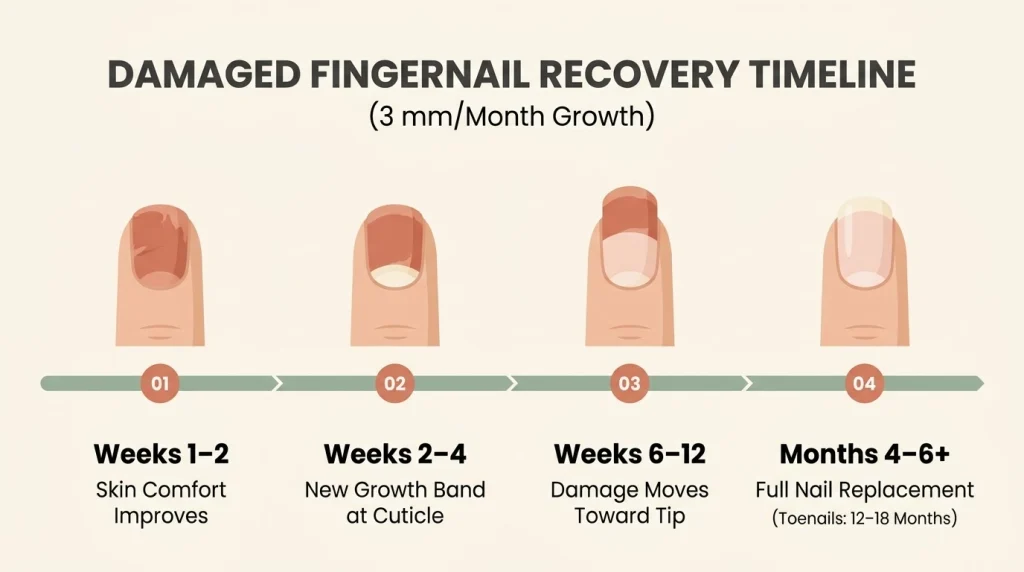
There isn’t one recovery schedule that works for every nail. Minor dryness may improve relatively quickly, while damaged nail material usually needs several months to grow out.
Here’s a realistic timeline for common superficial fingernail damage when the source of injury has stopped.
During the First 1–2 Weeks
Your surrounding skin may become more comfortable if you stop irritating it and moisturize regularly.
However, don’t expect deep scratches, peeling layers, or thin sections of the nail plate to disappear. Those areas haven’t had enough time to grow out.
After 2–4 Weeks
You may begin noticing a small band of newer growth near your cuticles.
At a typical growth rate of approximately 3 millimeters per month, visible progress can be modest. Improvements are usually easier to judge through photographs than daily inspection.
After 6–12 Weeks
A larger section of new nail may become visible. Old surface irregularities can move farther toward the fingertips.
If you continue experiencing frequent new peeling, breaking, or pain, reconsider possible ongoing causes rather than assuming the problem is resolved.
After 4–6 Months or Longer
Much of a fingernail may have been replaced, with complete replacement commonly requiring around six months or more.
Significant damage to the nail matrix can make recovery slower, incomplete, or unpredictable. Toenails typically take much longer, often 12–18 months.
For a closer explanation of regrowth, see our guide on how long it takes a nail to grow back.
Pro Tip
Track new nail growth rather than judging recovery by your damaged tips. The older portion may remain rough even when the nail growing from its base looks healthier.
How Can You Support Healthy Nail Recovery?
The goal of your routine is to prevent additional damage while new nail grows. You don’t need a complicated collection of products.
Keep Your Nails Short and Smooth
Trim your nails to a comfortable length and use a gentle file to remove snags.
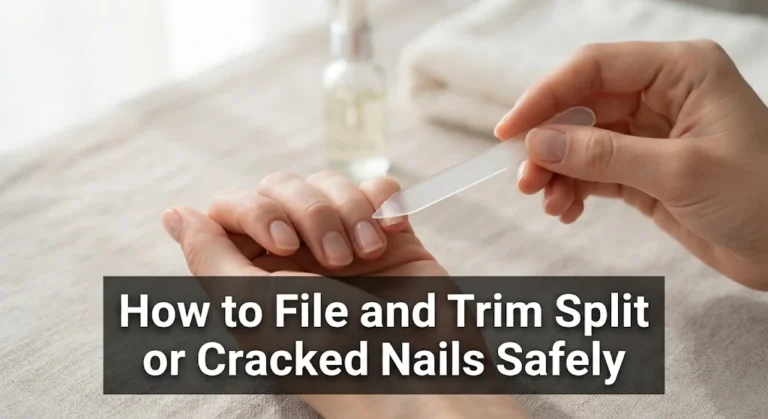
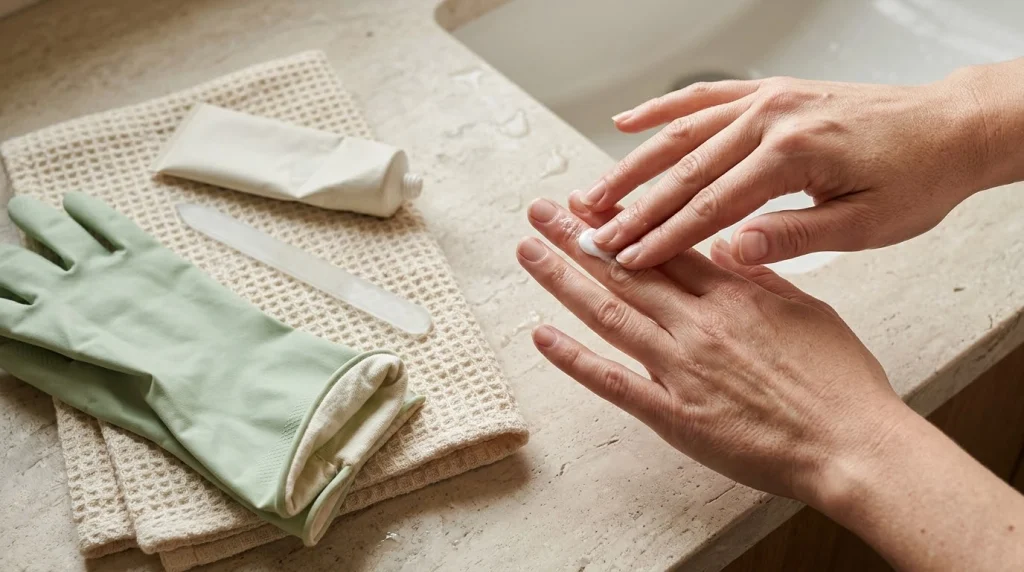
A fine glass nail file can help you shape natural nail edges without aggressive buffing.
Don’t file away visible nail layers to make the surface appear smooth. Removing additional material can make already-thin nails more vulnerable.
Moisturize Your Nails and Cuticles Regularly
After washing your hands, massage a small amount of moisturizer into your nails and surrounding skin.
A fragrance-free hand cream is a practical option, especially if your skin becomes irritated by scented products.
Moisturizing helps reduce dryness and keeps the surrounding skin comfortable. It doesn’t reverse missing nail layers or guarantee faster growth.
Protect Your Hands During Wet Chores
Repeated water exposure can contribute to nail splitting and brittleness.
Wear comfortable cotton-lined cleaning gloves while washing dishes or using household cleaners.
Remove the gloves afterward and dry your hands thoroughly. If moisture builds up inside them, change the lining or let your hands dry before continuing.
Stop Picking at Nail Enhancements
Don’t peel away gel, acrylic, dip powder, or press-on adhesive to speed up removal.
If you’re still wearing an enhancement, choose an appropriate removal method rather than forcing the product off.
Repeatedly peeling enhancements can strip additional nail material and create new damage.
Use a Simple Cuticle Oil if You Enjoy One
Cuticle oil can be a convenient addition to your moisturizing routine, particularly if your nails and surrounding skin feel dry.
Recommended Nail Care Product Type
Jojoba-Based Nail and Cuticle Oil
A simple cuticle oil can help condition dry nails and surrounding skin. Choose a product you tolerate well, and remember that oil supports comfort rather than repairing damaged nail layers.
Explore Cuticle Oils on Amazon
As an Amazon Associate, we earn from qualifying purchases.
For an easy daily schedule, explore our simple nail recovery routine.
What Should You Do and Avoid While Your Nails Recover?
Do
- Keep nails comfortably short.
- Moisturize after handwashing.
- Wear gloves during wet chores.
- Track new growth monthly.
- Gently file snagged edges.
Don’t
- Peel off gel or acrylic.
- Buff away damaged layers.
- Cut living cuticle tissue.
- Force long nails to grow.
- Cover suspicious changes.
How Can You Tell Whether Your Nails Are Getting Worse Instead?
Not every nail change reflects ordinary recovery from cosmetic damage.
Some symptoms can indicate an infection, an inflammatory condition, a significant injury, or another underlying problem.
Warning: Signs That Need Medical Attention
Seek medical evaluation if you notice increasing pain, warmth, swelling, pus, unexplained dark streaks, spreading discoloration, significant nail lifting, or nails that stop growing. A new or changing dark band deserves prompt assessment by a dermatologist, especially if pigmentation extends onto the surrounding skin.
Persistent nail problems may require an examination rather than another cosmetic treatment.
For minor, painless surface damage, our guide on how to repair a damaged nail at home safely covers practical protective care.
However, home nail-care products cannot treat every infection or underlying medical condition.
How Should You Track Nail Recovery Without Guessing?
Daily checking can make slow progress difficult to appreciate. A simple photo record is more useful.
- Choose a starting date. Photograph your clean, unpolished nails in natural light.
- Use the same angle. Keep your hand position and lighting as consistent as possible.
- Repeat every two weeks. Look for the movement of old marks and the appearance of smoother new growth.
- Record new problems. Note fresh peeling, cracking, tenderness, or discoloration rather than focusing only on appearance.
- Review monthly. Compare your latest photo with your first photo to identify gradual changes.
You don’t need perfect-looking nails to recognize improvement. Fewer new injuries and steadily advancing nail growth can be valuable signs.
Frequently Asked Questions About Nail Damage Recovery
Q: How do I know if my damaged nail is healing?
A: Look for smoother new growth near your cuticle, fewer fresh splits, reduced discomfort, and older damaged areas moving toward the tip. These changes are more meaningful than expecting the existing damaged nail plate to repair itself.
Q: Can severely damaged nails become healthy again?
A: Many nails affected by superficial cosmetic damage can look healthier as new material grows out. However, significant injury to the nail matrix may cause persistent changes. A dermatologist can assess severe or unexplained damage.
Q: How long should I wait before getting another gel manicure?
A: There isn’t a universal waiting period. If your nails are thin, painful, peeling, or lifting, avoid another enhancement until the problem has improved and the cause is addressed. Significant damage may need months to grow out.
Q: Does cuticle oil make damaged nails grow faster?
A: Cuticle oil can help condition dry nails and surrounding skin, but there’s no reliable evidence that applying it makes nails grow substantially faster than their normal rate. Preventing additional damage is more important than expecting rapid growth.
Q: Is it normal for nails to look damaged even when they’re recovering?
A: Yes. Old damage can remain visible until that part of the nail grows out. A smoother band near your cuticle and fewer newly damaged areas can indicate improvement even when the tips still look rough.
Final Thoughts: Your Nails Can Show Progress Before They Look Perfect
The most useful signs your nails are recovering from damage are healthier-looking new growth, fewer new splits, less tenderness, and damaged areas gradually moving toward your fingertips.
Keep your care routine gentle and consistent. Protecting your nails while they grow is usually more useful than chasing quick fixes.
Save this guide to your Pinterest nail-care board so you can compare your progress and remember the signs of healthier nail growth.
Medical note: This article provides general nail-care information and is not a substitute for diagnosis or treatment from a qualified healthcare professional.

Hi, I’m Jessica, the creator behind Unique Lash & Nails Katy.
I created this website for anyone who loves beautiful nails as much as I do. Here, I share trendy nail designs, seasonal manicure ideas, easy nail care tips, honest product recommendations, and step-by-step guides to help you create salon-worthy nails at home. Whether you’re looking for everyday inspiration or your next favorite nail trend, I hope you’ll find something you love.