How Fast Do Toenails Grow? Rate & Regrowth Guide
Quick Answer
Toenails typically grow about 1.5–1.6 millimeters per month, or roughly 0.05 millimeter per day. That is less than half the average fingernail growth rate. A completely lost toenail generally takes 12–18 months to regrow if its nail-producing tissue is intact. You can’t safely force rapid growth, but gentle trimming, protective footwear, and good foot care help new nail grow without repeated damage.
How Fast Do Toenails Grow?
A toenail can look almost unchanged for weeks, even while new nail is slowly forming underneath the skin. In one study, toenails grew an average of just 1.62 millimeters per month. If you’re waiting for a pedicure to grow out or a damaged nail to recover, that tiny number explains the wait. Here’s what normal growth looks like, what can slow it down, and how to protect every millimeter.


How Much Do Toenails Grow in a Day, Week, or Month?

The most useful benchmark is about 1.5–1.6 mm of toenail growth per month. A study of 22 healthy young adults measured an average of 1.62 mm monthly, while Cleveland Clinic gives a rounded estimate of 1.5 mm. Your personal rate can differ, so use these numbers as a guide rather than a deadline.
For perspective, these approximate amounts assume steady growth at 1.5–1.6 mm per month. They describe how far a section of nail moves, not how much free edge you’ll necessarily see.
- One day: About 0.05 mm, too small to notice.
- One week: About 0.35–0.37 mm, often difficult to spot.
- One month: About 1.5–1.6 mm, sometimes visible as a polish grow-out line.
- Three months: About 4.5–4.8 mm, a clearer change in the position of a mark or discolored area.
- Six months: About 9–9.6 mm, assuming the nail keeps growing at the same rate.
These are estimates, not promises. Your big toenail may behave differently from your smaller toenails, and illness or injury can interrupt growth. What matters is whether new nail is gradually appearing at its base over time.
Why Do Toenails Grow So Much Slower Than Fingernails?
Your fingernails grow about 3–3.5 mm monthly, more than twice as fast as toenails on average. Both types of nails are made from keratin, but the cells producing toenail plates generally create new nail at a slower rate. Researchers have measured that difference; there isn’t one proven everyday explanation for every person.
Think of nail growth as a production line hidden beneath the skin. At the base of each toe is the nail matrix, the tissue that makes new nail cells. As those cells mature and harden, they become part of the nail plate and push the older nail forward. Your toenail doesn’t grow from its white tip, and trimming that tip doesn’t make the matrix work faster.
The nail bed supports the growing plate, while the nearby folds and cuticle area help protect the base. This is why digging under the nail, aggressively cutting the cuticle, or repeatedly injuring the toe can cause more trouble than a little chipped polish. If you want the bigger picture of what affects nail production, see our guide to common causes of damaged nail growth.
There’s another interesting detail: in the same small growth study, big toenails grew faster than the other toenails on average. That doesn’t mean your big toe is guaranteed to recover first; a larger nail plate may still take considerably longer to replace completely.
How Long Does It Take for a Toenail to Grow Back Completely?
Full toenail regrowth usually takes around 12–18 months after the entire nail is lost, provided the matrix can still produce a replacement. That estimate is much longer than the time required to grow a visible millimeter or two. A nail has to replace its full length from the base to the tip.
When only the end is chipped, you don’t need to wait for the entire plate to renew. A damaged patch already near the tip may be clipped away in weeks or months. A mark close to the cuticle has farther to travel, so it can remain visible for much longer.
What should you expect after a toenail injury?
- First few weeks: Healing of the skin may be more noticeable than nail growth. A new nail can remain hard to see.
- One to three months: A narrow band of new nail may become visible near the base if the matrix is functioning.
- Several months: The new plate gradually advances, sometimes with temporary unevenness or grooves after trauma.
- About a year or longer: Many toenails approach full replacement, though some need 18 months or more.
An injured nail may not follow a neat calendar. Damage to the nail matrix can change the shape or thickness of future growth, and severe scarring can prevent normal regrowth. For a fuller explanation of those possibilities, see whether a damaged nail can regrow.
What Can Make Your Toenails Grow Faster or Slower?
Your growth rate is influenced by more than your pedicure routine. Some differences are completely normal; others are clues that your nails or your general health need attention.
Age and your natural growth pattern
Nail growth tends to slow with age, although people of the same age can have different rates. You may also notice one toenail consistently advancing a little faster than another. Compare a nail with its own earlier appearance instead of using a friend’s pedicure as a benchmark.
Previous injuries and pressure from shoes
Dropping something on a toe, repeated rubbing inside tight shoes, or pressure during sports can injure a nail or the tissue that makes it. A nail may temporarily look thicker, develop ridges, lift, or grow irregularly. If pressure continues every day, the fresh growth can keep getting damaged before it has a chance to look normal.
Health conditions and infections
Fungal infection, psoriasis, and certain medical conditions can alter how nails look or grow. Thick yellow nails aren’t automatically proof of slow growth; sometimes the plate is changing shape or building up debris. Sudden changes in several nails, especially with other symptoms, deserve a medical review rather than an at-home diagnosis.
Nutrition and overall health
Making keratin requires your body to have adequate nutrition, including protein and essential vitamins and minerals. Significant deficiencies can affect nail quality, but taking extra vitamins when you aren’t deficient hasn’t been shown to reliably speed normal toenail growth. If your diet is restricted or your nails change alongside fatigue or other symptoms, ask a clinician whether testing makes sense.
Seasonal differences
You may hear that nails grow faster in summer. Some research suggests small seasonal effects, but the difference isn’t a reliable way to predict your next pedicure or regrowth date. Your health and the condition of the nail matrix matter more than expecting the weather to transform your nails. For related context, explore what science says about seasonal nail growth.
Disclosure: As an Amazon Associate, we earn from qualifying purchases.
Can You Make Toenails Grow Faster Naturally?
There is no well-established home trick that dramatically accelerates healthy toenail growth. What you can control is the environment around a growing nail: reduce trauma, prevent painful ingrown edges, and catch problems before they interfere with recovery. Think of the goal as healthy regrowth, not overnight length.
Trim your toenails straight across
Use a clean, sharp clipper after bathing, when nails may be easier to cut. Keep the edge relatively straight and smooth sharp corners gently with a file. Avoid cutting down into the sides to create a deeply rounded shape; that can encourage an ingrown toenail, especially when shoes press against the toe.
For thick but otherwise healthy nails, a sturdy toenail clipper can make straight, controlled cuts easier. Never force a clipper through a very thick, painful, or distorted nail; a podiatrist can help with safer trimming.
Choose shoes that leave room for your toes
Your toes should be able to move without pressing hard against the front or top of your shoes. During long walks, workouts, or dancing, check whether your big toenail repeatedly hits the toe box. That repeated impact can cause bruising or lifting, setting your nail-care progress back even when the matrix keeps producing new nail.
Keep feet clean, dry, and comfortable
Wash your feet gently, dry between your toes, and change damp socks after exercise. This supports skin health and reduces the moist conditions in which athlete’s foot and some nail infections thrive. You don’t need harsh scrubs or prolonged soaking. If you wear polish, occasionally look at the bare nail so you can spot changes.
Moisturize dry skin without flooding the toes
Apply a small amount of plain moisturizer to dry skin around the toenails after washing. A fragrance-free foot cream is a convenient option when the skin feels rough. Moisturizer can improve comfort and reduce cracking, but it does not directly make the nail matrix produce extra millimeters.
Eat regularly and avoid unnecessary supplements
Include protein-rich foods, fruits, vegetables, and other nutrient sources you enjoy. If you suspect a deficiency, seek a proper assessment before buying a high-dose nail supplement. Biotin, for example, is heavily marketed for nail growth, yet evidence is limited for people without deficiency, and high doses can interfere with certain laboratory tests.
Pro Tip
Take a photo of your bare toenail every four weeks in similar lighting and from the same angle. Compare the clear nail growing from the base, not just the damaged tip. Monthly photos make subtle progress easier to recognize without poking or scraping the nail.
What Should You Do While a Toenail Is Growing Back?
If a toenail has been damaged, the most helpful routine is simple and consistent. Protect the toe from fresh impact, keep the area clean, and avoid peeling away a partly attached nail. If the nail has been removed by a clinician, follow their specific dressing and wound-care instructions instead of using a general pedicure routine.
For an intact nail, smooth a snag with a fine glass nail file rather than pulling the loose edge. Don’t use sharp tools to dig under the plate. That space contains sensitive skin, and damaging it won’t help a new nail appear sooner.
Be cautious with gel polish, acrylic enhancements, and adhesive press-ons on a recovering toenail. Covering a problem can hide discoloration or lifting, while aggressive removal can tear the already vulnerable plate. If the nail is painful, detached, or possibly infected, skip cosmetic products until a clinician has assessed it.
For everyday upkeep, our simple nail care routine covers gentle cleaning, moisturizing, and safe maintenance habits you can adapt for your feet.
Do
- Leave room for your toes in shoes.
- Keep clippers clean and trim straight.
- Track progress monthly, not daily.
- Ask for help with persistent changes.
Don’t
- Pull off a loose or damaged nail.
- Cut deeply into the nail corners.
- Assume supplements speed growth.
- Cover painful changes with polish.
When Is Slow Toenail Growth a Reason to Worry?
Slow growth alone is often normal. Concern rises when the nail stops changing after an injury, develops an unusual shape, or is accompanied by pain or skin changes. A thickened nail can look as if it isn’t growing because the new plate isn’t moving forward smoothly, so appearance alone can’t tell you the cause.
When to get medical advice
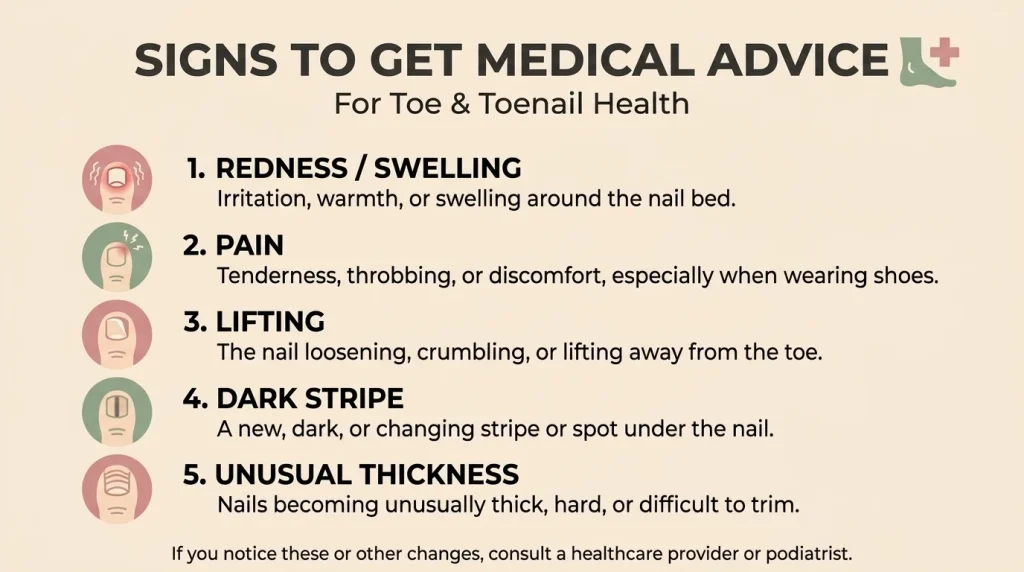
See a clinician or podiatrist if you have increasing redness, warmth, swelling, drainage, significant pain, a nail that’s lifting, a new dark stripe, or a nail that remains unusually thick or misshapen. Seek prompt care after a serious toe injury. If you have diabetes, poor circulation, or reduced sensation in your feet, ask for advice early rather than treating a nail injury yourself.
Don’t assume every yellow nail is fungus or every dark mark is a bruise. Several conditions can look similar, and effective treatment depends on the actual cause. Our article on signs of unhealthy nails offers more examples of changes worth noticing.
After complete nail loss, a lack of visible new growth over the following months is worth discussing with a professional, particularly after a crushing injury. It doesn’t automatically mean permanent damage, but an examination can check the matrix and surrounding tissue instead of leaving you to guess.
Frequently Asked Questions About Toenail Growth
Q: How much do toenails grow in two weeks?
A: At an average rate of 1.5–1.6 mm per month, a toenail grows roughly 0.7–0.8 mm in two weeks. It may be visible as a tiny gap beneath polish, but your rate can vary.
Q: Do big toenails grow faster than smaller toenails?
A: One small study found that big toenails grew faster on average than other toenails. Because a big toenail is larger, however, replacing its entire plate can still take many months.
Q: Will a toenail grow back if it falls off?
A: Often, yes, if the nail matrix remains intact. Complete regrowth commonly takes 12–18 months. Severe matrix damage may result in an irregular nail or prevent normal regrowth.
Q: Does nail polish stop toenails from growing?
A: Ordinary polish on an intact nail doesn’t stop the matrix from producing new nail. Problems are more likely from irritation, repeated trauma, or rough product removal. Avoid polish over injured or infected nails until they’ve been evaluated.
Q: Why does my toenail seem to have stopped growing?
A: Growth can be hard to see because it is so slow. A previous injury, thickening, infection, or a problem affecting the matrix can also change its appearance. If growth truly seems absent or the nail is painful or distorted, arrange an examination.
How Fast Do Toenails Grow? The Takeaway
Your toenails usually gain only about 1.5–1.6 mm each month, so healthy regrowth is measured in months rather than days. Protect the nail from pressure and injury, keep a gentle care routine, and get unusual changes checked. Save this guide to your Pinterest nail-care board so you can revisit the realistic growth timeline whenever you need it.

Hi, I’m Jessica, the creator behind Unique Lash & Nails Katy.
I created this website for anyone who loves beautiful nails as much as I do. Here, I share trendy nail designs, seasonal manicure ideas, easy nail care tips, honest product recommendations, and step-by-step guides to help you create salon-worthy nails at home. Whether you’re looking for everyday inspiration or your next favorite nail trend, I hope you’ll find something you love.