Why Do Some Nails Grow Faster Than Others? 7 Reasons
Quick Answer
Some nails grow faster than others because each nail has its own growth pattern, influenced by finger location, age, genetics, health, and sometimes hand use. Fingernails typically grow around 3 millimeters per month, but your little fingernails may grow more slowly. Breakage can also make perfectly normal growth look uneven. Small differences are usually nothing to worry about.
Ever noticed that your middle fingernail seems ready for a trim while your pinky nail is barely catching up? You’re not imagining things. Your nails don’t necessarily grow at exactly the same speed.
Researchers have actually measured differences between individual fingernails. The interesting part? Sometimes your slow-growing nail isn’t growing slowly at all. It may simply be breaking faster than it can gain length.
Here’s what determines your nail growth, why some fingers seem to race ahead, and how you can help your natural nails stay healthy and beautiful.


Why Do Some Nails Grow Faster Than Others?
Your nails grow from a special area beneath the skin near their base called the nail matrix. This is where new nail cells form. As new cells develop, older cells move forward, harden, and become the visible nail plate.
Each finger has its own nail matrix. Although all ten nails follow the same basic process, their growth rates aren’t necessarily identical.
In a published study involving 22 healthy young adults, researchers recorded an average fingernail growth rate of 3.47 millimeters per month. They also found that little fingernails grew more slowly than other fingernails.
Another study involving 50 adults reported an average growth rate of approximately 0.103 millimeters per day, with differences between individual fingers.
That means your nails aren’t operating on one perfectly synchronized schedule. Their growth reflects a combination of biology, everyday conditions, and the health of each nail.
What Are the 7 Main Reasons Your Nails Grow at Different Speeds?
1. Your Different Fingers Naturally Have Different Growth Rates
One of the simplest explanations is that individual fingers naturally show different nail-growth patterns.
Your middle or index fingernail may appear to grow quickly, while your pinky nail seems to take forever. This isn’t necessarily a sign that something is wrong.
Research has documented slower average growth in little fingernails compared with several other fingers. However, the exact fastest-growing finger isn’t identical for everyone.
Finger size and nail anatomy may contribute to these differences, but there’s no universal rule saying your middle fingernail must always grow the fastest.
What this means for you: If your nails have always grown at slightly different speeds and otherwise look healthy, that pattern may simply be normal for your hands.
2. Your Dominant Hand May Grow Nails Slightly Faster
Have you heard that nails grow faster on the hand you use most? There’s some support for this idea, although the evidence isn’t completely consistent.
Traditional nail-health references describe faster growth on the dominant hand. Greater daily activity and differences in local conditions may play a role.
However, controlled studies have also found no significant overall difference between right- and left-hand growth rates.
So if you’re right-handed, your right nails aren’t guaranteed to grow faster.
Another important detail is that your dominant hand often experiences more physical wear. Typing, opening packages, cleaning, and handling objects can cause tiny chips and cracks.
As a result, your busier hand might actually have shorter nails, even when their underlying growth rate is perfectly healthy.
3. Genetics Influence Your Natural Nail Growth
Just as your natural hair texture and growth patterns differ from your friends’, your nails have individual characteristics too.
Genetic factors contribute to nail shape, thickness, and the biological processes involved in nail formation.
You may naturally have strong, thick nails that seem to reach impressive lengths without much effort. Someone else may have thinner nail plates that need more protection against splitting.
These differences can make nail growth look very different from person to person.
Genetics aren’t the only influence, though. Your daily routine, nutritional status, and overall health can affect the results you see.
Remember: Having naturally slow-growing nails doesn’t automatically mean your nails are unhealthy.
4. Age and Hormonal Changes Affect Nail Growth
Your nail growth can change throughout your life.
Nail growth generally slows with advancing age, although the change is gradual and varies between individuals.
Hormonal changes, including those associated with pregnancy, can also influence nail appearance and growth. Some people notice faster nail growth during pregnancy, while others experience increased brittleness.
Changes in your normal routine, nutrition, and overall health may affect what you observe at the same time.
If you notice that all your nails are growing differently than they did several years ago, age or hormonal factors may be part of the explanation.
However, a sudden major change shouldn’t automatically be blamed on hormones without considering other causes.
5. Nutrition and Overall Health Support Nail Formation
Your nail matrix constantly produces new cells. That process requires adequate energy, protein, and essential nutrients.
Protein provides amino acids needed for keratin production, while nutrients including iron, zinc, and certain vitamins support normal cellular functions.
If you have a significant nutritional deficiency, your nail growth or appearance may change.
However, taking extra vitamins when you already get enough of them won’t necessarily make your nails grow faster.
Instead of buying several nail-growth supplements, focus on a balanced eating pattern that includes:
- Eggs, fish, poultry, tofu, or beans for protein.
- Lentils, lean meat, and leafy vegetables for iron-containing foods.
- Nuts, seeds, and legumes for zinc and other nutrients.
- Colorful fruits and vegetables for a variety of vitamins.
- Enough overall food intake to support normal body functions.
For more meal inspiration, explore our guide on what to eat for stronger, healthier nails.
If you suspect a deficiency, ask a healthcare professional whether testing is appropriate before starting high-dose supplements.
6. Injuries or Nail-Matrix Damage Can Change Growth
Sometimes one nail really does grow differently because its growth area has been affected.
For example, a slammed finger, repeated pressure, aggressive cuticle cutting, or a previous nail injury may interfere with normal nail formation.
Mild surface damage usually moves outward as your nail grows. More serious damage involving the matrix can cause longer-lasting changes.
You might notice ridges, unusual thickness, splitting, or a nail that grows in a different direction.
A single nail that’s been abnormal since an injury deserves different attention from nails that have always varied slightly in length.
Warning
If one nail suddenly stops growing, becomes painful, separates from the nail bed, develops swelling, or shows a new dark streak, have it examined by a healthcare professional. Significant changes involving a single nail shouldn’t be dismissed as normal uneven growth.
7. Breakage Makes Some Nails Look Like They’re Growing Slower
This is one of the most useful things to understand about uneven nail lengths: growth rate and visible nail length aren’t the same thing.
Imagine two fingernails each produce approximately 3 millimeters of new growth in a month.
The first nail stays intact and gains nearly 3 millimeters of length. The second nail repeatedly splits or chips at its tip.
By the end of the month, the first looks longer while the second looks almost unchanged.
Both nail matrices may be working normally. The difference is how much length each nail retains.
Frequent water exposure, harsh removal techniques, repeated picking, and using nails as tools can all contribute to damage.
Our article on how hot water can damage your nails explains why repeated soaking and drying may encourage peeling and splitting.
Which Fingernail Usually Grows the Fastest?
There isn’t one finger that grows fastest for absolutely everyone.
Some nail-growth references suggest that longer fingers, such as the middle finger, often have relatively fast nail growth.
However, studies comparing individual fingers have reported differing patterns. One consistent finding in some research is that little fingernails tend to grow more slowly.
Rather than expecting a fixed ranking, look at your own natural pattern over several weeks.
If your index and middle fingernails usually need trimming first, that can be completely normal. If your ring fingernail seems to lag behind slightly but looks smooth and healthy, that may also be normal.
The key distinction is whether the pattern is stable or represents a sudden, unexplained change.
How Fast Do Healthy Fingernails Actually Grow?
Healthy adult fingernails typically grow around 3 millimeters per month, although individual growth rates vary.
One study measured approximately 3.47 millimeters per month for fingernails and 1.62 millimeters per month for toenails.
Here’s what an approximate fingernail growth rate of 3 millimeters per month looks like over time:
- One week: Around 0.7 millimeters.
- Two weeks: Around 1.5 millimeters.
- One month: Around 3 millimeters.
- Two months: Around 6 millimeters.
- Three months: Around 9 millimeters.
These are estimates, not guaranteed results. Your actual growth will depend on your individual nail biology and health.
Because fingernails grow slowly, a completely new nail usually takes approximately four to six months to replace the existing nail plate. Some people take longer.
Toenails take considerably more time, often roughly 12 to 18 months to replace completely.
How Can You Tell Whether a Nail Is Growing Slowly or Just Breaking?
Before trying to improve your nail growth, it helps to identify what’s actually happening.
Look at the condition of your shorter nail. If its free edge is peeling, jagged, cracked, or frequently snagging on clothing, breakage may explain the length difference.
If the nail stays smooth and intact but consistently develops less visible growth than neighboring nails, its actual growth rate may be lower.
You can observe growth more carefully with a simple nail-polish tracking method:
- Apply a narrow band of regular nail polish near the base of a clean, healthy nail.
- Take a clear photograph and record the date.
- Leave the polish in place without picking or scraping it.
- After two to three weeks, photograph the nail again from a similar angle.
- Compare the gap that has appeared between your cuticle area and the painted band.
This gives you a rough visual indication of new nail growth. It isn’t a medical measurement, and your results may be affected by polish wear or photography angles.
Pro Tip
Photograph your nails every two weeks rather than checking their length every day. Fingernail growth is so gradual that daily comparisons are unlikely to reveal much, while consistent photographs make patterns easier to recognize.
How Can You Help Your Nails Grow Healthier and Keep Their Length?
You can’t force all ten nails to grow at identical speeds. However, you can create conditions that support normal growth and reduce unnecessary breakage.
Moisturize Your Nails and Cuticles Consistently
Dry, brittle nails are more vulnerable to splitting, especially around the tips.
Apply a small amount of cuticle oil around each nail fold, then use a moisturizing hand cream. Ingredients such as glycerin, petrolatum, and ceramides help support moisture retention in the surrounding skin.
A jojoba cuticle oil pen is a convenient option for your desk or handbag.
Moisturizing won’t magically accelerate nail-matrix activity. Its main benefit is keeping your nail surroundings comfortable and helping reduce dryness-related damage.
Protect Your Hands During Wet Chores
Frequent exposure to water and detergents can weaken nails through repeated wetting and drying.
Wear reusable waterproof gloves when washing dishes, cleaning bathrooms, or handling household chemicals.
Choose gloves that fit comfortably and dry them between uses. If you experience irritation, consider a suitable protective lining.
This simple habit can be especially helpful if one hand regularly does more cleaning or household work than the other.
Keep Your Nail Length Manageable
Very long natural nails experience more leverage during everyday activities. If your nail tips frequently bend, snag, or crack, shortening them slightly may help you retain more healthy growth.
Try a softly rounded or squoval shape to reduce sharp corners that catch on fabric.
A fine-grit or smooth glass nail file for natural nails can help you shape tips gently without aggressive sawing.
File carefully, avoid working on softened nails immediately after prolonged soaking, and never tear away a peeling layer.
Be Gentle With Polish and Nail Enhancements
Gel, acrylic, and regular nail polish don’t automatically stop your natural nails from growing.
However, scraping off enhancements, over-buffing your nail plate, and forcefully peeling off polish can remove or damage surface layers.
That makes your nails more likely to split before their growth becomes noticeable.
Use appropriate removal methods, allow damaged areas to grow out, and avoid repeated aggressive filing.
If you’re considering a break from manicures, our guide to whether nails are healthier without nail polish explains what actually matters.
Support Healthy Growth Through Your Diet
A balanced diet is more useful than relying on products that promise dramatic overnight growth.
Include adequate protein and a variety of nutrient-rich foods. If your nails have changed alongside fatigue, hair changes, or other symptoms, discuss the pattern with a healthcare professional.
For example, vitamin B12 deficiency can affect normal body functions, but supplemental B12 isn’t a universal solution for nail growth.
Learn more in our article on whether vitamin B12 helps fingernails.
What Nail-Care Habits Should You Do and Avoid?
Do
- Moisturize your nail folds daily.
- Wear gloves during wet chores.
- File rough tips gently.
- Eat enough protein and varied foods.
- Monitor unusual changes.
Don’t
- Pick off gel polish.
- Cut or injure your cuticles.
- Use your nails as tools.
- Expect overnight growth.
- Ignore painful nail changes.
Which Products Help Protect Uneven Natural Nails?
Products can’t reliably make every fingernail grow at the same speed. The most useful options help you protect the length you’re already growing.
Recommended Product
Jojoba Cuticle Oil Pen
A portable oil applicator helps you maintain a consistent moisturizing routine around dry nail folds.
As an Amazon Associate, we earn from qualifying purchases.
Recommended Product
Fine Glass Nail File
A smooth, fine filing surface helps you tidy small snags before they become larger cracks.
As an Amazon Associate, we earn from qualifying purchases.
Recommended Product
Reusable Waterproof Cleaning Gloves
Protective gloves reduce repeated contact with water and detergents, helping limit preventable nail damage.
As an Amazon Associate, we earn from qualifying purchases.
What Are Some Smart Tricks for Keeping All Your Nails Looking Even?
Trim According to Your Shortest Healthy Nail
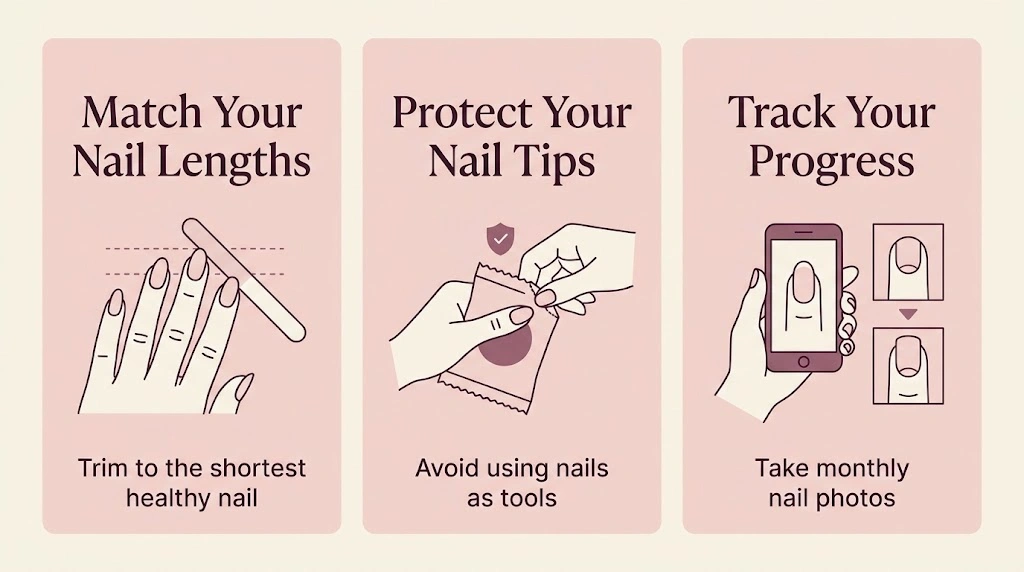
If you prefer a perfectly matched manicure, keep your longest nails near the length of your shortest healthy one. This creates a balanced appearance while reducing the pressure on weaker tips.
Give Frequently Breaking Fingers Extra Protection
If your index fingernail repeatedly breaks while opening containers, change how you perform that task rather than assuming the nail needs a growth treatment.
Use the pads of your fingers or an appropriate tool instead of prying with the nail tip.
Watch Your Growth Pattern Over Several Months
A few days won’t tell you much about nail growth. Use monthly photographs to compare changes in nail length, shape, and surface condition.
Consistent patterns are generally more informative than one chipped nail after a busy weekend.
When Should Uneven Nail Growth Concern You?
Minor differences between individual nails are common. However, certain changes deserve professional attention.
Arrange an assessment if you notice:
- One nail suddenly stops appearing to grow.
- A new dark or changing pigmented streak.
- Persistent pain, redness, swelling, or discharge.
- Significant thickening, lifting, or distortion.
- Several nails changing unexpectedly at the same time.
- An abnormal nail that isn’t improving after an injury.
These signs can have different causes, including trauma, infection, inflammatory nail conditions, or other medical issues.
Don’t try to diagnose a persistent abnormality based only on growth speed. A dermatologist can evaluate the nail and its surrounding structures.
Frequently Asked Questions About Uneven Nail Growth
Q: Why does my middle fingernail grow faster than my pinky nail?
A: Different fingers can have naturally different growth rates. Research has found that little fingernails grow more slowly on average than several other fingernails. Your individual pattern may vary.
Q: Why do nails on one hand seem to grow faster?
A: Hand use may influence nail growth or breakage patterns, but research hasn’t consistently shown that the dominant hand grows nails faster. Differences in daily wear can also explain uneven lengths.
Q: Can cuticle oil make all my nails grow at the same speed?
A: No. Cuticle oil can help with dryness and nail-fold care, but there’s no good evidence that it synchronizes growth between fingers. It may help your manicure retain length by reducing dryness-related problems.
Q: Is it normal for one nail to be much shorter than the others?
A: It can be, especially if that nail breaks frequently or has always had a different growth pattern. A sudden unexplained change, particularly with pain, lifting, or discoloration, should be evaluated.
Q: Does trimming your nails make them grow faster?
A: No. Trimming removes the dead nail plate at the tip and doesn’t directly stimulate the nail matrix. Regular gentle trimming can prevent snagging and breakage, helping nails stay more even.
Should You Worry If Your Nails Grow at Different Speeds?
Usually, no. Your individual fingernails don’t have to grow at identical speeds to be healthy. Natural variation, age, daily activity, and breakage can all affect the lengths you see.
Focus on gentle care, protecting your nail tips, and recognizing unexpected changes rather than trying to force faster growth. Save this guide to your Pinterest nail-care board so you can revisit these tips whenever your manicure starts looking uneven.

Hi, I’m Jessica, the creator behind Unique Lash & Nails Katy.
I created this website for anyone who loves beautiful nails as much as I do. Here, I share trendy nail designs, seasonal manicure ideas, easy nail care tips, honest product recommendations, and step-by-step guides to help you create salon-worthy nails at home. Whether you’re looking for everyday inspiration or your next favorite nail trend, I hope you’ll find something you love.