Which Oil Is Best for Weak, Damaged or Brittle Nails? 7 Oils to Try
Quick Answer
For most weak, dry or brittle nails, a jojoba-based cuticle oil is the best all-around choice because it’s lightweight, easy to massage around the nail, and practical enough to use every day. Mineral oil is an excellent budget alternative, while squalane works well if you dislike greasy products. Nail oil helps mainly by reducing dryness and improving flexibility—it can’t instantly rebuild nail plate that has already split, peeled or been over-filed.
When your nails bend, peel in layers, crack at the corners or break as soon as they grow past your fingertips, it’s tempting to search for one miracle oil that will make them hard again overnight.
The better goal is slightly different. You want an oil that makes it easy to keep your nail plate, cuticle area and surrounding skin consistently conditioned while damaged nail gradually grows out.
You also don’t need the most expensive bottle on the shelf. A simple oil applied regularly can be more useful than a complicated “nail growth” treatment you remember to use once a week.
What Is the Best Oil for Weak and Brittle Nails?
Jojoba oil is my best overall choice for everyday weak or brittle nail care.
Technically, jojoba is a liquid wax rather than a traditional plant oil, but that doesn’t change how convenient it is in your routine. It spreads easily, feels lighter than many kitchen oils and works well around dry cuticles without leaving your fingers excessively slippery.
That matters because consistency is more important than chasing an exotic ingredient. If an oil feels comfortable enough to use after washing your hands, before bed or after removing polish, you’re much more likely to keep using it.
Jojoba oil won’t fuse a peeling nail back together or permanently thicken an already damaged nail plate. What it can do is help reduce the dry, rough feeling around your nails and support a more flexible surface while healthier nail grows forward.
If your nails are already badly overworked from manicures, combine oiling with the broader recovery habits in this guide on making damaged nails healthy again. Oil works best when you’re also reducing the habits that caused the damage.
Recommended Product
Jojoba-Based Cuticle Oil
A simple jojoba-based cuticle oil is my first choice if you want one lightweight product for daily nail and cuticle conditioning.
As an Amazon Associate, we earn from qualifying purchases.
Which Other Oils Are Good for Damaged Nails?
Jojoba isn’t your only useful option. The best choice depends on whether your biggest problem is dryness, sensitivity, convenience or simply sticking to a budget.
1. Mineral Oil: Best Budget Choice
Mineral oil is simple, stable and usually inexpensive. It forms a light coating over the nail and surrounding skin that helps slow moisture loss, which makes it useful when frequent handwashing leaves your fingertips feeling tight and dry.
It’s also a good option if you prefer fragrance-free products or want something uncomplicated rather than a botanical blend with several essential oils.
Use just one small drop around each nail. More isn’t better—you only need enough to leave the surface lightly conditioned.
2. Squalane: Best Lightweight Choice
Squalane is worth trying if you hate the greasy feeling of thicker oils. It has a silky texture and usually disappears into the skin quickly, so it’s convenient for daytime use when you still need to type, use your phone or handle papers.
Its biggest advantage isn’t that it magically strengthens keratin. It’s that the pleasant texture can make frequent application easier.
Recommended Product
100% Squalane Oil
Squalane is a practical alternative when you want moisture around your nails without a heavy oily finish during the day.
As an Amazon Associate, we earn from qualifying purchases.
3. Coconut Oil: Best If You Already Have It at Home
Coconut oil can work as a basic conditioning option when it’s already sitting in your bathroom or kitchen. Warm a tiny amount between your fingertips and massage it around your nails before bed.
The downside is texture. Coconut oil can feel heavier than jojoba or squalane, and its consistency changes with temperature. If that makes you skip applications, switch to a lighter product.
4. Sweet Almond Oil: Good for Dry Cuticles
Sweet almond oil has a soft, emollient feel that works nicely when the skin around your nails looks flaky or rough. It’s especially pleasant as part of a bedtime hand massage.
Skip almond-based products if you know you’re sensitive or allergic to almonds or ingredients in the particular formula you’re considering.
5. Olive Oil: Fine in a Pinch
You don’t need to run to the beauty aisle if all you have is olive oil. A tiny amount can condition dry skin around your nails, particularly as an occasional overnight treatment.
For everyday use, though, many people find olive oil heavier and messier than a dedicated cuticle oil. Convenience usually wins when you’re trying to build a habit.
6. Vitamin E Oil: Useful in Blends, But Not Essential
Vitamin E appears in many nail and cuticle products, often mixed with jojoba, sunflower, almond or other oils. Those blends can feel rich and protective around dry nail folds.
You don’t need pure vitamin E oil to get good results. Some concentrated formulas are extremely sticky, and heavily fragranced blends may irritate sensitive skin. Stop using a product if you develop persistent redness, itching or burning.
Which Oil Should You Choose for Your Specific Nail Problem?
If you’re still deciding, match the product to the problem you actually notice:
- Dry, brittle nails: Start with jojoba oil or mineral oil.
- Dry cuticles and rough surrounding skin: Try jojoba, sweet almond or a richer blended cuticle oil.
- You hate greasy fingers: Choose squalane or a lightweight jojoba pen.
- You want the cheapest simple option: Mineral oil is difficult to beat.
- You want an overnight treatment: Use your preferred oil, then add a thin layer of petroleum jelly over the nail and cuticle area to reduce moisture loss.
- Your nails are peeling after gel or acrylic removal: Use oil for moisture, but also shorten the fragile length and stop picking, scraping and aggressive buffing.
If repeated polish or enhancement removal seems to be the main problem, see whether a temporary break from nail polish makes your routine easier while the damaged section grows forward.
How Should You Apply Nail Oil for the Best Results?
 Save
SaveYou don’t need to soak your fingertips in a bowl of oil. Small, frequent applications are easier and much less messy.
- Start with clean hands. Remove obvious dirt or residue and dry your hands gently.
- Apply one small drop per nail. Place it around the cuticle line, sidewalls and visible nail plate.
- Massage for about 20–30 seconds. Work the product around the nail instead of leaving a large puddle sitting on top.
- Pay attention to the free edge. If your nails extend past the fingertip, lightly coat the underside of the edge too.
- Repeat after drying activities. Handwashing, sanitizers, cleaning products and polish removal can leave your hands feeling dry.
- Use a richer layer before bed. Nighttime is ideal if you dislike having oil on your hands during the day.
Pro Tip
Keep one cuticle oil pen beside your bed and another near your desk. A product you can reach without thinking usually gets used more consistently than a large bottle hidden in a bathroom cabinet.
Recommended Product
Refillable Cuticle Oil Pens
A brush pen makes small applications easy and is useful if remembering to use nail oil is harder than choosing the oil itself.
As an Amazon Associate, we earn from qualifying purchases.
How Often Should You Oil Brittle Nails?
Start with one to three light applications a day when your nails and surrounding skin feel noticeably dry. Bedtime is the easiest non-negotiable application because you won’t immediately wash the product away.
If three times a day feels unrealistic, don’t abandon the routine. One consistent nightly application is better than an elaborate plan you stop after four days.
Apply hand cream too. Nail oil is useful for targeted conditioning, while a cream or ointment can cover your entire hand, fingertips and nail folds. The two products don’t have to compete.
If you want a simple maintenance schedule beyond oiling, follow this basic nail care routine and keep your product lineup small.
How Long Does Nail Oil Take to Work?
You may notice softer cuticles and less tight, dry-feeling skin within a few applications. Brittle nails themselves require more patience.
An oil doesn’t erase damage that has already happened. If a section of your nail has been thinned by filing, peeled during gel removal or split from repeated bending, that section must gradually move toward the tip as your nail grows.
Think in weeks and months rather than overnight transformations.
Your immediate goal is to make the existing nail easier to protect. Your long-term goal is to avoid repeatedly damaging the new nail growing from the base.
What Mistakes Make Nail Oil Less Effective?
Using too much. Flooding your nails in oil makes your hands slippery but doesn’t automatically give you a better result.
Applying it only once a week. A tiny amount used regularly usually makes more sense than an occasional heavy treatment.
Oiling immediately before polish. Oil residue can interfere with nail-polish adhesion. If you’re doing a manicure, clean and prepare the nail plate as required by your polish system first.
Expecting oil to treat every nail problem. Oil is a conditioning product, not a diagnosis or treatment for infection, persistent nail separation or unexplained color changes.
Continuing the damaging habit. No oil can keep up with constant picking, peeling, biting, aggressive filing or using your nails to pry things open.
What Should You Do—and Avoid—While Your Nails Recover?
Do
- +Keep weak nails slightly shorter while damaged length grows out.
- +Oil your nails consistently and use hand cream after washing.
- +Wear gloves for prolonged dishwashing and cleaning.
Don’t
- −Peel gel, acrylic, dip or regular polish from the nail plate.
- −Buff thin or peeling nails aggressively to make them look smooth.
- −Use concentrated essential oils directly on irritated skin.
Should You Use Nail Oil or Vaseline?
 Save
SaveYou don’t actually have to choose.
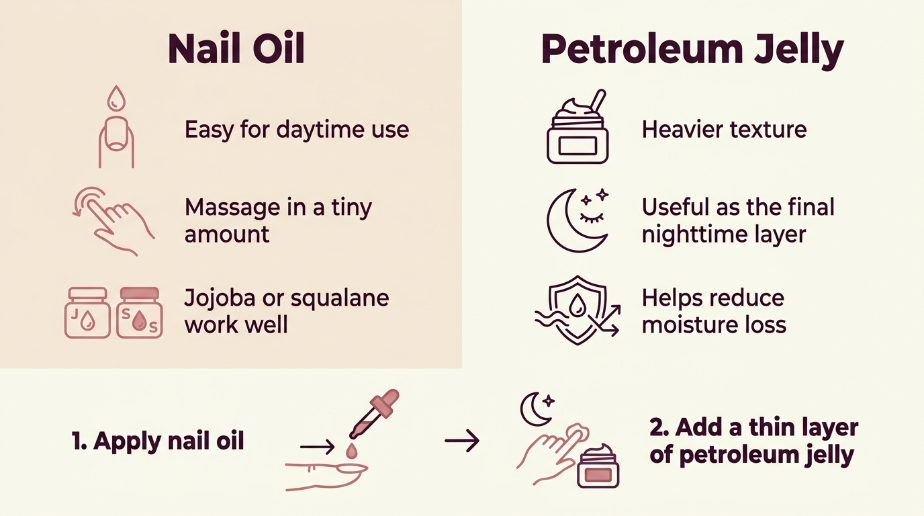
Nail oil is easier for daytime use because you can massage in a tiny amount quickly. Petroleum jelly is much heavier, which makes it convenient as the final layer of an overnight routine when your nails and cuticles feel extremely dry.
Try applying your jojoba or squalane oil first, then a very thin layer of petroleum jelly around the nail area before bed. The heavier layer helps reduce moisture loss while you sleep.
For a deeper comparison, see how Vaseline can fit into a nail-care routine.
Recommended Product
Petroleum Jelly for Overnight Nail Moisture
A thin layer over your usual oil can be useful at night when repeated handwashing has left your nails and cuticles particularly dry.
As an Amazon Associate, we earn from qualifying purchases.
Are There Times When Nail Oil Isn’t Enough?
Warning
Don’t rely on nail oil to hide or self-treat a nail that is painful, swollen, warm, draining, significantly lifting from the nail bed or developing an unexplained persistent color or shape change. Those changes deserve proper evaluation instead of simply being covered with polish or artificial nails.
Brittleness sometimes comes from ordinary dryness and repeated cosmetic damage, but not every unusual nail is just “dry.” If the problem keeps getting worse even after you’ve simplified your routine, consider getting professional advice.
You can compare your nails with these signs of unhealthy nails before deciding whether home care alone makes sense.
Pro Tips for Getting More From Your Nail Oil
Use oil after polish removal. Acetone and repeated remover exposure can leave the surrounding nail area feeling dry, so moisturize after you’ve finished removing the manicure.
File snags before they spread. Oil won’t stop a loose layer from catching on your sweater. Smooth a rough edge gently instead of pulling it away.
Don’t obsess over ingredient lists. A basic fragrance-free oil you actually use daily often makes more sense than a luxurious blend you save for special occasions.
Pair moisture with protection. If you’re washing dishes for 20 minutes with bare hands every night, adding more oil afterward isn’t as efficient as wearing gloves and reducing the repeated wet-dry cycle in the first place.
Frequently Asked Questions
Q: Is jojoba oil or coconut oil better for brittle nails?
A: I prefer jojoba for everyday use because it feels lighter and is easy to apply frequently. Coconut oil is still a reasonable conditioning option if you already have it and don’t mind the heavier texture.
Q: Can nail oil repair damaged nails?
A: It can help dry nails feel more conditioned and flexible, but it can’t permanently repair a section of nail that has already split, peeled or been filed too thin. Protect that area while healthier nail grows forward.
Q: Can I put nail oil on every day?
A: Yes. Daily use is a practical approach, especially when your nails and cuticle area feel dry. Start with one light application at bedtime and add another after handwashing if needed.
Q: Which oil is best after removing gel or acrylic nails?
A: Jojoba oil is an easy everyday choice, but the bigger priority is avoiding additional scraping, peeling and aggressive buffing. Keep fragile nails shorter and moisturize while the damaged length grows out.
Q: Is nail oil better than nail hardener?
A: They do different jobs. Oil focuses on conditioning and reducing dryness, while hardeners create a firmer coating or alter how the nail feels. Very rigid nails can still snap, so don’t assume the strongest hardener is automatically best for every brittle nail.
So, Which Nail Oil Should You Buy?
If you want one simple answer, start with a jojoba-based cuticle oil. It’s lightweight, convenient and easy to work into a daily routine. Choose mineral oil when budget and simplicity matter most, or squalane if greasy formulas make you avoid using nail oil altogether.
The oil itself is only one part of the recovery process. Keep fragile nails shorter, moisturize consistently, protect your hands during wet chores and stop peeling or scraping off manicures. Those habits give healthier new nail a better chance to grow forward without repeating the same damage.
Save this guide to Pinterest so you can quickly compare the best oils again whenever your nails start feeling dry, brittle or overworked.

Hi, I’m Jessica, the creator behind Unique Lash & Nails Katy.
I created this website for anyone who loves beautiful nails as much as I do. Here, I share trendy nail designs, seasonal manicure ideas, easy nail care tips, honest product recommendations, and step-by-step guides to help you create salon-worthy nails at home. Whether you’re looking for everyday inspiration or your next favorite nail trend, I hope you’ll find something you love.