Can a Black Nail Go Back to Normal? Healing Times and Warning Signs
Quick Answer
Yes, a black nail can usually return to normal when the color comes from bruising after an injury. The trapped blood won’t wash away, but it should move toward the tip as a healthy nail grows underneath. A fingernail may take four to six months to replace itself, while a toenail commonly needs 12 to 18 months. Get unexplained, spreading, or nonmoving discoloration checked rather than waiting for it to disappear.
Seeing part of your nail turn black can be alarming, especially when you don’t remember injuring it. The reassuring news is that many black nails are bruises caused by a bump, tight footwear, or repeated pressure.
Color alone can’t tell you the cause, though. Your nail’s recent history, pain level, texture, and growth pattern all matter. Here’s how to work out whether your nail is probably growing out normally and when you shouldn’t wait.


Why Did Your Nail Turn Black?
 Save
SaveA black nail isn’t one condition. It describes a color change that can come from blood, pigment, an infection, staining, or—much less commonly—a growth beneath the nail.
Blood trapped beneath the nail
The most common explanation after an injury is a subungual hematoma, which means blood has collected between your nail plate and nail bed. You may get one after slamming a finger in a door, dropping something on a toe, or wearing shoes that repeatedly press against the nail.
The spot may begin red or purple and become brown or black as the blood ages. A recent injury can cause throbbing because pressure is building in a confined space. Smaller bruises may cause little or no pain.
Runners and hikers sometimes develop a black toenail without one memorable accident. Repeatedly hitting the front of a shoe can create many tiny injuries. Shoes that are too short, downhill walking, and long toenails increase that pressure.
Natural nail pigment
Melanin can produce one or more brown-to-black vertical bands called longitudinal melanonychia. These bands are more common in people with darker skin tones and can be benign. Certain medicines, pregnancy, inflammation, or repeated trauma may also affect nail pigment.
A stable band that has been present for years isn’t the same as a new or rapidly changing mark. You still can’t confirm the cause from a photograph or home test, so show a new band to a dermatologist—particularly when it affects only one nail.
Fungal or bacterial infection
Some nail infections cause dark discoloration, although fungus more often creates yellow, white, or brown changes. An infected nail may also become thick, crumbly, distorted, separated from its bed, or surrounded by sore skin.
Black or green-black color can occasionally appear when organisms grow beneath a lifted nail. Painting over it hides the change without treating its cause. A clinician may need to examine a clipping or scraping because several nail problems look alike.
Polish, dye, or product staining
Very dark polish can stain a porous nail plate, especially when you skip base coat. This usually leaves a more even surface discoloration rather than a deep pool or stripe underneath the nail.
Remove the polish gently and inspect your bare nail in bright natural light. Don’t aggressively buff away the stain; thinning the nail won’t make new, unstained nail grow any faster.
A less common medical cause
Nail-unit melanoma is rare, but it matters because early assessment is important. It can appear as an irregular brown or black band, widening pigment, nail splitting, or discoloration extending onto nearby skin. It doesn’t always hurt.
Most dark nails aren’t melanoma. However, neither a remembered injury nor young age can completely rule it out. A clinician may use dermoscopy and, when necessary, a biopsy to distinguish suspicious pigment from a bruise or benign band. Medical literature identifies nail biopsy as the definitive diagnostic test when melanoma is suspected.
How Can You Tell Whether a Black Nail Is a Bruise?
A likely bruise usually has a clear trigger and follows a predictable pattern. Look at the whole story rather than relying on one visual feature.
- There was recent pressure or trauma: You stubbed the toe, trapped the finger, started running longer distances, or wore tight shoes.
- The discoloration appeared suddenly: A bruise commonly develops within hours or days rather than slowly widening over many months.
- The shape resembles a blotch: Trapped blood often forms a red, purple, brown, or black patch with a defined edge.
- It moves as the nail grows: Over several weeks, a visible strip of clear new nail should appear between the cuticle and the mark.
- The surrounding skin isn’t becoming increasingly inflamed: Mild early tenderness may settle, while worsening redness or drainage suggests another problem.
Take a clear photo today, then photograph the nail again in two to four weeks under similar lighting. Don’t judge it from day to day because nail growth is slow. Compare the distance between the cuticle and the dark area’s nearest edge.
Pro Tip
Measure the clear nail at the base instead of waiting for the black color to fade. Old blood often stays dark, but its movement toward the tip is a more useful sign that the mark is growing out.
Will a Black Nail Go Away on Its Own?
A small, uncomplicated bruise will often go away without treatment. Your body may absorb some blood, but much of the discoloration remains within or beneath the nail plate until growth carries it forward.
The dark section may look unchanged at first. After a few weeks, you should begin to see healthy nail at the base. Eventually, the mark reaches the free edge and can be clipped away.
If the injury damaged the connection between the nail and nail bed, the old nail may loosen or fall off. That can look dramatic, but a replacement often grows beneath it. Don’t pull the old nail off because the attached section protects sensitive tissue.
Recovery is less predictable when the nail matrix—the growth center hidden beneath the cuticle—was badly injured. A significant matrix injury can produce ridges, splitting, thickening, or permanent shape changes. You can learn more about this process in the guide to whether a damaged nail can regrow.
How Long Does a Black Nail Take to Return to Normal?
Your timeline depends on which nail is affected, how much of it is bruised, and whether the nail remains attached.
- Black fingernail: A full replacement commonly takes about four to six months.
- Black toenail: A full replacement commonly takes about 12 to 18 months.
- Small mark near the tip: You may be able to trim it away sooner because it has less distance to travel.
- Mark near the cuticle: It may require almost the nail’s entire replacement time to reach the edge.
Toenails grow much more slowly than fingernails, so patience is part of the process. Age, circulation, nutrition, illness, and damage to the growth center can also change the pace. The article on how fast nails grow explains what a realistic growth rate looks like.
No oil, supplement, or strengthening polish can instantly push trapped blood out. Supportive care may reduce breakage, but the discoloration still has to grow forward with the nail.
What Should You Do While the Black Nail Grows Out?
 Save
SaveOnce serious injury and suspicious pigment have been ruled out, your main job is to protect the nail and watch its progress.
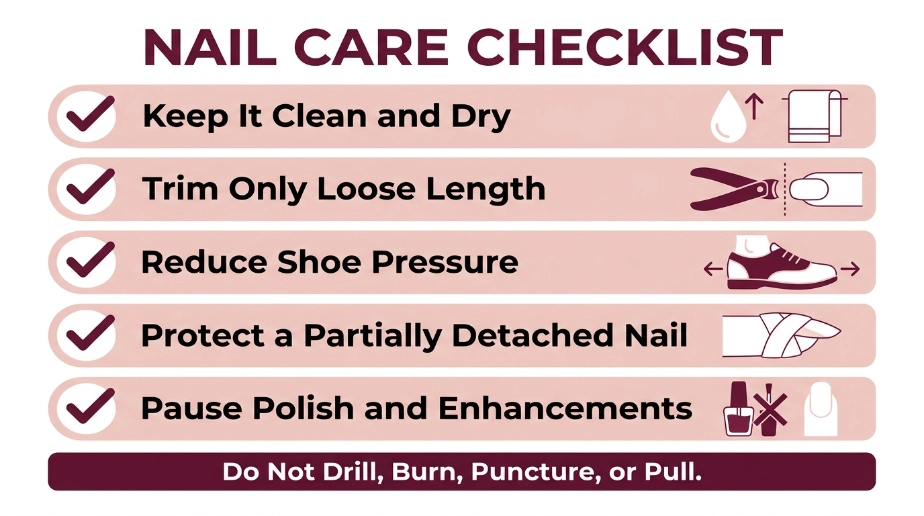
Keep it clean and dry
Wash gently with soap and water, then dry the nail and surrounding folds. If the edge has lifted, moisture can remain underneath and make infection more likely.
Trim only loose length
Use clean clippers to shorten the free edge. Leave firmly attached nail in place. If a loose corner catches on fabric, smooth the sharp edge carefully with a fine file.
A compact stainless-steel nail clipper and glass nail file can help you maintain the edge without tearing it.
Reduce pressure on a black toenail
Choose shoes with a thumb’s width of space in front of your longest toe and a toe box wide enough for your toes to lie flat. Lace shoes securely so your foot doesn’t slide forward on descents.
If rubbing continues, a soft silicone toe cap may provide temporary cushioning. It should feel comfortable, not tight, and it won’t treat blood already trapped beneath the nail.
Protect a partially detached nail
Cover a snag-prone nail loosely with a nonstick dressing during activities. Change it whenever it becomes damp or dirty. Avoid wrapping the finger or toe so tightly that it throbs, tingles, becomes cold, or changes color.
A small pack of nonstick sterile pads is useful when the skin is exposed or the nail edge catches easily.
Pause polish and enhancements
Leave the nail bare while you’re monitoring an unexplained mark. Gel, acrylic, press-ons, and opaque polish can hide changes and add pressure to an already separated nail.
Once a clinician has confirmed that the nail is healthy, you can return to color carefully. Use base coat to reduce staining and remove polish periodically so you can inspect the nail.
Do
- +Photograph the nail every two to four weeks.
- +Wear roomy footwear that stops repeated pressure.
- +Ask a clinician about unexplained or changing color.
Don’t
- −Drill, burn, or puncture the nail yourself.
- −Pull off nail that is still attached.
- −Hide an unexplained mark beneath opaque polish.
When Should You Get a Black Nail Checked?
Arrange an appointment with a dermatologist or primary-care clinician when you don’t know why the nail changed color. You should also get it checked if the mark fails to move toward the tip as the nail grows.
Warning
Seek medical evaluation promptly for a new dark band on one nail, pigment that widens or has uneven borders, color spreading onto the cuticle or nearby skin, unexplained nail splitting, a lump, bleeding, or a sore that doesn’t heal. These signs don’t prove melanoma, but they shouldn’t be diagnosed at home.
You should also seek care when:
- Severe or throbbing pain follows a recent injury.
- Most of the nail becomes dark after a crush injury.
- The finger or toe looks bent, numb, pale, or difficult to move.
- Redness, warmth, swelling, pus, or worsening pain develops.
- You have diabetes, poor circulation, reduced sensation, or a weakened immune system.
- Several nails change color without a clear cosmetic cause.
A clinician can sometimes drain a painful, recent collection of blood to relieve pressure. This works best early and should be performed with appropriate sterile equipment after checking for associated injury. Trying to burn or drill through the nail at home risks infection, burns, and damage to the nail bed.
What If the Black Nail Falls Off?
Don’t panic if an injured nail loosens. Keep the exposed area clean, protect it with a nonstick dressing, and let attached sections separate naturally. A new nail may already be growing beneath the old one.
See a clinician if the nail is torn from its base, the nail bed has a deep cut, bleeding won’t stop, or pain is severe. Early care matters when the growth center may have been injured.
Once the skin has closed, you can focus on preventing snags and dryness. The guide to caring for a damaged nail at home offers additional cosmetic maintenance tips, but home care shouldn’t replace an examination when you have infection or melanoma warning signs.
Common Black-Nail Problems and What to Do
The mark looks just as dark after a month
Darkness alone isn’t proof that healing has stopped. Compare photos and look for clear nail appearing at the base. If the mark isn’t moving outward, arrange a medical assessment.
The nail is separating from the bed
Trim only the loose free edge and protect it from catching. Don’t clean deeply beneath the nail with a sharp tool. Seek care if separation is spreading, painful, smelly, or producing drainage.
The same toenail turns black after every run
Check shoe length, toe-box width, lacing, sock bunching, and nail length. Recurrent bruising means pressure is continuing, so changing polish or applying oil won’t solve the cause.
The dark color appeared after removing polish
Leave the nail bare and inspect whether the color sits on the surface or beneath it. If it doesn’t gradually grow out, or it forms a changing band, don’t assume it’s only staining.
Frequently Asked Questions
Q: Can a black nail disappear without falling off?
A: Yes. A small bruise can move toward the tip with nail growth and eventually be clipped away while the nail stays attached. A larger injury is more likely to loosen the nail.
Q: Does a black nail always mean fungus?
A: No. Trauma, natural pigment, staining, infection, and other conditions can all cause dark color. Fungus often also causes thickening, crumbling, distortion, or separation, but testing may be needed to confirm it.
Q: Can you put nail polish over a black nail?
A: Leave an unexplained black nail uncovered until you know the cause. Polish can hide changes that help a clinician assess it. Avoid enhancements when the nail is painful, damaged, infected, or lifting.
Q: Should you drain a black nail at home?
A: No. Home puncturing can burn the nail bed, introduce bacteria, or miss a fracture. A clinician can decide whether a recent, painful hematoma needs drainage and perform it safely.
Q: How do you know whether a black nail is melanoma?
A: You can’t diagnose nail melanoma by appearance alone. A new, widening, irregular band or pigment extending onto surrounding skin needs prompt assessment by a dermatologist, who may use dermoscopy and a biopsy.
So, Can Your Black Nail Become Normal Again?
Yes—when the cause is a simple bruise, healthy nail usually replaces the dark area gradually. Protect it, reduce repeated pressure, and track whether the mark moves toward the tip.
Don’t wait indefinitely when the discoloration is unexplained, changes shape, spreads onto nearby skin, or remains fixed while your nail grows. Save this guide to Pinterest so you’ll have the healing timeline and warning signs available when you check your nail again.

Hi, I’m Jessica, the creator behind Unique Lash & Nails Katy.
I created this website for anyone who loves beautiful nails as much as I do. Here, I share trendy nail designs, seasonal manicure ideas, easy nail care tips, honest product recommendations, and step-by-step guides to help you create salon-worthy nails at home. Whether you’re looking for everyday inspiration or your next favorite nail trend, I hope you’ll find something you love.