Nail Damage vs Nail Weakness: Key Signs & Fixes
Quick Answer
Nail damage means your nail or the tissue around it has been changed or injured, often by filing, picking, impact, or harsh manicure removal. Nail weakness describes nails that bend, peel, split, or break easily. The two can overlap: damage can make nails weak, while naturally brittle nails are easier to damage. The right care depends on the cause, not just the way your nails look.
You remove your latest manicure and notice that your nails bend like paper. Or perhaps one nail has a rough white patch while the others keep breaking at the tips. Is this nail damage or nail weakness? Understanding the difference helps you avoid treatments that make fragile nails worse. Here’s how to read the signs and choose a gentler routine.


What Is the Main Difference Between Nail Damage and Nail Weakness?
Think of nail damage as a change or injury and nail weakness as a description of how fragile a nail behaves. Neither phrase tells you the exact cause on its own. A nail can be damaged but still feel fairly firm, or it can be weak without one obvious injury.
What counts as nail damage?
Nail damage can affect the visible nail plate, the nail bed underneath, or the area where new nail forms. On the nail plate, it may show up as scraped patches, thinning, grooves, tears, or lifting after an injury. Cosmetic habits are common triggers: peeling off gel, filing too deeply, pulling off press-ons, and picking at lifting acrylic can all disturb the nail surface.
A bruise under a nail after shutting your finger in a door is another kind of damage. So is a split caused by catching a nail on a zipper. Those problems have different levels of seriousness, even though people may call them all damaged nails.
What counts as nail weakness?
Nail weakness usually means your nails have less resistance to everyday bending and breakage than you expect. They may peel in thin layers at the free edge, split down the tip, or snap before reaching your preferred length. Dermatologists often describe persistent splitting and peeling as brittle nails.
Weakness may develop after repeated water exposure, frequent manicures, or ordinary physical wear. Occasionally, an underlying skin condition, nutritional problem, medication, or thyroid disorder contributes. You cannot identify a deficiency just by looking at a nail.
Nail Damage vs Nail Weakness: Which Signs Matter Most?
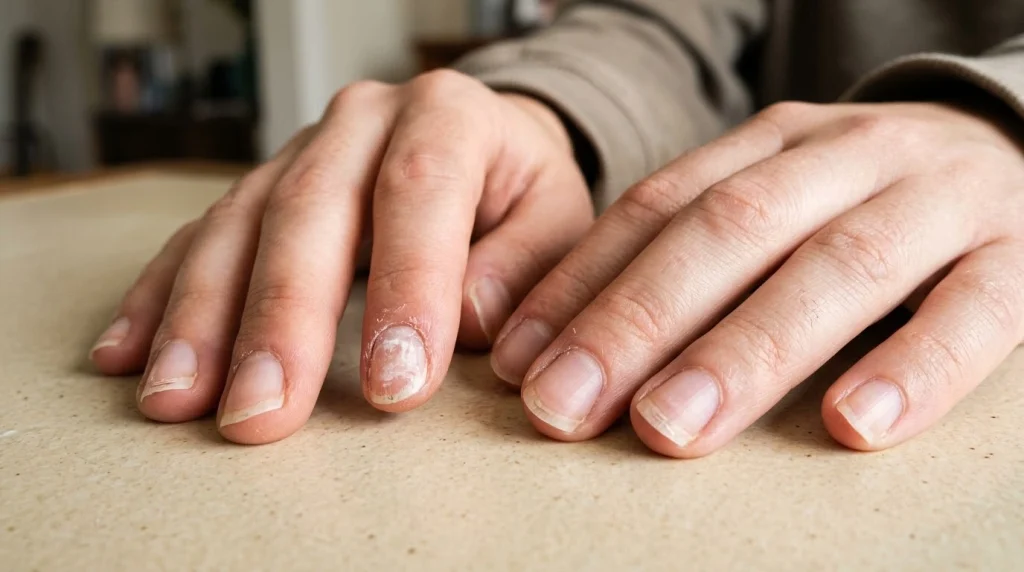
Use this comparison as a starting point, not a diagnosis. The same nail can belong in both columns.
| Clue | More suggestive of damage | More suggestive of weakness |
|---|---|---|
| When it started | After an impact, picking, or manicure removal | Gradually, with frequent everyday breakage |
| Appearance | Scraped areas, uneven patches, a tear, or lifting | Peeling tips, repeated splits, and fragile edges |
| Number of nails | Sometimes one nail or nails recently treated | Often several nails, although not always |
| What helps | Stop the injury and protect the nail as it grows out | Reduce repeated stress, moisturize, and address causes |
For example, if you peel off gel and immediately see thin, rough patches, recent damage is a strong possibility. If your nails have been splitting for months despite few manicures, the bigger question is why they remain fragile. Our guide to dry nails versus brittle nails explores another distinction that can help you describe what you see.
Why Do Nails Become Damaged or Weak?
Your nail plate consists mainly of compacted keratin cells. The visible plate does not repair a missing layer in the way living skin heals. Instead, you protect what remains while new nail gradually grows from the base. Several situations can affect the plate or the way it grows.
Manicure preparation and removal
Light preparation may be part of a manicure, but excessive buffing removes protective material. Pulling off gel, acrylic, or adhesive can take superficial nail layers with it. That explains why nails sometimes feel unexpectedly flexible right after removal. If this sounds familiar, see our dedicated guide to caring for weak nails after gel or acrylic removal.
Repeated wetting, drying, and cleaning
If you wash dishes, clean frequently, or spend long hours with wet hands, your nails repeatedly absorb and lose moisture. Along with exposure to soaps and detergents, that cycle can contribute to brittle edges. A moisturizer helps condition your nails and skin, but protective gloves are especially useful when the exposure keeps happening.
Everyday knocks and picking
Typing, opening containers with your nails, scratching labels, or picking at a split can turn a small snag into a larger crack. Biting and manipulating your cuticles also stress the growing nail and surrounding tissue. The issue is often the repeated force rather than one dramatic accident.
Skin conditions and other health factors
Eczema, psoriasis, fungal nail infection, certain medications, iron deficiency, and thyroid conditions can sometimes be associated with nail changes. These possibilities matter more when problems persist, affect many nails, or appear alongside other symptoms. Don’t assume every peeling nail needs supplements or that every thick nail has a fungal infection. A clinician can examine the pattern and decide whether testing is appropriate.
How Can You Tell What Is Happening to Your Own Nails?
Start with your history, not a dramatic close-up photo from social media. A five-minute check can help you decide whether gentle home care is reasonable or whether you need professional advice.
- Think about timing. Did the problem appear after product removal or an accident? A clear recent event points toward damage, although weakness may follow.
- Check the location. Rough patches across the plate may suggest surface injury. Peeling that repeatedly begins at the free edge often fits brittleness. Neither pattern proves a cause.
- Compare other nails. One injured nail raises different questions from ten nails that suddenly look different. Note whether toenails are affected too.
- Notice discomfort. Mild cosmetic brittleness should not cause significant swelling, pus, bleeding, or increasing pain. Those are reasons to seek assessment.
- Track new growth. Take a clear photo in consistent lighting every few weeks. Look for healthy-looking nail emerging near the cuticle rather than expecting old surface damage to disappear overnight.
Warning
Seek medical advice for a new or changing dark streak, significant pain, redness, swelling, drainage, bleeding, unexpected lifting, or a nail change that keeps worsening. A rapidly spreading infection or serious crush injury needs prompt care. Avoid covering suspicious changes with an enhancement.
Can a Nail Be Both Damaged and Weak?
Absolutely. Imagine a nail that was already prone to peeling because you regularly wash and sanitize your hands. If you then scrape off a gel manicure, the plate may lose additional surface layers. The nail now has both an existing tendency toward weakness and a more recent injury.
The reverse can happen too. Repeated minor damage can create what feels like ongoing weakness. This is why buying a stronger hardener without changing your removal method may not solve the problem. For other patterns that contribute to persistent fragility, explore why your nails may be weak.
How Should You Care for a Damaged Nail?
For minor, painless surface damage, your priority is to prevent further tearing while healthier nail grows in. You don’t need to scrape away every rough patch or hide it beneath another thick enhancement.
- Keep the free edge manageable. Trim only the part you can comfortably cut, leaving attached tissue alone. Shorter nails catch on clothes less often.
- Smooth small snags. Use a fine file with gentle pressure. Stop before you thin the upper nail surface any further.
- Pause damaging treatments. Avoid aggressive buffing, picking, and repeated adhesive removal. If a product is firmly attached, follow its proper removal method rather than forcing it off.
- Condition dry surrounding skin. Apply hand cream after washing and a small amount of oil or petroleum jelly around the nail folds when needed.
- Protect the nail from knocks. Be careful with bags, zippers, and cleaning chores. Do not glue a split that extends into painful, attached tissue.
If your damage is limited to a small split at the tip, the safe approach may be different from care for a lifted or painful nail. Our guide to caring for a damaged nail at home explains those practical limits.
How Can You Improve Weak, Brittle Nails?
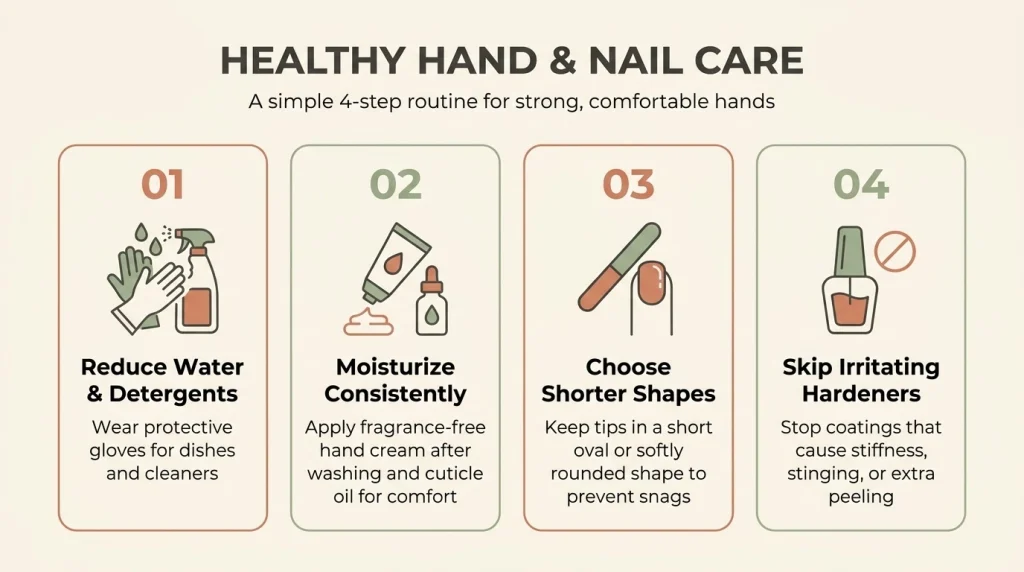
Weakness usually responds best to a repeatable routine rather than one dramatic treatment. Your aim is to reduce the forces that cause splitting and give new nail growth a better chance to remain intact.
Reduce water and detergent exposure
Wear protective gloves when washing dishes or handling household cleaners. Dry your hands afterward and apply moisturizer. If glove material irritates your skin, consider a different material or a breathable liner. You still need normal handwashing for hygiene; the goal is to avoid unnecessary prolonged exposure.
Moisturize consistently
Keep a simple hand cream beside your sink and apply it after washing. A fragrance-free cream can be a comfortable option if your skin is easily irritated. Cuticle oil can help condition the nail area, but it will not fuse peeling layers back together permanently or make nails grow overnight.
Choose shorter, smoother shapes
Short oval or softly rounded nails are often easier to maintain when tips keep catching or splitting. Avoid very thin, sharp corners while your nails are fragile. Instead of chasing length right away, focus on getting through everyday tasks without another break.
Reconsider products that sting or cause peeling
Some nail hardeners create a firmer coating, but they do not treat every reason for fragility. A product that makes your nails feel excessively rigid, irritates your skin, or worsens peeling is not a good match. Stop products that cause a reaction and seek advice for ongoing symptoms.
Pro Tip
If your nails keep splitting in the same place, take a picture of the free edge before trimming it. This helps you notice whether the split follows repeated mechanical stress or appears even when the nail stays short and protected.
Which Nail Care Products Are Actually Useful?
You don’t need a ten-step nail routine. Choose a few basic items that solve a specific problem: snags, dryness, or repeated household exposure. These are product categories to consider, not guaranteed treatments for a nail disorder.
Affiliate disclosure: As an Amazon Associate, we earn from qualifying purchases.
Recommended Tool
Fine Glass Nail File
A fine glass file can help you smooth small free-edge snags with controlled pressure. It won’t restore layers removed by over-buffing.
Recommended Care Item
Jojoba-Based Cuticle Oil
A few drops can condition dry nail folds and make your everyday moisturizing routine easier. Oil is for comfort and conditioning, not structural reconstruction.
For frequent handwashing, a fragrance-free hand cream is a practical everyday staple. If your hands regularly meet water and detergents, consider reusable household cleaning gloves as well. Those habits may matter more than another specialty bottle.
What Should You Do and Avoid While Nails Recover?
Do
- Keep fragile tips short and smooth.
- Use hand cream after washing.
- Protect hands during wet chores.
- Watch for healthier growth near the base.
Don’t
- Peel or force off nail enhancements.
- Buff thin nails to hide uneven patches.
- Use nails to pry open objects.
- Cover painful or discolored nails without checking them.
These habits can be surprisingly hard to spot when you’re used to weekly manicures. Our list of common weak nail care mistakes can help you review your routine without giving up nail art permanently.
How Long Does Nail Damage or Weakness Take to Improve?
There’s no universal recovery deadline. If dryness and repeated exposure are the main problems, your nails and surrounding skin may feel more comfortable after a few weeks of consistent protection. But damaged nail plate cannot replace missing material in place; the affected portion must move outward as the nail grows.
A fingernail commonly takes roughly four to six months, sometimes longer, to grow out substantially or completely. Toenails generally take longer. The timing depends on which part was affected, your individual growth rate, and whether the source of injury continues.
During the first month, judge progress by practical changes: fewer fresh snags, less repeated splitting, and a new section of smoother nail near the base. If nails remain unusually fragile despite gentle care, or the pattern suddenly changes, a dermatologist can help investigate the cause.
Do Weak Nails Need Supplements or a Nail Hardener?
Not automatically. Biotin and other supplements are frequently marketed for stronger nails, but evidence for routine use is limited, and high-dose biotin can interfere with certain laboratory tests. Taking iron without a confirmed need can also be harmful. Ask a healthcare professional about persistent nail changes before starting supplements.
A nail hardener might temporarily change how a nail feels, yet no coating can reverse missing layers, repair an injured nail matrix, or treat a fungal infection. Start with protection, gentle maintenance, and an explanation for the problem. Consider cosmetic coatings only when the nail and surrounding skin are comfortable and there are no warning signs.
Frequently Asked Questions About Nail Damage vs Nail Weakness
Q: Are thin nails always damaged?
A: No. Some people naturally have thinner nail plates. A sudden change after aggressive filing or product removal is more suggestive of damage, especially when the nails also become rough or tender.
Q: Can weak nails become strong again?
A: Often, fragility improves when you reduce repeated exposure and address the underlying cause. Results vary, and existing splits will not knit back together permanently.
Q: Does peeling mean my nails are damaged or weak?
A: Peeling can reflect either or both. Peeling that starts right after rough manicure removal suggests surface damage; recurring peeling across several nails may point to ongoing brittleness.
Q: Will cuticle oil repair a damaged nail?
A: Cuticle oil helps condition dry nails and surrounding skin, but it cannot rebuild nail layers that have already been removed. Protection and healthy new growth are still essential.
Q: Should I stop getting manicures if my nails feel weak?
A: Pause procedures that require aggressive filing or removal while your nails are fragile. If you return to manicures, choose gentle preparation and removal, and avoid covering painful or unusual nail changes.
What Is the Most Important Takeaway?
Nail damage describes what happened to your nail; nail weakness describes how easily it gives way. Since one can cause the other, the best routine begins by identifying likely triggers, protecting fragile tips, and allowing new growth time to replace damaged sections. Save this guide to your Pinterest nail-care board so you can revisit the signs before your next manicure.

Hi, I’m Jessica, the creator behind Unique Lash & Nails Katy.
I created this website for anyone who loves beautiful nails as much as I do. Here, I share trendy nail designs, seasonal manicure ideas, easy nail care tips, honest product recommendations, and step-by-step guides to help you create salon-worthy nails at home. Whether you’re looking for everyday inspiration or your next favorite nail trend, I hope you’ll find something you love.