How Long Does It Take a Nail to Grow Back? Timeline
Quick Answer
A fingernail usually takes about 4–6 months to grow back completely after falling off, while a toenail may take 12–18 months. Fingernails grow approximately 3–3.5 mm per month, compared with about 1.5–1.6 mm for toenails. Your recovery depends on the injury, the health of the nail matrix, and whether infection or repeated damage occurs. Protecting the nail bed helps support normal regrowth.
Watching a nail fall off after an injury can be unsettling, especially when you aren’t sure if it’ll ever look normal again.
The reassuring news is that most nails can grow back when the tissue responsible for producing new nail remains healthy. However, recovery takes patience, and fingernails and toenails follow very different timelines.
Here’s what you can expect each month, how to care for your nail while it regrows, and which warning signs shouldn’t be ignored.


How Long Does It Take a Fingernail to Grow Back?

A completely lost fingernail typically needs around four to six months to grow back. Some nails take longer, particularly after a significant injury involving the nail bed or growth area.
Your fingernails grow an average of approximately 3–3.5 millimeters each month. That sounds tiny, but it means new nail gradually moves forward from beneath your cuticle until it reaches your fingertip.
If you lost only the tip of your nail, recovery can be much shorter. The remaining nail doesn’t have to regenerate from the beginning; it simply needs time to grow beyond the damaged area.
What does fingernail regrowth look like month by month?
- First 1–2 weeks: The exposed nail bed begins healing. Tenderness and sensitivity may improve as the skin recovers.
- Month 1: New nail growth may become visible near the base, although the exact timing varies.
- Months 2–3: The new nail gradually covers more of the nail bed. Temporary ridges or uneven areas may appear.
- Months 4–6: Many fingernails reach their usual length again, assuming the nail matrix remains healthy.
Remember that the skin underneath your missing nail heals on a different schedule from the nail itself. Your fingertip may feel much more comfortable long before the replacement nail finishes growing.
How Long Does It Take a Toenail to Grow Back?
Toenails grow considerably more slowly than fingernails. A completely lost toenail commonly takes about 12–18 months to return, especially when the entire nail has detached.
Toenail growth averages approximately 1.5–1.6 millimeters monthly. Your big toenail may seem particularly slow because it has a larger surface to replace.
If your toenail fell off after tight shoes, running, or accidentally hitting your toe, don’t assume the absence of quick visible growth means something is wrong.
However, persistent pain, swelling, discoloration, or an unusually shaped nail deserves evaluation rather than simply waiting another year.
Fingernail vs. toenail regrowth timeline
| Nail type | Average growth | Full regrowth |
|---|---|---|
| Fingernail | 3–3.5 mm/month | About 4–6 months |
| Toenail | 1.5–1.6 mm/month | About 12–18 months |
These figures are typical estimates, not guaranteed deadlines. A serious injury, infection, or damage to the nail-producing tissue can change your recovery substantially.
How Does a Nail Actually Grow Back?
Your visible nail is made primarily of hardened keratin. Unlike living skin, the nail plate itself cannot repair a crack or rebuild a missing section.
Instead, new nail cells form in the nail matrix, an area of living tissue mostly hidden beneath the skin at the base of your nail.
As new cells develop, they push older nail material forward. That’s why you see healthy growth appearing near your cuticle while damaged sections gradually move toward the tip.
The nail matrix is especially important after an accident. If it remains functional, the replacement nail can often grow normally. If it develops significant scarring, the new nail might become permanently ridged, split, or misshapen.
You can explore this further in our guide explaining whether a damaged nail can regrow.
Why Do Nails Fall Off in the First Place?
Not every missing nail has the same cause. Understanding what happened helps you decide whether gentle home care is enough or medical treatment is needed.
1. Injury or accidental trauma
Slamming a finger in a door, dropping something heavy on your toe, or repeatedly hitting the nail during sports can damage its attachment to the nail bed.
Blood may collect beneath the nail, creating dark discoloration and pressure. Sometimes the nail loosens and eventually separates as a replacement grows underneath.
A painful crush injury needs prompt medical assessment because fractures or deeper nail-bed damage may also be present.
2. Acrylic or gel nail damage
Peeling off gel polish, pulling away acrylic extensions, or aggressively filing the natural nail can damage its surface.
Most cosmetic damage causes peeling or thinning rather than complete nail loss. However, significant trauma during artificial nail removal can sometimes cause the nail plate to lift.
If your nails are already fragile, follow a gentle routine for repairing a damaged nail at home, provided the injury is minor and the skin isn’t open or infected.
3. Nail infections
Fungal infections may cause thickening, crumbling, discoloration, and separation. Bacterial infections can also affect the surrounding skin and nail structures.
Moisturizer alone won’t treat an infection. A healthcare professional can identify the cause and recommend suitable treatment.
4. Repeated pressure from footwear
Runners and people who wear tight shoes sometimes experience toenail injuries from repeated impact against the front of the shoe.
Making room for your toes can reduce repeated pressure, particularly when walking downhill or exercising.
What Are the Stages of Nail Regrowth After an Injury?
Your nail doesn’t return overnight. Recovery usually involves three overlapping stages, each with a different priority.
Stage 1: Nail-bed healing
After a nail is completely lost, the exposed nail bed needs protection while the skin heals. For an uncomplicated injury, initial healing may take approximately seven to ten days, although more serious wounds can take longer.
Follow your clinician’s wound-care instructions, especially if you needed stitches, drainage, or nail removal.
Stage 2: Visible new growth
As the matrix produces new nail, you may begin noticing a thin replacement near the base. It may initially look uneven or have a different texture from your other nails.
Don’t scrape, buff, or pick at this delicate new growth. Protecting it is more useful than trying to make it look perfect immediately.
Stage 3: Full replacement
Eventually, new nail extends toward the fingertip or toe tip. If the matrix is healthy, the appearance may become more uniform as the damaged section is replaced.
Some ridges and shape changes improve over time, while others can persist after a deeper injury.
Pro Tip
Take a clear photograph every four weeks under similar lighting. Comparing monthly pictures is more useful than checking your nail every day because normal growth is too slow to notice from one morning to the next.
What Factors Affect How Fast Your Nail Grows Back?
Although average growth rates provide a helpful reference, your actual recovery can be affected by several things.
- Severity of the injury: A small break at the tip usually resolves faster than losing the entire nail.
- Nail matrix health: Injury to the tissue producing new nail can slow growth or cause lasting changes.
- Age: Nail growth generally becomes slower with increasing age.
- Nutrition: Inadequate protein or certain nutrient deficiencies can affect nail health.
- Medical conditions: Some skin diseases, infections, circulation problems, and other health issues may influence nail appearance and growth.
- Repeated trauma: Picking, biting, tight footwear, or harsh manicure removal can interfere with recovery.
That doesn’t mean you need a collection of supplements or expensive treatments. For most people, the best approach is to address the cause, protect the recovering area, and maintain sensible nail-care habits.
Our article about common causes of damaged nail growth explains which everyday habits are worth changing.
How Can You Help Your Nail Grow Back Safely?
You can’t force a replacement nail to appear in a few days, but you can reduce unnecessary damage while your body does the growing.
Protect the exposed nail bed
If your nail recently came off, follow the wound-care directions provided by your healthcare professional. A suitable nonstick dressing can help protect the area when recommended.
Change dressings as directed and avoid products that irritate the wound. Don’t apply cuticle oil, polish, or cosmetic glue directly onto broken skin.
Keep the surrounding skin moisturized
Once the wound is closed and healed, apply a fragrance-free moisturizer around the nail and cuticle area.
A simple hand cream or a small amount of petroleum jelly can reduce dryness. Moisturizing helps protect surrounding skin, but it doesn’t make the nail matrix produce new cells dramatically faster.
Prevent repeated snags and pressure
Keep surviving nail edges comfortably short and smooth. If part of the nail remains attached, don’t pull it off.
For toenails, choose shoes with enough space in the toe box. For fingernails, avoid using your recovering nail to open packages, peel stickers, or scrape surfaces.
Eat a balanced diet
Your body needs nutrients to produce healthy nail tissue. Include adequate protein and a variety of foods that supply iron, zinc, and vitamins.
High-dose biotin isn’t a reliable shortcut for everyone. It can also interfere with certain medical laboratory tests, so discuss supplements with a healthcare professional before taking them for nail growth.
Choose gentle nail-care tools
After your injury has healed, a fine-grit nail file and regular moisturizer are usually more useful than aggressive nail treatments.
You might find these basic care items helpful:
- Glass nail file for smoothing intact nail edges without excessive filing.
- Fragrance-free hand cream for moisturizing healed skin around your nails.
- Nonstick sterile gauze pads for wound protection when a healthcare professional recommends dressing the area.
As an Amazon Associate, we earn from qualifying purchases.
For an everyday maintenance plan after healing, see our simple nail-care routine.
What Should You Do and Avoid While Your Nail Regrows?
Do
- Protect an exposed nail bed with appropriate wound care.
- Keep intact nail edges short and smooth.
- Moisturize surrounding skin after healing.
- Wear comfortable, roomy footwear.
- Monitor changes with monthly photographs.
Don’t
- Rip off an attached nail.
- Apply polish or acrylic over an open wound.
- Cut or dig into sensitive cuticles.
- Ignore increasing pain or discharge.
- Expect supplements to replace proper care.
When Should You Worry About a Nail Not Growing Back?
Slow nail growth isn’t automatically dangerous. However, some symptoms indicate that waiting isn’t the safest approach.
Warning
Get prompt medical attention for a deep cut, crushed fingertip, severe pain, uncontrolled bleeding, or a suspected fracture. After an injury, increasing redness, warmth, swelling, pus, or fever may indicate infection. Don’t attempt to drill through a painful, blood-filled nail at home.
You should also arrange an appointment if your nail doesn’t show expected progress over time, continually separates, develops significant thickening or discoloration, or grows with a persistent split.
A clinician can examine the nail bed and matrix, investigate infection, and determine whether further treatment is necessary.
Can You Wear Nail Polish or Acrylics While a Nail Grows Back?
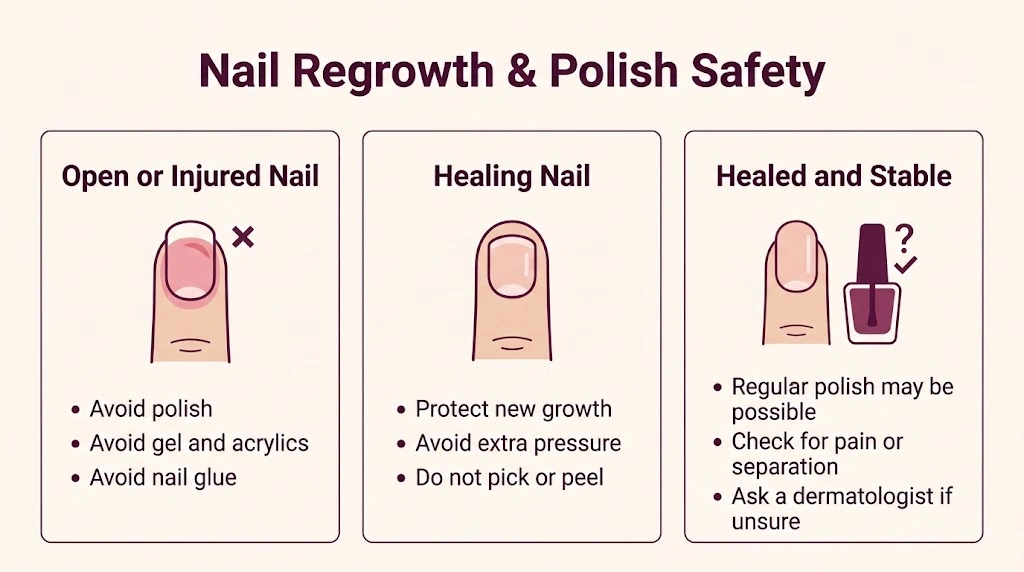
It’s understandable to want to hide an uneven or missing nail, especially when you love beautiful manicures.
However, an exposed nail bed, open wound, or painful lifting nail shouldn’t be covered with polish, acrylic, gel, or press-on adhesive.
Once the skin has healed and the new nail is stable, ordinary polish may eventually be an option. The appropriate timing depends on the original injury and whether any sensitivity or separation remains.
Artificial enhancements deserve extra caution because application and removal can introduce additional pressure or trauma.
If you’re unsure whether your recovering nail is ready for a manicure, ask a dermatologist rather than experimenting with glue or enhancements over a fragile area.
Frequently Asked Questions About Nail Regrowth
Q: Will my nail grow back if it falls off completely?
A: Usually, yes, if the nail matrix remains functional. A complete fingernail commonly takes around four to six months to replace, while toenails may need 12–18 months. Severe matrix scarring can affect the final result.
Q: Can a nail grow back in two weeks?
A: A completely missing nail won’t normally regrow in two weeks. Your exposed nail bed may begin healing during that period, but full replacement usually takes several months or longer.
Q: Why is my new nail growing back bumpy?
A: Trauma to the nail-producing tissue can temporarily affect how the replacement nail forms. Some ridges improve as later growth appears, but persistent deformities should be examined by a dermatologist.
Q: Does cuticle oil make a missing nail grow back faster?
A: Cuticle oil helps moisturize intact skin and nails, but there’s no strong evidence that it dramatically speeds up regrowth after nail loss. Don’t apply it directly to an unhealed wound.
Q: Can a toenail grow back after being removed?
A: Often, yes. If the matrix was preserved, a toenail may grow back over 12–18 months. However, procedures intended to permanently destroy part or all of the matrix can prevent regrowth in the treated area.
Final Thoughts: Give Your Nail Time to Recover
So, how long does it take a nail to grow back? Expect roughly four to six months for a fingernail and as long as 12–18 months for a toenail. The most important thing is protecting the nail-producing tissue and avoiding another injury while recovery continues.
Save this guide to your Pinterest nail-care board so you can revisit the timeline and safe recovery tips whenever you need them.

Hi, I’m Jessica, the creator behind Unique Lash & Nails Katy.
I created this website for anyone who loves beautiful nails as much as I do. Here, I share trendy nail designs, seasonal manicure ideas, easy nail care tips, honest product recommendations, and step-by-step guides to help you create salon-worthy nails at home. Whether you’re looking for everyday inspiration or your next favorite nail trend, I hope you’ll find something you love.