What Is the Free Edge of a Nail? Simple Guide
Quick Answer
The free edge of a nail is the part of your nail plate that extends beyond the tip of your finger or toe and is no longer attached to the nail bed underneath. It’s the section you trim, file, and shape during a manicure. Made from hardened keratin, the free edge helps protect your fingertip and gives you room to create different nail shapes.
Here’s something you might not realize: the part of your nail you file into a perfect almond or square shape is actually a distinct anatomical structure called the free edge.
Understanding where your nail’s free edge begins helps you shape your nails correctly, avoid painful over-trimming, and recognize when something doesn’t look healthy.
Whether you’re learning nail anatomy or perfecting your at-home manicure, this guide explains everything you need to know.


What Exactly Is the Free Edge of a Nail?
The free edge of a nail is the distal portion of the nail plate that projects past the end of the nail bed. In everyday language, it’s the part of your nail that grows beyond the tissue underneath.
Your nail plate is made primarily of hard keratin, a durable protein also found in your hair and the outer layer of your skin. As new nail cells form in the nail matrix, the nail plate gradually moves forward.
Eventually, the growing nail plate reaches the end of the nail bed. The portion that continues beyond this point becomes the free edge.
Unlike the nail plate covering your nail bed, the free edge doesn’t have underlying nail-bed tissue attached to its underside. That’s why you can carefully trim this portion without cutting into living nail-bed tissue.
However, the skin beneath the tip of your nail, called the hyponychium, is living tissue. Cutting too close to it can cause pain, bleeding, and irritation.
Where Is the Free Edge Located?
Look at your fingernail from above. You’ll usually notice a pinkish or skin-toned area extending from the base toward the tip. Beyond that area, you may see a white or translucent section.
That projecting section is your free edge.
You can identify it by looking at three important features:
- Location: At the far end of your nail, beyond the attached nail bed.
- Appearance: Often white, ivory, or translucent, depending on nail thickness and lighting.
- Function: Provides an extension of the nail plate that can be trimmed and shaped.
If your nails are cut extremely short, you might have little or no visible free edge. That’s normal, provided the surrounding tissue isn’t injured.
Why Does the Free Edge of a Nail Look White?
Have you ever wondered why the tips of your natural nails appear white while the rest looks pink?
The answer comes down to how light interacts with the nail plate and the tissue beneath it.
Over your nail bed, the relatively translucent nail plate allows the color of underlying tissue and blood vessels to show through. This creates the familiar pink appearance of healthy-looking nails.
Once the nail plate extends beyond the nail bed, that underlying pink tissue is no longer directly beneath it.
Light scattering through the keratin layers, along with the absence of the nail bed underneath, makes the free edge appear whitish.
Not every free edge looks bright white. Some nails naturally have clear, cream-colored, or slightly translucent tips.
Important: A white free edge isn’t automatically a sign of strong nails. Strength depends on factors such as nail structure, thickness, hydration, and exposure to damage.
Free Edge vs. Nail Bed: What’s the Difference?
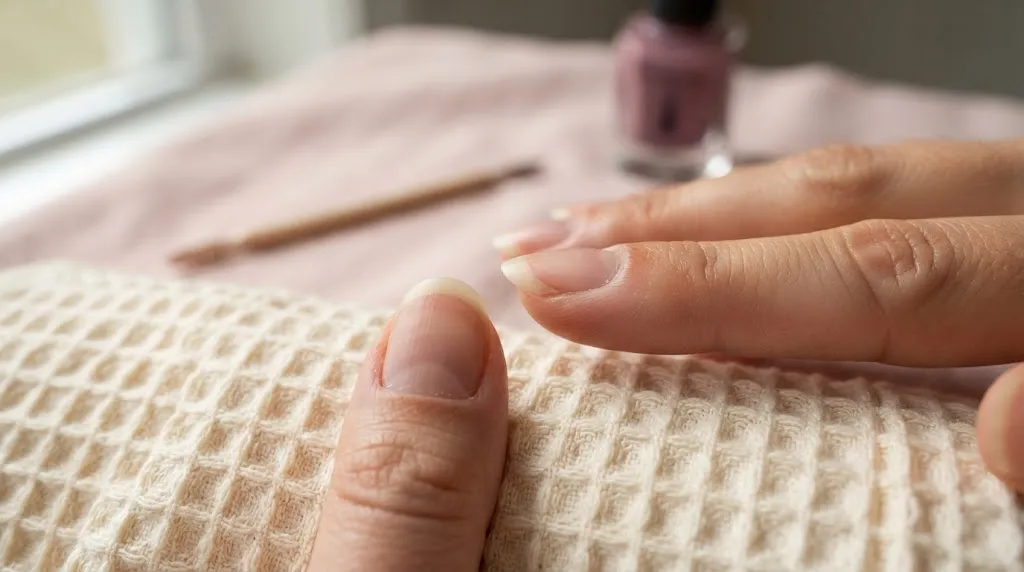
The free edge and nail bed are closely related, but they aren’t the same structure.
Your nail bed is the specialized living tissue beneath the attached portion of your nail plate. The free edge is part of the nail plate itself, extending beyond that attachment.
| Feature | Free Edge | Nail Bed |
|---|---|---|
| Structure | Hardened nail plate | Living tissue |
| Location | Beyond the attached nail bed | Under the attached nail plate |
| Typical appearance | White or translucent | Pinkish through the nail |
| Can you trim it? | Yes, carefully | No |
This distinction matters when you’re cutting your nails. Trimming the projecting free edge is normal nail maintenance. Cutting into attached tissue can cause injury.
What Are the Main Functions of the Nail’s Free Edge?
The free edge might seem like a small detail, but it contributes to several everyday activities.
1. Helps Protect Your Fingertips
Your nail plate provides a firm covering over the upper surface of your fingertip. A modest free edge can offer additional protection near the tip, although excessively long nails may be more likely to catch or break.
Keeping your free edge smooth reduces snagging on clothing, hair, and other surfaces.
2. Supports Fine Finger Movements
Your nails provide a firm surface that helps your fingertips work efficiently during precise movements.
For example, nails can help you pick up thin objects, separate small items, and perform delicate tasks.
You don’t need long nails for these benefits. Much of the functional support comes from the attached nail plate.
3. Allows Different Nail Shapes
Your free edge is the main area you reshape when creating a manicure.
With sufficient length, you can file your natural nails into square, oval, round, squoval, or almond shapes.
The shape you choose affects both appearance and how easily the corners or tips may catch on objects.
4. Creates the Classic French Manicure Look
The natural color difference between your nail bed and free edge inspired the familiar French manicure design.
Traditional French tips use a pale base and a contrasting white tip. Modern versions include colorful, metallic, pastel, and micro-French designs.
The painted tip doesn’t have to follow your natural free edge exactly, especially when you’re working with shorter nails.
How Does the Free Edge of a Nail Grow?
Your free edge doesn’t grow independently. Instead, it becomes longer as the entire nail plate advances forward from the nail matrix.
The nail matrix sits beneath the skin near the base of your nail. It produces the cells that eventually form the hardened nail plate.
As new cells are produced, the existing nail plate moves toward the fingertip.
Once part of the nail plate passes beyond the nail bed, it forms the visible free edge.
How Fast Does the Free Edge Grow?
Healthy adult fingernails typically grow about 3 millimeters per month, although the exact rate varies.
Toenails generally grow more slowly, often around 1 to 1.5 millimeters per month.
Several factors influence nail growth:
- Age: Growth rates often decrease as you get older.
- Individual biology: Your natural growth rate may differ from someone else’s.
- Health and nutrition: Certain illnesses and nutritional deficiencies can affect nail growth.
- Injury: Damage to the nail matrix can temporarily or permanently change nail production.
- Seasonal variation: Some people experience slightly faster fingernail growth during warmer months.
Remember that visible length also depends on breakage. Your nails may be growing normally even when frequent splitting prevents the free edge from getting longer.
How Long Should Your Nail’s Free Edge Be?
There’s no single ideal free-edge length for everyone.
The right length depends on your daily activities, nail strength, personal comfort, and preferred manicure style.
For practical everyday maintenance, a short free edge of approximately 1–2 millimeters may be comfortable for many people. This is a grooming preference, not a medical requirement.
If you type frequently, handle delicate objects, play sports, or work with your hands, shorter nails may be easier to manage.
Longer free edges offer more shaping possibilities but also create greater leverage when your nail catches on something.
Pro Tip
If your nails repeatedly split at the corners, try a short squoval shape. Gently rounding the sharp corners can reduce snagging while keeping the neat appearance of square nails.
How to File and Shape the Free Edge Safely
You don’t need professional nail training to maintain a neat free edge. A few careful techniques can make your natural manicure look more polished.
Choose the Right Nail File
For natural nails, a fine-grit file around 180–240 grit is commonly used for gentle shaping. A quality glass nail file is another useful option.
Avoid using very coarse files intended for artificial nail enhancements on thin or fragile natural nails.
If you’re building a basic nail-care kit, consider a glass nail file for natural nails.
Trim Excess Length First
If your free edge is much longer than your desired shape, carefully shorten it with clean nail clippers before filing.
Make small cuts instead of forcing a large clipper through a thick nail. This gives you more control and can help avoid accidental cracking.
Leave enough free edge to file the final shape without reaching the sensitive skin beneath the nail.
File With Light Pressure
Support your finger and gently guide the file along the free edge.
Use smooth, controlled strokes rather than aggressive sawing motions. Filing direction matters less than avoiding excessive pressure, friction, and repeated trauma.
Check both sides regularly to keep the shape balanced.
Smooth Rough Corners
Once you’ve created your desired shape, lightly smooth any rough spots along the edge.
Run the pad of another fingertip gently across the nail tip to check for snagging.
If you feel a sharp corner, refine it with a few additional file strokes instead of peeling or tearing away the rough section.
Finish With Moisturizer
Apply hand cream or cuticle oil after shaping your nails.
A simple jojoba-based cuticle oil pen can make moisturizing convenient, especially when you’re away from home.
Moisturizers help condition the surrounding skin and can improve the feel of dry nails. They won’t permanently repair an existing split in the nail plate.
What Nail Shapes Can You Create With the Free Edge?
Your natural nail length determines which shapes are realistic without extensions.
Round Nails
Round nails follow the natural curve of your fingertip. They’re particularly suitable when you prefer a short free edge and minimal maintenance.
This shape avoids pronounced corners that can catch on fabric.
Square Nails
Square nails feature a relatively straight free edge with defined corners.
They create a clean, structured appearance and work beautifully with classic French tips.
However, sharp corners can snag more easily, particularly when your natural nails are thin.
Squoval Nails
Squoval combines a straight-looking tip with softly rounded corners.
It’s a versatile choice when you want a tidy manicure without maintaining sharp square edges.
Oval Nails
Oval nails have gently tapered sides and a rounded tip.
You’ll generally need a little more free-edge length to create an attractive oval shape without filing too close to the nail bed.
Almond Nails
Almond nails taper toward a softly pointed tip.
They usually require more length than round or squoval nails. If your natural free edge is very short, you may need to grow it before achieving this shape.
What Problems Can Affect the Free Edge of a Nail?
Because your free edge is exposed, it’s often the first area to show signs of mechanical damage.
Peeling or Layering at the Nail Tip
If the free edge separates into thin layers, your nail plate may be experiencing lamellar splitting, also called onychoschizia.
Repeated wetting and drying, harsh solvents, mechanical trauma, and aggressive nail filing can contribute.
Keep your nails at a manageable length, moisturize regularly, and wear protective gloves during prolonged wet work.
Free Edge Breaking Easily
Long free edges are more likely to experience leverage when they strike or catch on objects.
If one nail repeatedly breaks, examine your filing technique and whether that finger receives more daily impact.
Persistent brittleness affecting multiple nails may deserve medical evaluation, particularly when it’s a new change.
Uneven or Jagged Nail Edges
Small chips, rough filing, or accidental snags can create an uneven free edge.
For a minor chip confined to the projecting nail tip, gently file the rough area until smooth.
Don’t pull a split backward toward the attached nail plate. That can extend the damage into sensitive tissue.
Free Edge Separating From the Nail Bed
Sometimes the white-looking area seems to move backward toward the cuticle. This may indicate onycholysis, a condition in which the nail plate separates from the nail bed.
Potential causes include trauma, certain nail products, skin conditions, and fungal infections.
This isn’t simply normal free-edge growth. If the attached portion is lifting, avoid digging beneath it or trying to glue it back down.
Warning
Seek medical advice if your nail develops unexplained lifting, persistent pain, swelling, discharge, green or dark discoloration, or a new dark streak. These changes shouldn’t be treated as ordinary free-edge problems without evaluation.
How to Keep Your Nail’s Free Edge Healthy
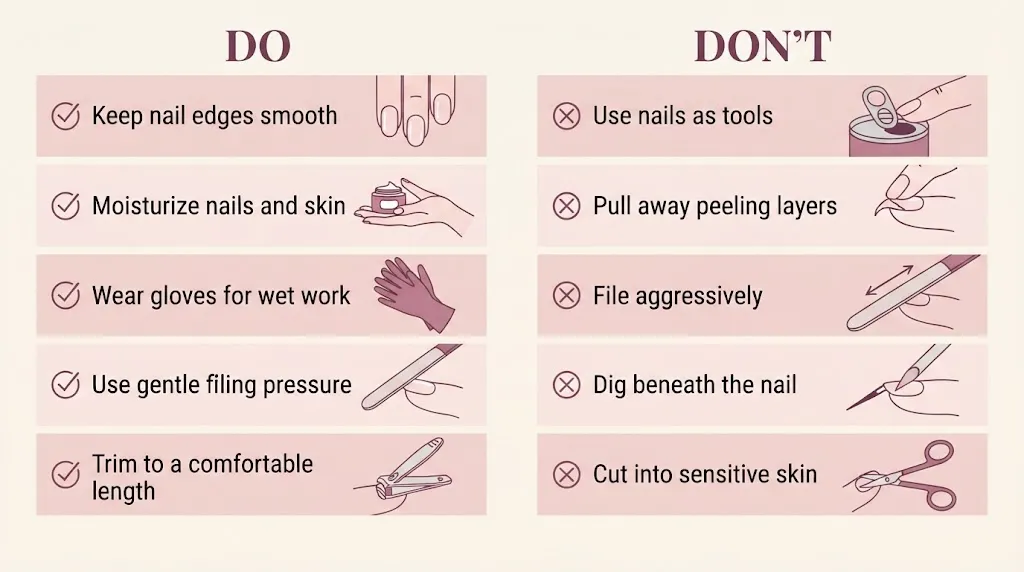
Maintaining a healthy-looking free edge doesn’t require an elaborate routine. Consistency and gentle handling matter more than expensive products.
Do
- Keep nail edges smooth and snag-free.
- Moisturize nails and surrounding skin regularly.
- Wear gloves for cleaning and prolonged wet work.
- Use gentle filing pressure.
- Trim nails to a comfortable length.
Don’t
- Use your nails to open cans or scrape surfaces.
- Pull away peeling nail layers.
- File aggressively into the sidewalls.
- Dig beneath the nail with sharp tools.
- Cut into sensitive skin under the nail tip.
Protect Your Nails During Household Tasks
Repeated contact with water and cleaning products can contribute to brittle, splitting nails.
Use appropriately fitted household gloves when washing dishes or handling cleaning solutions. Dry your hands thoroughly afterward and apply moisturizer.
Avoid Excessive Buffing
Buffing can temporarily smooth the nail surface, but repeated aggressive buffing removes nail-plate material.
Focus on shaping the free edge instead of thinning the top surface of your natural nails.
Use Nail Polish Thoughtfully
Regular nail polish can provide a decorative coating, but it won’t correct an underlying nail disorder.
If you enjoy painting your nails, use a base coat when appropriate and remove polish gently rather than scraping it away.
A gentle nail polish remover may be useful for your manicure routine. Remember that even acetone-free removers can dry your nails with frequent use.
Can You Strengthen the Free Edge of Your Nails?
You can reduce avoidable damage and improve how well your free edge holds up during everyday activities.
However, the visible nail plate is made from hardened, nonliving cells. Existing damage can’t be biologically healed in the same way as living skin.
Instead, damaged sections gradually grow outward and can eventually be trimmed away.
For nails that split easily, concentrate on preventing new trauma:
- Maintain a shorter free edge until the damaged portion grows out.
- Reduce repeated water and chemical exposure.
- Use a fine file to smooth small snags promptly.
- Moisturize after washing your hands.
- Take breaks from nail treatments that repeatedly cause thinning or peeling.
Some nail-strengthening products create a temporary protective coating, but they don’t permanently change the structure of the nail that has already grown.
If you choose a natural nail strengthening base coat, follow its directions and stop using it if you notice irritation or increased brittleness.
How Is the Free Edge Different in Artificial Nails?
Natural and artificial nails can both have a projecting tip, but their construction differs.
Your natural free edge is part of your own keratin nail plate.
With acrylic, gel, or other nail enhancements, a technician may build an artificial extension beyond your fingertip.
The visible extended tip can be shaped like a natural free edge, but the added material isn’t living nail tissue or naturally grown nail plate.
Long enhancements can create additional leverage on your natural nails, especially when they catch on objects.
For this reason, choosing a comfortable extension length and having products applied and removed correctly matters.
Common Mistakes When Caring for the Free Edge
Cutting the free edge too short
If trimming exposes or injures sensitive tissue, stop cutting and allow the nail to grow. Next time, leave a small comfortable margin instead of trying to remove every visible white section.
Using the wrong file
A very coarse file can be unnecessarily harsh on natural nails. Switch to a fine-grit or glass file and use light pressure to shape the tip.
Scraping underneath the nail
Sharp tools can injure the hyponychium and contribute to separation. Clean gently with water, mild soap, and a soft nail brush instead of digging beneath the nail.
Ignoring repeated splitting
A single chipped tip is common, but repeated unexplained splitting may need closer attention. Reduce mechanical stress and consult a healthcare professional if the problem persists or worsens.
Frequently Asked Questions About the Free Edge of a Nail
Q: Is the free edge of a nail living or dead?
A: The free edge consists of hardened, nonliving keratinized cells. That’s why you can trim the projecting nail without pain. However, the living skin underneath and around the nail can still be injured.
Q: Why is my nail’s free edge transparent instead of white?
A: Natural nail tips vary in thickness, translucency, and appearance. A transparent free edge can be completely normal. Sudden changes accompanied by lifting, discoloration, or discomfort should be assessed.
Q: Can you cut off the entire free edge of a nail?
A: You can trim the projecting free edge very short, but don’t cut into the hyponychium or attached nail tissue. Leaving a small margin often makes trimming more comfortable.
Q: Does the free edge grow from the nail bed?
A: No. The nail plate is primarily produced by the nail matrix near the nail’s base. As the nail plate moves forward beyond the nail bed, its projecting portion becomes the free edge.
Q: Why does my free edge keep peeling?
A: Repeated moisture exposure, nail trauma, harsh products, and aggressive filing can contribute to peeling nail layers. Gentle filing, moisturizing, and reducing exposure may help prevent further damage.
Final Thoughts: Understanding Your Nail’s Free Edge
The free edge of a nail is simply the portion of your nail plate that extends beyond the attached nail bed. Although it’s small, understanding it helps you trim more safely, choose flattering nail shapes, and recognize common signs of damage.
Keep your free edge smooth, protect it from unnecessary trauma, and choose a length that suits your everyday routine.
Love learning about nail care? Save this guide to your Pinterest nail-care board so you can revisit these tips before your next manicure.

Hi, I’m Jessica, the creator behind Unique Lash & Nails Katy.
I created this website for anyone who loves beautiful nails as much as I do. Here, I share trendy nail designs, seasonal manicure ideas, easy nail care tips, honest product recommendations, and step-by-step guides to help you create salon-worthy nails at home. Whether you’re looking for everyday inspiration or your next favorite nail trend, I hope you’ll find something you love.