What Age Do Nails Grow the Fastest? Nail Growth by Age Explained
Quick Answer
Nails appear to grow fastest during childhood and early adolescence, with dermatology literature commonly placing peak nail growth around ages 10 to 14. Growth generally remains fairly quick through young adulthood and gradually slows as you get older. Your exact rate can still vary because age is only one of several factors affecting nail growth.
You might remember trimming your nails constantly as a teenager, only to feel like they barely move now. That difference isn’t necessarily your imagination.
Your nails grow throughout your life, but they don’t always grow at exactly the same speed. Research on nail growth suggests that younger people generally grow nails more quickly than older adults, with early adolescence often identified as the fastest period.
That doesn’t mean every 12-year-old will outgrow every 25-year-old, though. Nail growth varies from person to person, which is why it’s more useful to think of age as one influence rather than a strict timer controlling your manicure.


At What Age Do Your Nails Usually Grow the Fastest?
The clearest answer is around ages 10 to 14. Reviews of nail development in children describe this early-adolescent period as the stage when nail growth reaches its highest rate before becoming more similar to the rate seen in young adults.
After adolescence, your nails continue growing normally. The change isn’t like flipping a switch on your 15th birthday. Instead, growth tends to shift gradually over the years.
Studies of young adults have measured average fingernail growth at roughly 3 to 3.5 millimeters per month. Researchers have also observed a general relationship between younger age and faster nail growth, although the differences between nearby adult age groups can be small.
This is why someone who is 22 and someone who is 35 may notice very similar growth, while the difference between younger adulthood and much later adulthood can be more noticeable.
Why Does Nail Growth Change With Age?
Your visible nail plate is produced in an area beneath the skin called the nail matrix. New nail cells form there, become filled with keratin, and gradually push the older nail forward.
When you’re young, cell production and tissue renewal are generally more active. During childhood and adolescence, your body is also going through rapid physical development, so it’s not surprising that tissues such as nails can grow relatively quickly.
As you age, that cellular activity becomes less efficient. Research comparing younger and older adults has found slower nail growth in older groups, and long-term observations have also shown that nail growth tends to decline progressively with age.
That slowing is usually gradual. You probably won’t notice a dramatic difference from one birthday to the next.
How Does Nail Growth Change at Different Ages?
 Save
SaveThere isn’t one universal chart that predicts exactly how many millimeters your nails will grow at every age. Genetics, health, finger, season, habits, and individual biology create too much variation for that.
Still, the overall pattern looks something like this.
Childhood
Children’s nails grow actively as their bodies develop. Nail plates are smaller and thinner in early childhood, but their growth rate becomes increasingly similar to that of young adults.
By later childhood, nail growth can be surprisingly quick, which is one reason children’s fingernails often seem to need frequent trimming.
Ages 10 to 14
This is the age range most commonly associated with the fastest nail growth.
Early adolescence is a period of rapid physical change, and nail-producing cells are highly active. That doesn’t mean you should expect dramatic visible length every few days, but the underlying growth rate tends to be near its natural peak.
Late Teens and 20s
Nails still grow quickly during your late teens and twenties. In fact, many nail-growth studies use healthy young adults because their nail growth is relatively steady and easy to measure.
If you’re in your twenties and feel like your nails aren’t growing, breakage may be hiding the new length. A nail that grows 3 millimeters but loses 3 millimeters from splitting or peeling will appear to have made no progress.
If that’s happening, this guide on how to make your nails healthy again can help you focus on protecting the nail that’s already growing.
30s and 40s
Your nails don’t suddenly become slow once you reach 30. Research involving adults between roughly 18 and 40 has found surprisingly similar average growth across age groups when measurements are taken over relatively short periods.
That means lifestyle, nail damage, nutrition, and ordinary person-to-person differences can sometimes matter more than whether you’re 29 or 39.
50s and Beyond
The effect of aging tends to become easier to notice later in adulthood. Nail production may gradually slow, and the nails themselves can become drier, more ridged, or more prone to breaking in some people.
A slower rate doesn’t automatically mean your nails are unhealthy. Aging naturally affects many tissues in your body, including the structures responsible for nail production.
How Fast Do Fingernails Normally Grow?
Healthy fingernails typically grow around 3 to 3.5 millimeters per month, although your personal rate may be faster or slower.
That works out to roughly one tenth of a millimeter per day. At that pace, replacing an entire fingernail takes several months rather than a few weeks.
Toenails are much slower. Research measuring both types has found fingernails growing at more than twice the rate of toenails in some groups.
This difference explains why a chipped manicure seems to reveal new growth quickly on your hands while a damaged toenail can feel like it’s taking forever to grow out.
Do All Your Fingernails Grow at the Same Speed?
No. Even on the same hand, individual nails can grow at slightly different rates.
Studies have repeatedly found differences between fingers. The little fingernail is often among the slower-growing nails, while the thumb, index, or middle fingernails may grow more quickly depending on the person and study.
This means you don’t need to panic if one nail always seems shorter than the others. Part of the difference may come from growth speed, and part may come from how much wear that finger receives during everyday activities.
Why Do My Nails Seem to Grow Slower Now?
Age may be part of the explanation, but don’t automatically blame your birthday.
If your nails suddenly seem shorter, first ask whether they’re actually growing more slowly or simply breaking more often.
Frequent handwashing, cleaning products, peeling gel polish, picking at enhancements, rough filing, and using your nails as tools can all damage the free edge. You may still be producing new nail normally while losing the same amount from the tip.
That distinction matters because you can’t control your age, but you can change many of the habits that prevent you from keeping your natural length.
A simple nail care routine can make that difference much easier to see.
What Else Affects How Fast Your Nails Grow?
Your age is only one piece of the puzzle. Several other factors can influence how quickly your nails appear to grow.
Your overall health
Your nail matrix depends on normal body functions to produce new nail. Illnesses, major physical stress, nutritional deficiencies, and some medications can affect nail appearance or growth.
That’s why a sudden change affecting several nails deserves more attention than naturally slow growth you’ve had for years.
Nutrition
Your nail plate is made largely from keratin, a protein. Your body therefore needs adequate calories, protein, vitamins, and minerals to produce normal tissue.
You don’t need a special “nail diet,” and eating extra biotin won’t automatically make healthy nails race forward. A balanced diet is more useful than chasing one miracle nutrient.
If you’re curious about nutrition, see what drinks can support healthy nail growth without expecting them to override your natural growth rate.
Breakage
This is one of the biggest reasons nails can look like they aren’t growing.
Imagine your nails grow 3 millimeters this month, but repeated peeling and splitting remove 2 or 3 millimeters from the tips. Biologically, your nails grew. Visually, almost nothing changed.
Protecting the free edge is therefore just as important as worrying about the growth happening underneath your cuticle.
Your individual biology
Two healthy women of the same age can have noticeably different nail growth. Genetics, finger size, activity, circulation, everyday use, and other biological differences all contribute.
Use your own normal growth pattern as the better comparison instead of judging your nails against someone else’s manicure photos.
Can You Make Your Nails Grow Faster at Any Age?
You have limited control over your natural nail-growth speed. There’s no oil, polish, drink, or home remedy proven to suddenly double the rate at which a healthy nail matrix produces nail.
What you can do is create conditions that support normal growth and help you keep the length you’ve already produced.
That difference is important.
If your nail grows normally but keeps snapping, preventing the snapping can make your nails look as though they’re growing much faster because you’re finally retaining the new length.
Do
- +Moisturize your nails and surrounding skin regularly
- +File snags before they become larger tears
- +Eat enough protein and a varied, balanced diet
Don’t
- −Peel gel, dip, or acrylic products from the nail
- −Use your nails to pry, scrape, or open objects
- −Expect supplements to override your natural growth rate
Pro Tip
Take a photo of your bare nails every four weeks using the same hand position and lighting. Monthly photos are much more useful for judging growth than checking your nails every morning.
What Products Help You Keep the Length Your Nails Grow?
You don’t need a shelf full of nail-growth treatments. A few basic products can help prevent dryness and snagging, which makes it easier to retain your natural length.
A cuticle oil pen is convenient if frequent handwashing leaves the skin around your nails dry. It doesn’t accelerate the nail matrix, but regular moisturizing can help the nail area stay comfortable and flexible.
A glass nail file is useful for smoothing tiny snags before they turn into larger breaks. The goal is preservation, not faster biological growth.
If your whole hands feel dry, a moisturizing hand cream can be easier to use consistently than applying several separate treatments.
As an Amazon Associate, we earn from qualifying purchases.
If you’re wondering whether leaving your nails bare would help, this guide explains whether nails are healthier without polish and when a manicure break actually makes sense.
When Is Slow Nail Growth Worth Paying Attention To?
 Save
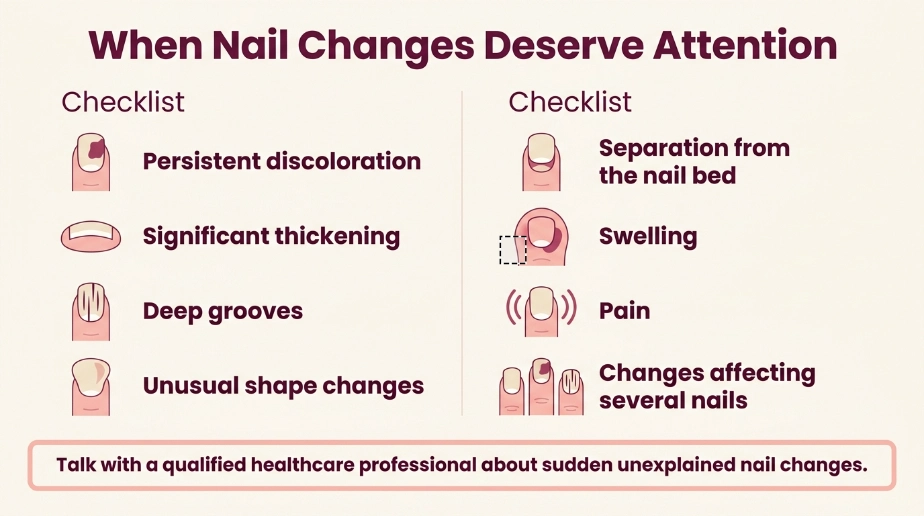
SaveGradually slower growth as you get older is usually different from a sudden unexplained nail change.
Warning
Talk with a qualified healthcare professional if your nails suddenly change growth pattern along with persistent discoloration, significant thickening, deep grooves, unusual shape changes, separation from the nail bed, swelling, pain, or changes affecting several nails. Nail changes can have many causes, so don’t assume age or a vitamin deficiency is responsible.
If you’re unsure what deserves attention, compare your nails with these common signs of unhealthy nails.
Frequently Asked Questions About Nail Growth and Age
Q: What age do fingernails grow the fastest?
A: Nail growth appears to be fastest in early adolescence, commonly around ages 10 to 14. Growth remains relatively fast through young adulthood and generally slows gradually with aging.
Q: Do nails grow slower after age 30?
A: Not necessarily in a dramatic way. Nail growth tends to slow with age overall, but studies of adults between about 18 and 40 have found fairly similar average rates. The change becomes more meaningful across larger age differences.
Q: How fast should healthy fingernails grow?
A: A common average is roughly 3 to 3.5 millimeters per month, but there is plenty of normal variation. Different fingers on the same hand can even grow at slightly different speeds.
Q: Why did my nails grow faster when I was younger?
A: Nail-producing tissue is generally more active when you’re younger. Cell renewal gradually becomes less efficient with aging, so nail growth can slow over time even when your nails remain healthy.
Q: Can biotin make older nails grow as fast as teenage nails?
A: You shouldn’t expect biotin to reverse normal age-related differences in nail growth. Biotin is an essential nutrient, but taking extra when you aren’t deficient hasn’t been proven to make healthy nails grow at dramatically faster rates.
So, When Do Nails Grow the Fastest?
Your nails generally grow fastest when you’re young, with ages 10 to 14 standing out as the most commonly reported peak period. Growth remains active through your teens and young adulthood before gradually slowing as you get older.
Don’t judge nail health by speed alone. If your nails are growing slowly but look normal, that may simply be your natural rate. Focus on protecting them from breakage, moisturizing regularly, eating a balanced diet, and watching for sudden changes rather than chasing products that promise overnight growth.
Save this guide to Pinterest so you can come back whenever you wonder whether your nail growth is normal for your age.

Hi, I’m Jessica, the creator behind Unique Lash & Nails Katy.
I created this website for anyone who loves beautiful nails as much as I do. Here, I share trendy nail designs, seasonal manicure ideas, easy nail care tips, honest product recommendations, and step-by-step guides to help you create salon-worthy nails at home. Whether you’re looking for everyday inspiration or your next favorite nail trend, I hope you’ll find something you love.