What Happens After a Nail Turns Black? Healing Timeline and Warning Signs
Quick Answer
After an injury, a nail usually turns black because blood has collected beneath the nail plate. The discoloration should slowly move toward the tip as your nail grows. The nail may stay attached, loosen, or fall off before a new one replaces it. Seek medical care if you have severe pain, an open wound, infection signs, or unexplained dark pigment that does not grow out.
A black nail can look alarming, especially when you don’t remember injuring it. In many cases, the dark area is simply a bruise beneath the nail, known as a subungual hematoma. Your body gradually clears the injury while the stained portion grows toward the free edge.
However, not every black nail is a harmless bruise. This guide explains what normally happens next, how to protect the nail, and which changes deserve a medical examination.
Medical Note
This article provides general information, not a diagnosis. A clinician or dermatologist should examine a black nail that appeared without an obvious injury, changes shape or color, spreads onto nearby skin, or fails to move outward as the nail grows.


Why Does a Nail Turn Black?
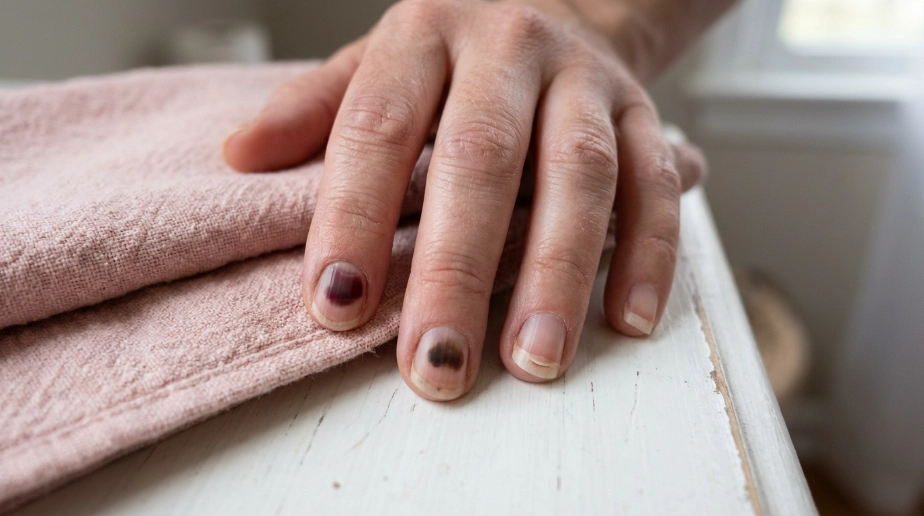
The most common cause is bleeding under the hard nail plate. A bumped finger, stubbed toe, dropped object, or slammed door can break tiny blood vessels in the nail bed. Because the nail plate leaves little room for swelling, the trapped blood may create pressure, throbbing, and a dark red, purple, brown, or black patch.
You don’t always need one dramatic accident. Repeated pressure can produce the same result. Runners, hikers, dancers, and people wearing tight shoes may develop a black toenail when the toe repeatedly hits the front of the shoe.
Other possible causes include:
- Fungal infection: The nail may become dark, yellow-brown, thick, brittle, crumbly, or distorted.
- Nail-product staining: Dark polish can leave surface staining, especially when you skip base coat, although this usually looks different from blood trapped beneath the nail.
- Medication or health-related pigment changes: Some medicines and medical conditions can alter nail color, sometimes across several nails.
- Subungual melanoma: This uncommon but serious skin cancer can develop beneath or around a fingernail or toenail.
If you want to compare the discoloration with other visible nail changes, this guide to unhealthy nail colors and what they may mean offers a useful overview.
What Usually Happens After an Injured Nail Turns Black?
 Save
Save1. Pain and pressure settle
During the first few hours, the nail may throb because blood is trapped in a tight space. Mild pain often improves over the next several days. A large bruise, fracture, cut, or deeply damaged nail bed can hurt more and take longer to settle.
Worsening pressure is a reason to contact urgent care. A healthcare professional may be able to drain fresh trapped blood through a procedure called nail trephination. Never burn, drill, or puncture the nail yourself. A homemade opening can damage the nail bed and introduce bacteria.
2. The color changes
The bruise may begin red or purple and then darken to brown or black as the blood ages. Later, the discoloration can look lighter or more fragmented. That color change doesn’t mean dirt is trapped under the nail.
With a typical injury, the dark area gradually travels toward the tip along with the growing nail. You may notice a clear strip of healthy new nail appearing near the cuticle. That movement is one of the most reassuring signs that the mark is an old bruise growing out.
3. The nail may lift
Blood and tissue damage can separate part of the nail plate from the bed beneath it. The lifted area may look pale, white, or hollow around the black bruise. It may also catch on hair, socks, or clothing.
A small bruise may grow out without loosening the nail. After a stronger injury, part or all of the old nail can detach. You may not notice this immediately; loosening sometimes becomes obvious days or weeks later.
4. A new nail begins growing underneath
The nail-producing tissue at the base continues making keratin if the growth area wasn’t severely damaged. The replacement nail slowly pushes forward beneath or behind the injured plate.
New growth may initially have grooves, ridges, or an uneven surface. Minor irregularities often improve as later growth replaces the damaged section. A deep injury involving the nail matrix can cause a lasting split, ridge, or altered shape, which is why a crushed nail deserves professional assessment.
Will a Black Nail Always Fall Off?
No. Whether it falls off depends on the amount of blood, the force of the injury, and how much of the nail separated from its bed. A small dark spot can remain firmly attached and simply disappear when you trim away the grown-out portion.
A nail is more likely to loosen when most of its surface is bruised, the nail bed is badly injured, or the plate has already lifted near the base. Even then, don’t pull it off. An attached portion acts as a natural cover over sensitive tissue.
Let the loose section detach at its own pace unless a clinician tells you otherwise. You can carefully trim only an edge that is completely free, using clean clippers. Stop if trimming pulls on attached tissue or causes pain.
If the damage leaves you wondering whether the nail can return to normal, see this explanation of how a damaged nail regrows.
Pro Tip
If an edge starts catching, cover it lightly with a breathable bandage during chores or exercise. Remove the covering when you can protect the nail without it, because constant dampness can soften the surrounding skin.
How Long Does a Black Nail Take to Grow Out?
Nail bruises don’t vanish as quickly as bruises on your skin. The discolored part is locked beneath or within the plate, so you normally wait for nail growth to carry it to the tip.
A fingernail may take roughly four to six months to replace itself fully. A toenail grows more slowly and can take about 12 to 18 months. The exact time depends on the nail, your health, your age, and whether the growth area was damaged.
A mark near the tip will be trimmed away sooner than one sitting close to the cuticle. Photographing the nail every two to four weeks in similar lighting can help you see whether the dark area is moving outward. Don’t rely on daily checks; nail growth is too slow to make the movement obvious from one day to the next.
For more detail about realistic regrowth rates, read how fast fingernails and toenails grow.
How Should You Care for a Newly Blackened Nail?
 Save
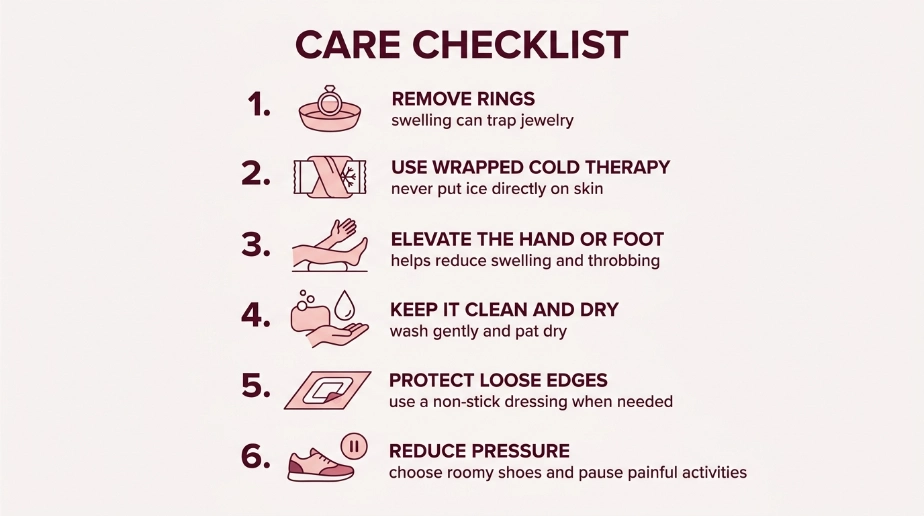
SaveIf the injury is minor, the nail remains in place, and you can move the finger or toe normally, simple protection may be enough.
- Remove rings immediately. Finger swelling can make jewelry difficult or dangerous to remove later.
- Use wrapped cold therapy. Apply a cold pack wrapped in a thin towel for short intervals. Never place ice directly on your skin.
- Elevate the area. Keeping the injured hand or foot raised can reduce throbbing and swelling.
- Keep the nail clean and dry. Wash gently with soap and water, then pat the area dry.
- Protect loose edges. Use a non-stick dressing if the nail or nearby skin is open, following a clinician’s instructions for wound care.
- Reduce pressure. Choose roomy shoes and pause activities that make a black toenail hurt.
Helpful First-Aid Item
Reusable Small Cold Pack
A flexible cold pack is easier to position around a sore finger or toe than a rigid ice block; always wrap it before use.
As an Amazon Associate, we earn from qualifying purchases.
Helpful Protection
Sterile Non-Stick Gauze Pads
A non-stick pad can protect broken skin without bonding to the tender nail bed as ordinary cotton sometimes does.
As an Amazon Associate, we earn from qualifying purchases.
Should You Cover a Black Nail With Polish or Acrylic?
It’s tempting to hide the color, but an opaque manicure makes the nail harder to monitor. Skip gel, dip powder, press-ons, and acrylic enhancements while the nail is painful, lifting, draining, or surrounded by broken skin.
Enhancements can place extra pressure on an unstable plate. Removal may pull at the damaged area, while trapped moisture can make it harder to notice infection. Nail glue should never be applied to an open wound or exposed nail bed.
Once the skin is intact, the nail is comfortable, and a healthcare professional hasn’t advised otherwise, regular polish may be possible. Still, leaving the nail bare makes it easier to track whether the mark grows outward. If you do polish it, remove the color periodically and inspect the entire nail in good light.
Do
- +Keep the nail short and smooth
- +Watch for clear growth near the cuticle
- +Wear shoes with enough toe room
Don’t
- −Puncture or drain it at home
- −Rip away an attached nail
- −Hide unexplained pigment with polish
When Does a Black Nail Need Medical Attention?
Get prompt medical advice after a forceful injury if the pain is severe or increasing, the finger or toe looks bent, you cannot move it normally, the nail is split at the base, or there is a deep cut. These signs can accompany a fracture or nail-bed injury.
You should also seek care if:
- Bleeding won’t stop with gentle pressure.
- The nail is largely detached or trapped outside its normal position.
- Numbness, unusual paleness, or loss of sensation develops.
- Redness, warmth, swelling, or pain gets worse instead of better.
- Pus, cloudy drainage, a bad smell, or fever appears.
- You have diabetes, poor circulation, a weakened immune system, or take blood-thinning medicine.
If the injury is fresh and pressure beneath the nail is causing intense throbbing, don’t wait several days to ask about treatment. Professional drainage is most useful while the blood is still fluid, and a clinician must first decide whether drainage is appropriate.
Warning
Book a medical or dermatology examination for dark nail pigment with no known injury, a band that widens or changes, pigment extending onto the cuticle or surrounding skin, nail splitting, a new lump, repeated bleeding, or a mark that stays near the base instead of growing toward the tip.
How Can You Tell a Bruise From a Concerning Dark Streak?
You can’t reliably diagnose every dark nail by appearance alone. Still, the history and pattern provide useful clues.
An injury-related bruise often appears suddenly after impact or repeated shoe pressure. It commonly resembles a blotch or pool of color. Over the following weeks, its position should advance toward the tip as clear nail emerges behind it.
A potentially concerning pigment change may appear without trauma and develop gradually. It may look like a brown or black lengthwise band extending from the base toward the tip. Warning features include a band that becomes wider or less even, several colors within it, nail destruction, or color spreading onto nearby skin.
These clues are not a home diagnostic test. A bruise can sometimes look streaky, and melanoma doesn’t always match a textbook image. Don’t assume that a painless mark is harmless. Subungual melanoma can be painless, especially early on.
A dermatologist can examine the nail with magnification, compare its pattern over time, and arrange testing if necessary. Early assessment is far safer than waiting for an unexplained mark to disappear.
How Can You Protect the New Nail as It Grows?
Keep the damaged nail neatly trimmed, but don’t cut into attached or tender areas. File sharp corners in one direction so they don’t catch. When new nail becomes exposed, handle it gently because it may feel thin and sensitive at first.
Once all broken skin has healed, a small amount of plain cuticle oil or fragrance-free moisturizer can soften dry surrounding skin. Oil won’t make the bruise disappear or repair a damaged nail matrix, but it can reduce cracking around the nail folds.
Optional Aftercare
Fragrance-Free Jojoba Cuticle Oil
After the skin has fully closed, a simple oil can condition dry nail folds without hiding the color you need to monitor.
As an Amazon Associate, we earn from qualifying purchases.
For a toenail, check the fit of your footwear before returning to running or long walks. You should have space in front of your longest toe, and your heel should not slide enough to drive the toes forward. Lace shoes securely and replace socks that bunch around the toe box.
Continue watching the new growth. If it becomes unusually thick, crumbly, painful, or repeatedly separates, schedule an examination rather than repeatedly buffing or covering it. You can also follow a simple nail care routine once the injury has healed.
Frequently Asked Questions About Black Nails
Q: How long will a black nail stay black?
A: The dark area usually remains until nail growth carries it to the tip. A fingernail may need several months to replace itself, while a toenail can take 12 to 18 months.
Q: Does a black nail mean the nail is dead?
A: Not necessarily. The black color is often old blood beneath the nail plate. The growth tissue may still be healthy and capable of producing a replacement nail.
Q: Should you remove a black nail?
A: Don’t pull it off yourself. Keep attached nail in place and ask a healthcare professional about a badly torn, crushed, or displaced nail. You may trim only a completely detached edge if doing so causes no pulling or pain.
Q: Can a black nail heal without falling off?
A: Yes. A small bruise can remain attached and move toward the tip with normal nail growth. You eventually remove the stained area during ordinary trimming.
Q: When should you worry about a black toenail?
A: Arrange an examination if there was no clear injury, the pigment spreads or widens, it reaches surrounding skin, or it doesn’t move toward the tip. Severe pain, deformity, pus, increasing redness, or fever also needs prompt care.
What Is the Most Important Change to Watch?
After a straightforward injury, a black nail should become less painful and the dark area should move outward as new nail grows. Protect it, don’t puncture it, and allow any loose portion to detach naturally.
If the mark appeared without an injury, remains fixed near the cuticle, or develops warning signs, let a healthcare professional identify the cause. Save this guide on Pinterest so you’ll have the healing timeline and red flags when you need them.

Hi, I’m Jessica, the creator behind Unique Lash & Nails Katy.
I created this website for anyone who loves beautiful nails as much as I do. Here, I share trendy nail designs, seasonal manicure ideas, easy nail care tips, honest product recommendations, and step-by-step guides to help you create salon-worthy nails at home. Whether you’re looking for everyday inspiration or your next favorite nail trend, I hope you’ll find something you love.