Nail Growth Cycle: How Fast Nails Grow & What Helps
Quick Answer
Your nails grow continuously from the matrix under your cuticle, harden as they move across the nail bed, and are slowly replaced at the free edge. A full fingernail usually takes about four to six months to replace, while a toenail can take twelve to eighteen months. Growth speed varies by finger, age, circulation, and daily habits, so patience matters more than any quick fix.
Here is a fact that surprises most nail lovers: your nails never really take a break. Unlike hair, which sheds and regrows in clear cycles, your nails keep forming new cells day after day. That steady process is why a break near your cuticle can take months to grow out, even when you are doing everything right. In this guide, you will learn how the nail growth cycle works, how fast your nails should grow, what slows growth down, and which simple habits actually support stronger nails.


What Is the Nail Growth Cycle, Really?
When people say nail growth cycle, they usually mean the full journey from new nail cell to old tip. New cells form in the matrix, which sits just under the skin at the base of your nail. Those cells then fill with keratin, the tough protein that gives nails their strength, and flatten as they are pushed forward. Over time, the older part of your nail reaches the free edge, where it wears away, breaks, or gets trimmed.
That journey matters because it explains your waiting time. Damage at the base does not disappear overnight, since the damaged section has to travel the whole length of your nail before you can trim it away. For the same reason, a healthy habit you start today may not show up at your nail tips for several weeks. Your matrix is doing the work now, but your tips are still showing older growth.
Unlike hair, your nails do not have a separate shedding phase. Instead, growth is continuous, with short pauses after injury or illness and faster or slower periods linked to circulation and age. Think of it less like a loop that restarts and more like a slow conveyor belt that never fully stops.
The 4 Stages Your Nail Goes Through
Every nail you see today passed through the same four stages. Knowing them helps you spot where a problem started, and why some fixes take longer than others.
1. New Cells Form in the Matrix
Growth begins in the matrix, a pocket of living cells hidden under your cuticle and the pale half-moon you may see near the base. Those cells divide constantly and push older cells forward, which is the engine behind all nail growth. Because the matrix is living tissue, it is also the most vulnerable part of your nail. A hard knock, aggressive cuticle cutting, or repeated pressure here can leave a ridge or weak spot that travels forward for months.
2. Cells Harden Into Keratin
As new cells move forward, they fill with keratin and lose their nucleus, turning from soft living cells into hard, flat nail plate. This hardening stage is what turns a fragile new cell into the smooth surface you paint and file. Without enough moisture balance, however, that plate can become brittle. Too much water makes nails soft and bendy, while too little moisture leaves them dry and prone to splitting, so balance is the goal.
3. The Nail Travels Across the Nail Bed
Next, the hardened plate glides forward over the nail bed, the pink skin beneath it that supplies blood and nutrients. A healthy nail bed helps the plate stay attached, smooth, and evenly coloured. Lifting, peeling, or separation often starts here, especially after trauma, harsh removal, or long periods with water trapped under polish or extensions. Protecting this bond is one reason gentle removal matters so much.
4. The Free Edge Wears Away and Is Replaced
Finally, the oldest nail reaches the free edge beyond your fingertip. Daily typing, washing, and contact with surfaces slowly wear this edge down, which is normal. Trimming and filing simply speed up that natural replacement. Once you cut the old tip away, the newer nail behind it takes its place, and the conveyor belt keeps moving.
How Fast Do Nails Actually Grow?
On average, fingernails grow about 3 to 3.5 millimetres per month, while toenails grow much more slowly at around 1.5 millimetres per month. Those are typical averages, not promises for every person, and your own rate can sit a little above or below them without anything being wrong. Your middle finger usually grows fastest, since it tends to get the most use and blood flow, while your little finger and thumb often grow more slowly.
Several everyday factors explain the gap between hands and feet. Fingernails get more movement, warmth, and circulation than toenails, which spend much of the day inside shoes. Younger adults also tend to grow nails faster than older adults, and many people notice slightly faster growth in warmer months. Your dominant hand may grow a little faster too, simply because you use it more.
Growth can also change over time for reasons that have nothing to do with your nail routine. Pregnancy, illness, a change in activity, or a period of poor circulation can all shift your rate for a while. That is why comparing your nails to someone else’s growth, or even to your own growth last year, can be misleading.
What Speeds Up or Slows Down Your Nail Growth?
Your matrix needs steady blood flow, gentle protection, and time. Anything that cuts off circulation, damages the matrix, or repeatedly weakens the plate will slow your visible progress, even if new cells are still forming underneath.
Habits that slow growth include biting, picking, peeling polish off, and forcing extensions off, because each one can lift the plate or injure the bed. Hot water and harsh chemicals can weaken your nails too, since they strip natural oils and make the plate swell and shrink. Repeated swelling weakens the layers over time, which leads to peeling that looks like slow growth but is really breakage.
On the supportive side, regular moisturising helps because hydrated nails bend instead of snapping. Wearing gloves for cleaning, filing in one direction instead of sawing back and forth, and keeping nails at a practical length all reduce breakage. Those steps do not force your matrix to work faster, but they let the growth you already have survive long enough to reach a length you can see.
Nutrition plays a background role as well. Your body builds keratin from the nutrients you eat, so a very restricted diet can show up in weaker nails over time. Still, no single food or supplement can override genetics, age, or circulation, and sudden nail changes deserve a professional opinion rather than a shopping spree.
How Long Does It Take to Grow a Whole New Nail?
For most people, a full fingernail replacement takes about four to six months from matrix to free edge. Toenails move far more slowly, so a full replacement often takes twelve to eighteen months. A small ridge near your cuticle may take eight to twelve weeks to reach the middle of a fingernail, which explains why patience is part of every nail recovery plan.
Use that timeline to set realistic expectations after a break or a bad manicure. If you damaged the base of your nail in January, you may still be trimming that weak spot away in spring. That does not mean your care routine failed. It means the damaged section simply needed time to travel out, and your newer growth behind it may already be stronger.
Signs Your Growth Cycle Is Off Track
Slow growth alone is rarely a warning sign, since normal rates vary widely. Watch instead for sudden changes that do not match your usual pattern, such as a nail that stops growing, lifts from the bed, or changes colour or shape without an obvious injury. Deep grooves across several nails, persistent pain, swelling around the cuticle, or a dark streak that does not grow out all deserve prompt professional advice.
Peeling, splitting, and frequent breakage are more often habit or damage clues than growth clues. If your nails keep breaking at the same short length, your growth may be fine, but your tips are not surviving daily wear. Shorter nails, gentler filing, and regular moisture usually help you keep more of the length you grow.
Warning
Do not cut, dig at, or try to treat a painful, swollen, or discoloured nail at home. Pushing tools under the cuticle or forcing a lifted nail off can injure the matrix and make recovery much longer. Get professional advice first, especially if the change appeared suddenly or affects several nails.
How to Support Healthy Nail Growth
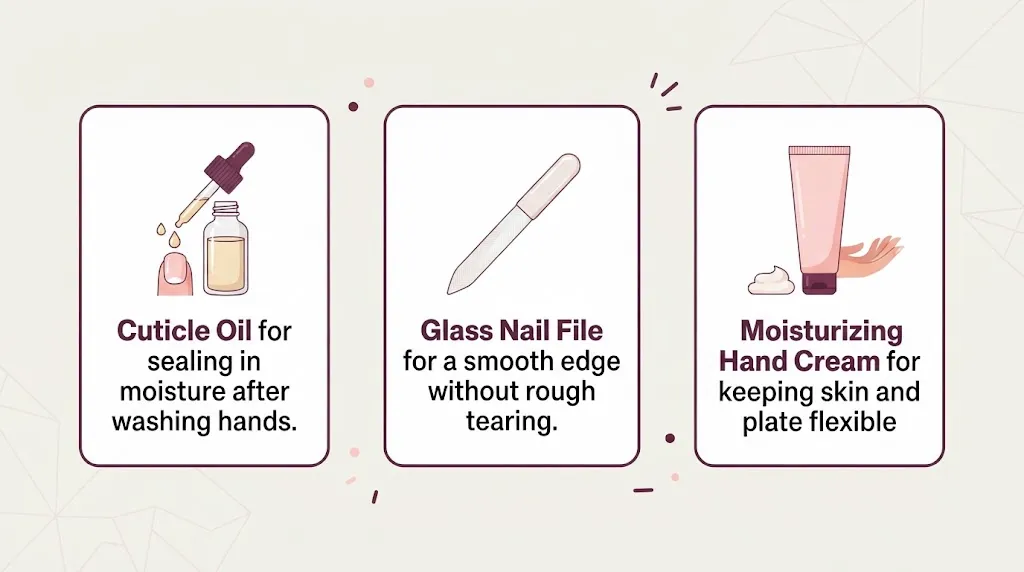
Your best routine is simple, gentle, and consistent. Start by moisturising your nails and cuticles daily, since flexible nails resist snapping better than dry, rigid ones. An cuticle oil for nails can help seal in moisture after washing your hands, especially in cold or dry weather. Follow it with hand cream, and reapply after cleaning or long handwashing sessions.
Keep your filing gentle and your length realistic for your lifestyle. A glass nail file gives you a smooth edge without the rough tearing that can start a split. File in one direction, round sharp corners slightly, and trim a little at a time rather than cutting nails very short in one go.
Give your nails regular breaks from polish and extensions, too. Taking a break from nail polish can help your nails recover from removal stress and trapped moisture, and it lets you see changes in colour or texture more clearly. When you do wear polish, remove it gently instead of peeling it off, and avoid scraping the plate clean.
Do
- +Moisturise nails and cuticles daily, especially after washing your hands.
- +Wear gloves for cleaning, gardening, and long dishwashing sessions.
- +Keep nails at a length your daily routine can actually protect.
Don’t
- −Peel polish or extensions off, since lifting damages the plate and bed.
- −Cut cuticles aggressively or push tools deep under the nail base.
- −Saw back and forth with a coarse file, which can start splits at the edge.
Pro Tip
Photograph your nails once a month in the same light, with a ruler beside one hand. Small monthly changes are hard to notice day to day, but a photo series shows whether your growth and breakage are improving over a full replacement cycle.
If you love a polished look while you wait, gentler options can reduce stress on the plate. Learning how to shine nails without polish gives you a groomed finish without removal chemicals, while a Japanese manicure without polish focuses on buffing and nourishment rather than colour. Either approach lets you check your nail surface honestly between manicures.
Nail Growth Myths That Slow You Down
One common myth says nails need to breathe, so polish should be left off for weeks at a time. Nails do not breathe like skin, since the plate is dead keratin and oxygen reaches the matrix through blood, not air. A short polish break still helps because it reduces removal damage and trapped moisture, not because your nails are gasping for air.
Another myth claims cutting nails makes them grow faster. Trimming only removes the old tip, so it cannot speed up cell production in the matrix. What trimming can do is prevent a long, weak tip from snapping back into the nail bed, which makes your growth look more successful. Similarly, extra coats of polish do not strengthen the nail underneath, and thick layers can trap moisture and make removal harder.
Editorial Picks That Support Your Routine
Products cannot rewrite your growth cycle, but a few simple tools make gentle care easier to stick with. The picks below are editorial picks for this topic, chosen for everyday nail care, not tested results.
Recommended Product — Editorial Pick
Cuticle Oil for Daily Nail Moisture
A small bottle by your sink makes daily cuticle care easy, and oiled nails tend to bend rather than split during everyday tasks.
As an Amazon Associate, we earn from qualifying purchases.
Pair that oil with a gentle file and a rich hand cream, such as a moisturizing hand cream for nails, to keep both skin and plate flexible. Those three basics cover most daily care without adding harsh treatments that could undo your progress.
Frequently Asked Questions
Q: How long does the nail growth cycle take?
A: A full fingernail usually takes four to six months to replace, while a toenail takes twelve to eighteen months. Your exact time depends on the nail, your age, and your circulation.
Q: Do nails grow in phases like hair?
A: No, nails grow continuously rather than shedding in a hair-like cycle. New cells form in the matrix, harden into keratin, travel across the nail bed, and wear away at the free edge.
Q: Why do my fingernails grow faster than my toenails?
A: Fingernails usually get more movement, warmth, and blood flow than toenails, which spend much of the day in shoes. That extra circulation supports faster cell production in the matrix.
Q: Can I make my nails grow faster?
A: You cannot force your matrix to grow much faster, but you can keep more of the growth you have. Gentle filing, daily moisture, gloves for cleaning, and avoiding peeling all reduce breakage.
Q: How long after damage will my nail look normal again?
A: Damage near the cuticle may take several months to grow out, since it must travel the full length of the nail. Damage at the tip clears much faster, because you can trim it away sooner.
Your Next Step
Your nail growth cycle is slow, steady, and worth protecting. Support your matrix with gentle care, keep your tips moisturised and sensibly short, and judge progress over months rather than days. Save this guide on Pinterest, photograph your nails once a month, and let your next full nail cycle show you what patient care can do.

Hi, I’m Jessica, the creator behind Unique Lash & Nails Katy.
I created this website for anyone who loves beautiful nails as much as I do. Here, I share trendy nail designs, seasonal manicure ideas, easy nail care tips, honest product recommendations, and step-by-step guides to help you create salon-worthy nails at home. Whether you’re looking for everyday inspiration or your next favorite nail trend, I hope you’ll find something you love.