Nail Anatomy Explained: Parts, Growth & Nail Care
Quick Answer
Your nail is more than the hard surface you paint. The nail plate is made of keratin and grows from a hidden nail matrix. Beneath it, the nail bed supports the plate; around it, the cuticle and nail folds help seal out irritants. The pale lunula is a visible part of the matrix, while the hyponychium protects the underside of the nail tip. Understanding these parts helps you care for your nails without damaging their growth area.
Here’s a surprising detail: the part of your nail you paint is made of hardened cells, but the machinery creating it is alive and mostly hidden beneath your skin. That’s why a manicure can look flawless while the delicate structures underneath still need protection.
This nail anatomy explained guide shows you exactly where each part sits, what it does, how your nails grow, and what that means for everyday nail care. You don’t need a science background—just a look at your fingertips.


What Is Nail Anatomy, and Why Does It Matter?
Nail anatomy describes the nail unit: the visible nail plate and the tissues beneath and around it. Your fingernails and toenails share the same basic structures, although toenails usually grow more slowly. Each component has a different job, and they’re designed to work together rather than separately.
Your nails protect sensitive fingertips, provide counterpressure when you touch small objects, and help with everyday tasks such as picking up a coin. The surrounding skin also helps keep dirt and microbes away from the areas where new nails form. If you understand the boundaries between hard nail and living skin, it’s easier to recognize why deep cuticle cutting, forceful scraping, or overfiling can cause trouble.
What Are the Main Parts of a Fingernail?
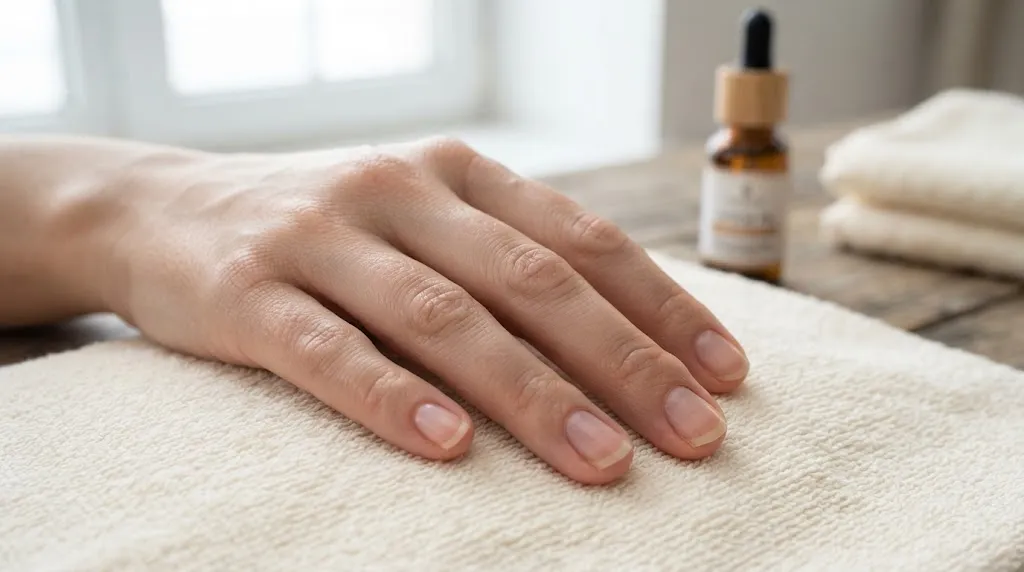
Look at your natural nail without polish. The hard center is the nail plate; the white or pale crescent near the base may be the lunula; and the skin framing the nail forms the nail folds. You can’t see most of the matrix or nail bed because the plate and surrounding skin cover them.
- Growth: Nail matrix and nail root.
- Visible surface: Nail plate and free edge.
- Support: Nail bed and its attachment to the plate.
- Protection: Proximal and lateral nail folds, cuticle, hyponychium, and onychodermal band.
- Visible landmark: Lunula, the pale half-moon at the base of some nails.
What Does Each Part of Your Nail Actually Do?
1. Nail Plate: The Hard Surface You Polish
The nail plate is the firm, slightly curved structure that gives your nail its shape. It’s built mainly from tightly packed keratin, a durable protein also found in hair and the outer layers of skin. Although it feels solid, the plate is somewhat translucent, allowing the color of the tissue beneath to show through.
The plate itself doesn’t contain nerves, so carefully trimming its free edge shouldn’t hurt. Pain during filing, drilling, or cutting usually means you’re affecting the sensitive tissues underneath or around it. Repeated aggressive buffing can remove layers and leave the plate thinner and more prone to splitting.
2. Nail Matrix: Where New Nail Growth Begins
The nail matrix is the growth-producing tissue tucked beneath the skin at the base of your nail. Its cells continually develop and harden into new nail plate material. As new cells form, they move the older plate toward your fingertip. Think of the matrix as the source of the nail, not the nail bed beneath the visible middle.
This area matters because deep injury or scarring to the matrix may permanently alter the nail’s growth, thickness, or shape. That’s why aggressive digging beneath the proximal nail fold is much riskier than gently shaping the white tip.
3. Nail Root: The Hidden Beginning of the Nail Plate
Your nail root is the portion of the developing nail tucked under the proximal nail fold. It sits near the matrix and isn’t something you should try to expose during a manicure. The root and matrix are closely related, but the matrix is the tissue that produces new nail cells, while the root refers to the hidden base of the nail plate.
4. Nail Bed: The Living Tissue Beneath the Plate
The nail bed is specialized skin underneath the attached portion of your nail plate. Tiny blood vessels help give the nail its familiar pink appearance on lighter skin; the visible color can vary with skin tone and lighting. Matching ridges on the plate and bed help them stay firmly attached.
The bed is sensitive. Scraping deeply under your nails or pulling off an enhancement that has bonded strongly to the plate may injure the nail or encourage it to lift away from the bed. Once a section separates, it generally has to grow forward rather than simply stick back down.
5. Lunula: The Little Half-Moon Near the Base
The lunula is the pale, crescent-shaped area you may notice near your nail’s base. It represents the visible distal portion of the nail matrix. It often looks most obvious on thumbnails, while other nails may show little or none of it.
Don’t worry if you can’t see a lunula on every finger. Its visibility differs naturally because the proximal nail fold may cover it. A manicure doesn’t need to expose this area, and there’s no benefit to digging into the base of the nail to find it.
6. Cuticle and Eponychium: The Protective Seal
The thin cuticle is a layer of dead skin cells that adheres to the nail plate near its base, forming a protective seal. In medical writing, eponychium is sometimes used for this region; in more precise salon terminology, it refers to living tissue associated with the proximal nail fold, rather than the dead cuticle on the plate.
What matters for your manicure is the boundary: don’t cut into living tissue or aggressively remove the seal. Doing so can allow irritants and microbes to reach vulnerable skin, increasing your chance of inflammation or infection. If the area looks dry, soften its appearance with moisturizer instead of cutting deeper.
7. Proximal and Lateral Nail Folds: The Skin Around Your Nail
The proximal nail fold covers the base where the nail emerges, while the lateral nail folds border its left and right sides. Together they shield the edges of the plate and help protect the hidden growth structures. You may hear the side areas called nail sidewalls in salon conversations.
8. Free Edge: The Part You Can Safely Trim
The free edge is the section of the nail plate that extends beyond the attached nail bed. It commonly appears white because there’s no underlying nail bed directly beneath that portion. This is the part you clip, shape, or decorate with a French tip.
9. Hyponychium: The Seal Under Your Nail Tip
The hyponychium is the skin under the free edge, where the attached nail area transitions toward the fingertip. It helps form a barrier that limits entry of dirt, germs, and irritating substances beneath the plate. On longer natural nails, this skin may extend farther forward than you expect.
Never cut or dig into attached skin under the tip to make your nails look longer. If a cleaning tool stings, you’ve gone too far. A soft brush and gentle washing are better choices than a sharp metal implement.
10. Onychodermal Band: The Boundary Near the Tip
The onychodermal band is a narrow zone near the end of the attached nail bed, just before the hyponychium. You may see it as a fine transition line between the attached, pinkish or more pigmented nail area and the paler free edge. It’s another part of the nail’s protective boundary.
How Do Nails Grow From the Matrix to the Fingertip?
Your nail doesn’t grow outward from the free edge. Growth begins beneath the proximal nail fold, where cells in the matrix multiply, become packed with keratin, and form the plate. As more nail material forms at the base, existing plate moves outward over the bed.
- Matrix cells develop: Living cells in the hidden growth region produce the material that will become nail plate.
- The plate hardens: Those cells become densely keratinized, making the visible nail strong but no longer living tissue.
- The nail moves forward: Newly produced material gradually pushes the older plate toward the fingertip while the nail bed supports it.
- The tip becomes free: Once the plate extends past its attachment to the bed, you can trim that portion without cutting living skin.
Fingernails typically grow around 3 millimeters per month, while toenails average roughly 1.5 millimeters per month. Actual rates differ with age, health, injury, and the individual nail. Replacing an entire fingernail commonly takes at least six months; a toenail can take 12 to 18 months.
This explains why peeling, overfiling, and other damage can’t be fixed overnight. The damaged portion must move outward as fresh nail forms behind it. If you’re recovering from a rough manicure, our guide to helping damaged nails grow out more comfortably explains how to protect the new growth.
Why Do Nails Look Pink, White, or Different Colors?
Your nail plate is translucent rather than naturally pink. Much of the color you see comes from the nail bed below, where small blood vessels and natural skin pigmentation affect its appearance. The unattached free edge often looks lighter because it no longer rests over that vascular tissue.
The lunula looks pale because the tissue in that region changes how light passes through the base of the nail. Its size or visibility alone isn’t a reliable test of your health. Likewise, vertical ridges may become more noticeable with age and aren’t automatically a sign of a vitamin deficiency.
Color can also change after dark polish, trauma, or repeated exposure to products. But an unexplained new dark stripe, significant separation, or persistent green, yellow, or unusual discoloration deserves attention rather than a cover-up. Look at the pattern and whether it is changing; don’t diagnose yourself by color alone.
How Does Nail Anatomy Change the Way You Do a Manicure?
Once you know where the living tissue begins, some popular manicure habits make more sense—and others become easier to question.
Protect the Cuticle Instead of Chasing a Deeper Clean
A neat nail base doesn’t require you to remove every trace of skin. Apply a small amount of jojoba cuticle oil or fragrance-free hand cream to dry surrounding skin. Avoid cutting intact cuticles or forcing tools beneath the proximal fold. For an everyday maintenance plan, see our daily nail care routine.
File the Free Edge, Not the Nail Bed
Shape the exposed edge with a gentle file instead of thinning the top of the plate to make polish grip. A glass nail file for natural nails can help smooth small snags with controlled strokes. Stop if you feel heat, pain, or sensitivity; those are signs that you’re going beyond simple shaping.
Remove Enhancements Without Pulling at the Plate
Gel polish, dip powder, acrylics, and press-ons sit on or attach to the nail plate. Peeling them off may tear away surface layers with the product. Follow the removal directions for the specific system, and seek trained help if a coating won’t release without force. If you love color, our discussion of whether nails are healthier without polish helps separate common myths from actual causes of damage.
How Can You Protect Every Part of Your Nail?
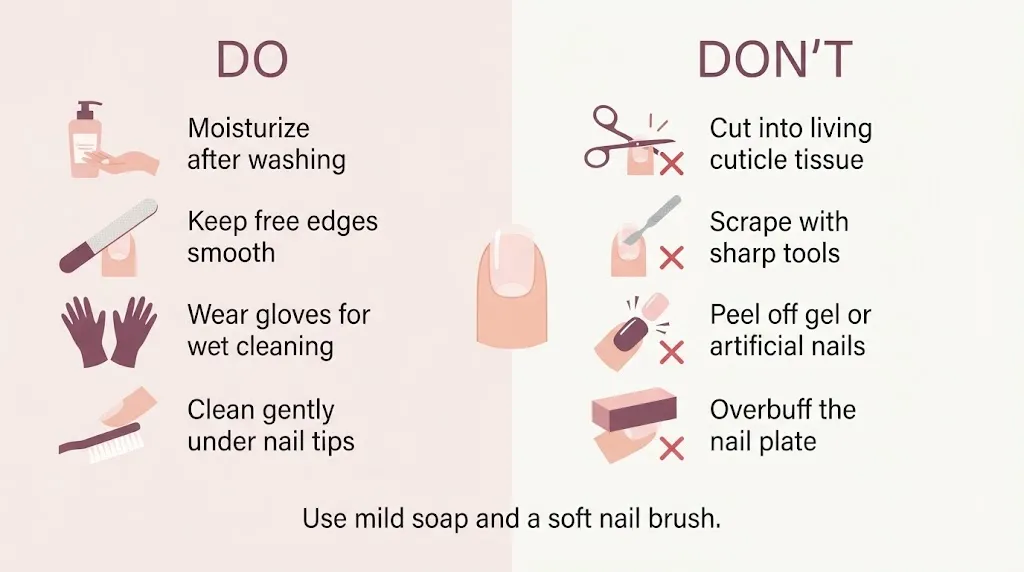
Healthy nail care is less about adding treatments and more about keeping the plate, surrounding skin, and protective seals intact. You can start with a few practical habits that respect the anatomy you’ve just learned.
Do
- Moisturize nails and surrounding skin after washing.
- Keep the free edge smooth and a comfortable length.
- Wear gloves for prolonged wet cleaning.
- Use gentle washing to clear debris under the tip.
Don’t
- Cut into the cuticle seal or surrounding living skin.
- Scrape beneath the attached nail with sharp tools.
- Peel off gel or pry artificial nails loose.
- Buff repeatedly until the plate feels thin or sore.
For ordinary dirt, use mild soap and a soft nail cleaning brush, then dry your hands well. A brush cleans around the free edge without the concentrated pressure of a pointed scraper. You’ll find more detail in our guide to the best way to clean your nails safely.
Pro Tip
Check your nails just before applying a fresh manicure. Bare nails make it easier to spot lifting, irritated nail folds, and unexpected color changes that opaque polish might hide.
Which Nail Changes Are Normal, and When Should You Get Help?
Not every unusual-looking nail signals a problem. A barely visible lunula, mild lengthwise ridges, or differences in nail shape can be normal. What matters more is a new, persistent, painful, or changing finding—especially when you can’t explain it by a recent injury.
When to Seek Medical Advice
Arrange an evaluation for a new or changing brown or black streak, a nail lifting away from its bed, persistent swelling or pain around a nail, significant pitting, or unexplained thickening and discoloration. Seek prompt medical care if you have spreading redness, pus, fever, or severe pain. Avoid covering an unexplained change with enhancements until it’s assessed.
Frequently Asked Questions About Nail Anatomy
Q: What are the seven basic parts of a nail?
A: A simplified list includes the nail plate, matrix, nail bed, lunula, cuticle, nail folds, and hyponychium. More detailed diagrams also identify the nail root, free edge, and onychodermal band.
Q: Is the nail plate alive?
A: The visible nail plate consists of hardened, nonliving keratinized cells. Living cells in the matrix produce new plate material, while living tissues around and beneath the nail support and protect it.
Q: What’s the difference between the nail matrix and nail bed?
A: The matrix produces most of the nail plate at its base. The nail bed sits beneath the attached plate and helps anchor it as it travels toward the fingertip.
Q: Why don’t all my nails have visible half-moons?
A: The lunula can be partly or completely hidden beneath the proximal nail fold. Having an obvious one on your thumb but not your little finger is common and doesn’t automatically mean anything is wrong.
Q: Can a damaged nail matrix grow back normally?
A: Some mild injuries heal and normal growth resumes, but deep damage or scarring may cause lasting ridges, splits, or shape changes. Have a clinician assess a significant nail-base injury rather than trying to repair it with polish.
The Most Important Thing to Remember About Nail Anatomy
Your nail plate may be the part you decorate, but the matrix, nail bed, cuticle, folds, and hyponychium are what make healthy nail growth possible. Treat the living edges gently, protect the free edge, and pay attention to changes that don’t seem normal for you.
Save this nail anatomy guide to Pinterest so you can identify every part of your nail before your next DIY manicure or salon appointment.

Hi, I’m Jessica, the creator behind Unique Lash & Nails Katy.
I created this website for anyone who loves beautiful nails as much as I do. Here, I share trendy nail designs, seasonal manicure ideas, easy nail care tips, honest product recommendations, and step-by-step guides to help you create salon-worthy nails at home. Whether you’re looking for everyday inspiration or your next favorite nail trend, I hope you’ll find something you love.