How to Clean Gel Nails at Home: Best Gel Cleanser to Use
Quick Answer
To clean gel nails at home, wash a finished manicure gently with mild soap and water, then dry it completely. If you need to remove the sticky inhibition layer immediately after curing gel, saturate a lint-free nail wipe with a professional gel cleanser or 91–99% isopropyl alcohol and wipe each nail once. Don’t use acetone for routine cleaning because acetone is primarily a removal solvent, not an everyday gel cleanser.
Time needed
5–10 minutes
Difficulty
Beginner
Items needed
3–5 basic items
Result lasts
Until nails get dirty again
Your gel manicure can look perfectly cured and still feel slightly sticky when you touch it. That doesn’t always mean you did something wrong. Many traditional gel systems leave a thin tacky film after curing that needs to be wiped away before you get that smooth, glassy finish.
The important part is matching your cleaning method to the problem. Cleaning freshly cured gel is different from washing a manicure you’ve already been wearing for several days, and both are different from removing gel polish completely.
Here’s how to clean gel nails at home without dulling the shine, weakening your manicure, or accidentally turning a five-minute cleanup into a full gel removal session.
What do you need to clean gel nails at home?
You don’t need a complicated manicure kit. Gather only the products that match what you’re cleaning.
- Lint-free nail wipes for removing cured gel residue without leaving cotton fibers behind
- Professional gel cleanser or 91–99% isopropyl alcohol for a traditional sticky inhibition layer
- Mild hand soap and clean water for normal everyday cleaning
- A soft nail brush if dirt collects around or beneath longer free edges
- Cuticle oil or hand moisturizer to rehydrate the skin after cleaning
Recommended Product
Professional Gel Nail Surface Cleanser
★★★★☆ Popular salon-style option
A dedicated gel cleanser makes it easy to remove the inhibition layer without reaching for acetone or ordinary polish remover.
As an Amazon Associate, we earn from qualifying purchases.
If you’re cleaning bare natural nails instead of a gel manicure, use this separate guide on how to clean nails at home. Natural nails and cured gel coatings don’t always need the same products.
What exactly are you trying to clean from your gel nails?
Before you open a bottle of cleanser, identify what’s actually on your nails. This prevents one of the most common gel mistakes: using a removal product when you only need a surface cleaner.
Sticky residue immediately after curing
If your top coat is designed to leave an inhibition layer, a slight tacky feeling can be normal. You remove that film after the final cure using gel cleanser and a lint-free wipe.
Oil, makeup, food, or everyday grime
If your manicure has already been finished and worn normally, you usually don’t need alcohol every time it gets dirty. Mild soap, water, gentle rubbing, and thorough drying are enough for everyday cleaning.
Dirt underneath longer gel nails
Use mild soap and a soft nail brush around the underside of the free edge. Avoid digging beneath the nail with scissors, metal tools, pins, or anything sharp.
Old gel polish you actually want to remove
That’s a completely different process. Gel cleanser removes surface residue; it does not replace proper soak-off removal. Don’t scrape or peel your manicure because doing so can pull layers from the natural nail underneath.
Warning
If you used a no-wipe top coat, it should normally finish without a sticky layer. Don’t keep rubbing an unexpectedly tacky no-wipe manicure with cleanser. Check the product’s curing instructions first because incorrect cure time, a mismatched lamp, an overly thick coat, or product incompatibility may be the real problem.
How do you clean sticky gel nails step by step?
 Save
Save
1
Confirm that your final gel layer is fully cured
Finish curing your gel according to the instructions for the exact gel system and lamp you’re using. Cleaning too early can disturb product that hasn’t finished curing properly.
Common mistake: Assuming every lamp uses the same curing time. Follow the timing specified for your gel because lamp power and gel formulas vary.
2
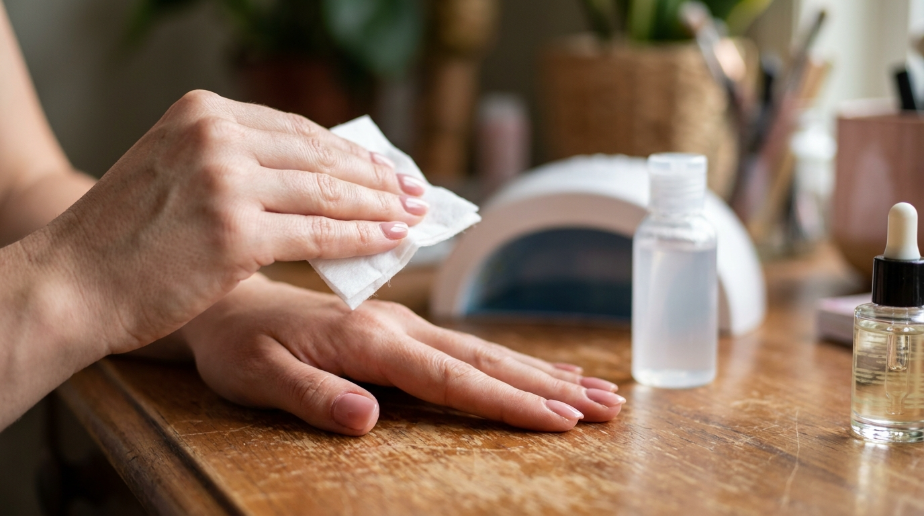
Saturate a lint-free wipe with gel cleanser
Dampen the wipe enough to clean the surface without dripping liquid around your cuticles. A professional gel cleanser is the easiest choice because it’s designed specifically for this stage of a gel manicure.
Common mistake: Using fluffy cotton balls. Loose fibers can stick to the tacky surface and make a freshly finished manicure look messy.
Recommended Product
Lint-Free Nail Wipes
★★★★☆ Useful for home gel manicures
Lint-free wipes give you a cleaner final surface because they don’t leave the fuzzy fibers ordinary cotton can leave behind.
As an Amazon Associate, we earn from qualifying purchases.
3
Wipe from the cuticle toward the free edge
Place the damp wipe on the nail and sweep toward the tip with light, even pressure. Use a clean section of the wipe as it collects residue so you aren’t spreading the tacky film from one nail back onto another.
Common mistake: Scrubbing repeatedly. If the gel is fully cured, a controlled wipe should be enough to remove the normal surface film.
4
Check the shine before wiping again
Look at the nail under good light. A properly cleaned gel surface should feel smooth and look evenly glossy if you used a glossy top coat. If one small area still feels tacky, use a fresh section of the wipe rather than saturating the nail repeatedly.
Common mistake: Treating persistent softness as normal sticky residue. Soft, wrinkled, dentable, or unusually tacky gel may need troubleshooting rather than more cleanser.
5
Finish with cuticle oil
Once the gel surface is clean, massage a small drop of cuticle oil into the skin around each nail. This puts moisture back where repeated hand washing, alcohol, and manicure prep can leave the surrounding skin feeling dry.
Common mistake: Applying oil before you finish cleansing. Oil can make the surface slippery and prevent you from clearly seeing whether all residue has been removed.
What is the best gel cleanser to use at home?
The best gel cleanser is one that removes the cured inhibition layer cleanly, evaporates without leaving an oily film, and is compatible with the gel system you’re wearing.
A dedicated professional gel cleanser is the easiest choice because it removes the guesswork. Products sold specifically as nail surface cleansers are intended for manicure prep and/or wiping cured gel residue, depending on the manufacturer’s instructions.
91–99% isopropyl alcohol is a practical alternative for many traditional gel systems. High-percentage isopropyl alcohol evaporates quickly and can remove oily or tacky surface residue without functioning like acetone-based gel remover.
If you want a deeper breakdown of which liquid belongs at each stage of your manicure, see the best liquid to clean nails.
Recommended Product
91% Isopropyl Alcohol for Nail Cleansing
★★★★☆ Simple gel-cleanser alternative
When your gel manufacturer allows alcohol cleansing, this is a simple option for wiping away the traditional post-cure inhibition layer.
As an Amazon Associate, we earn from qualifying purchases.
Can you use acetone to clean gel nails?
You generally shouldn’t reach for acetone when your goal is simply to clean a finished gel manicure.
Acetone belongs mainly in gel removal. Using it when you only need to remove surface oil, dirt, or an inhibition layer is unnecessary and can dry the surrounding skin. Extended acetone contact is also exactly what many soak-off gel systems rely on when it’s time to break down and remove the manicure.
Think of the difference this way: gel cleanser cleans the surface; acetone helps remove the coating.
Pro Tip
Label your bottles “CLEANSE” and “REMOVE” if you keep both alcohol or gel cleanser and acetone at your manicure station. The bottles can look similar, and separating them helps prevent accidental use of the wrong liquid.
How should you clean gel nails during everyday wear?
Once your manicure is completely finished, you don’t need to wipe it with alcohol every day. Treat your gel nails much like the rest of your hands.
Wash with mild soap and clean running water. Work the lather around your fingertips and nail edges, rinse well, and dry thoroughly. If you have longer nails and debris collects underneath the free edge, use a soft nail brush rather than digging with a metal implement.
For daily maintenance, the goal is cleanliness without constantly exposing your manicure and surrounding skin to stronger solvents.
You can combine this with a simple healthy nail care routine so the natural nail and skin underneath your manicure stay protected between gel changes.
What should you do and avoid when cleaning gel nails?
Do
- +Use lint-free wipes for freshly cured sticky gel.
- +Wash finished gel nails with mild soap for daily cleaning.
- +Dry around and underneath longer nails thoroughly.
Don’t
- −Don’t use acetone as your routine surface cleaner.
- −Don’t scrape underneath your nails with sharp tools.
- −Don’t peel lifted gel away from the natural nail.
What pro tips keep gel nails cleaner and shinier?
Pro Tip
Keep separate lint-free wipes for each hand when the inhibition layer is heavy. Once a wipe becomes coated in sticky residue, switching to a clean one gives you a clearer, streak-free finish.
Pro Tip
Clean underneath long nails during normal hand washing instead of waiting for visible buildup. A few gentle passes with a soft brush are easier on the underside of your nails than aggressive deep cleaning later.
Pro Tip
Check whether your top coat says “no wipe” before assuming tackiness is normal. Traditional wipe-off and no-wipe top coats finish differently, so knowing which one you applied changes the correct next step.
Recommended Product
Jojoba-Based Cuticle Oil
★★★★☆ Useful after gel cleansing
A small amount around the nail after cleansing helps keep the surrounding skin from feeling dry or tight.
As an Amazon Associate, we earn from qualifying purchases.
Why are your gel nails still sticky or dirty after cleaning?
 Save
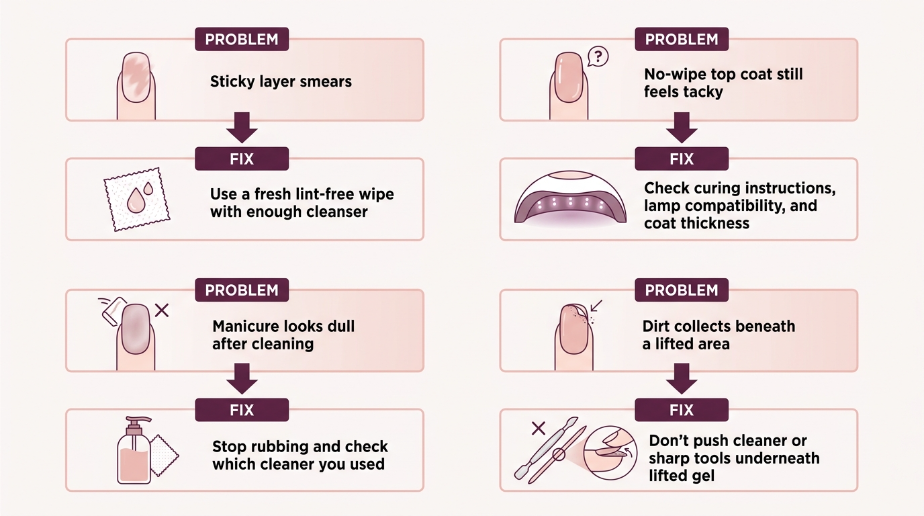
SaveProblem: The sticky layer smears instead of wiping away
Use a fresh lint-free wipe with enough cleanser to lift the residue instead of redistributing it. Next time, avoid reusing a heavily soiled section of the wipe across multiple nails.
Problem: A no-wipe top coat still feels tacky
Check the manufacturer’s curing instructions, lamp compatibility, and coat thickness before adding more cleanser. Prevent it next time by applying thin layers and using the recommended lamp and cure time.
Problem: Your manicure looks dull after cleaning
Stop rubbing and check which cleaner you used. If you accidentally used acetone or a harsh remover, repeated wiping won’t restore the top coat. Next time, reserve acetone for removal and use gel cleanser for the final wipe.
Problem: Dirt keeps collecting beneath a lifted area
Don’t push cleaner or sharp tools underneath lifted gel. A separated coating can trap moisture and debris. Have the lifted product removed safely and inspect the natural nail before covering it again.
If your natural nail feels thin, sore, or damaged after gel removal, use this guide on how to repair a damaged nail at home while the affected portion grows forward.
Warning
Stop covering or aggressively cleaning a nail if you notice unexplained greenish-black discoloration, significant lifting, worsening pain, redness, swelling, warmth, drainage, or another persistent change. Those signs deserve professional medical evaluation instead of another layer of gel.
Frequently asked questions about cleaning gel nails
Q: What can I use instead of gel cleanser?
A: For many wipe-off gel systems, 91–99% isopropyl alcohol works as an alternative for removing the cured inhibition layer. Check the instructions for your specific gel brand before substituting products.
Q: Why are gel nails sticky after curing?
A: Traditional gel products can leave a tacky inhibition layer on the surface after curing. That layer is usually wiped away after the final cure. A no-wipe top coat, however, is designed to finish without this cleansing step.
Q: Can I wash gel nails with soap and water?
A: Yes. Once your gel manicure is fully finished, mild soap and water are appropriate for normal everyday cleaning. Rinse well and dry around and underneath longer nails thoroughly afterward.
Q: Can I use nail polish remover to clean gel nails?
A: It’s better to use gel cleanser for post-cure residue and soap and water for everyday dirt. Acetone-containing removers are intended mainly for removing nail coatings and aren’t necessary for routine surface cleaning.
Q: Do you need to wipe every gel top coat after curing?
A: No. Traditional wipe-off top coats may leave an inhibition layer, while no-wipe top coats are formulated to finish without cleansing. Always follow the instructions for the exact top coat you applied.
What’s the easiest way to keep gel nails clean?
Keep the routine simple: use gel cleanser and a lint-free wipe only when your cured gel system leaves a normal sticky layer, then use mild soap and water for everyday cleaning. Save acetone for actual gel removal, and never dig beneath your manicure with sharp tools.
Once you know the difference between cleansing, washing, and removing, keeping gel nails glossy at home becomes much easier. Save this guide to Pinterest so you have the correct gel-cleaning steps ready for your next manicure.

Hi, I’m Jessica, the creator behind Unique Lash & Nails Katy.
I created this website for anyone who loves beautiful nails as much as I do. Here, I share trendy nail designs, seasonal manicure ideas, easy nail care tips, honest product recommendations, and step-by-step guides to help you create salon-worthy nails at home. Whether you’re looking for everyday inspiration or your next favorite nail trend, I hope you’ll find something you love.