What Organ Affects Your Nails? Signs You Shouldn’t Ignore
Quick Answer
Your liver, kidneys, heart, thyroid, and lungs all leave fingerprints on your nails. The liver and kidneys show up as pale or white nails, the heart shows up as clubbing or blue tint, the thyroid shows up as brittle or ridged nails, and the lungs can cause yellowing or curved “clubbed” tips. Most nail changes are harmless, but a sudden or ongoing change is worth mentioning to your doctor.
You’ve probably stared at your nails after a weird color change and wondered if it means something bigger is going on inside your body. It’s a fair question — your nails aren’t just a canvas for polish. They’re made from living tissue that depends on your blood supply, your protein levels, and your organ function to grow properly.
Doctors have used nails as a diagnostic clue for over a century, and dermatologists still check them during routine exams for exactly this reason. This guide breaks down which organs actually influence your nails, what the warning signs look like, and when a nail change is just cosmetic versus when it’s your body trying to get your attention.
Why Your Nails Reflect What’s Happening Inside Your Body
Your nail bed sits directly above a dense network of tiny blood vessels called capillaries. Because your nails grow slowly — about 3mm a month for fingernails — they act like a timeline, recording weeks or months of what’s circulating in your blood. When an organ isn’t functioning at its best, it changes the oxygen levels, protein levels, or waste filtration in your blood, and that shows up as color, texture, or shape changes at your nail bed long before you’d notice symptoms anywhere else.
This is why a doctor might glance at your nails during a checkup even if you came in for something unrelated. It’s a quick, non-invasive way to spot patterns that weak or brittle nails alone don’t always explain.
The Liver: Pale, White, or “Half-and-Half” Nails
Your liver filters toxins and produces the proteins your blood needs to carry nutrients efficiently. When liver function drops, protein levels in your blood fall too, and that shows up directly in your nail bed.
Terry’s nails are the classic liver-related pattern: most of the nail turns white or pale pink, with just a thin strip of normal color at the very tip. Another pattern, called “half-and-half nails,” splits the nail into a dull white top half and a pink or brown bottom half near the tip. Both patterns are associated with chronic liver conditions like cirrhosis, though they can appear with other causes too.
Warning
Terry’s nails and half-and-half nails aren’t diagnoses on their own, but if you notice this pattern across most of your nails at once — not just one nail — it’s worth a conversation with your doctor rather than a guess.
The Kidneys: Similar Pale Nails With a Different Pattern
Your kidneys filter waste out of your bloodstream, and when that filtration slows down, waste products build up and change the color of your nail bed in a very specific way. “Half-and-half nails” are actually more commonly linked to kidney disease than liver disease, especially in people on long-term dialysis. The line between the pale top half and darker bottom half tends to be sharper and more clearly defined with kidney-related changes.
You might also notice your nails growing more slowly or becoming more brittle overall, since kidney function affects how efficiently your body absorbs and uses nutrients like iron and calcium that nails need to grow strong.
The Heart and Lungs: Clubbing and Blue-Tinted Nails
 Save
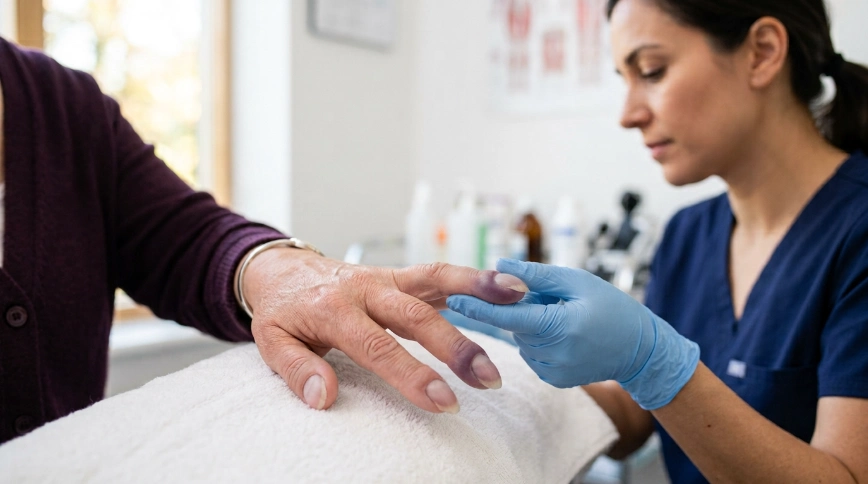
SaveClubbing is one of the most recognizable organ-related nail changes. It happens when the tips of your fingers become rounder and puffier, and your nails start to curve downward over them like the back of a spoon. The angle where your nail meets your skin, which is normally around 160 degrees, flattens out or even reverses.
Clubbing develops when your blood carries less oxygen than it should, which is common with chronic lung conditions and some congenital heart conditions. A bluish or purplish tint under your nails, called cyanosis, points to the same root cause — low oxygen levels in your blood, often from a heart or lung issue that’s affecting circulation.
Neither of these changes develops overnight. They build gradually over months, which is exactly why catching them early on your own hands matters more than most people realize.
The Thyroid: Brittle, Ridged, or Splitting Nails
Your thyroid regulates your metabolism, and it has a direct line to how fast your nails grow and how strong they are while they grow. An underactive thyroid (hypothyroidism) slows nail growth and often leaves nails dry, brittle, and prone to splitting down the middle. An overactive thyroid (hyperthyroidism) can cause a different pattern called onycholysis, where the nail actually starts lifting away from the nail bed at the tip.
If you’re already following a nail repair routine and nothing is sticking — your nails keep splitting no matter what oil or strengthener you try — a thyroid imbalance is one of the more common hidden reasons behind stubborn nail damage.
Other Organ-Linked Nail Signs Worth Knowing
A few more patterns are worth having on your radar, even though they’re less common:
- Spoon-shaped nails (koilonychia): Nails curve inward like a spoon instead of lying flat. This is most often tied to iron-deficiency anemia, which affects how well your blood carries oxygen throughout your body.
- Yellow nail syndrome: Nails thicken, grow slower, and take on a yellow-green tint. It’s linked to lung and lymphatic system issues, and it tends to affect several nails at once rather than just one.
- Beau’s lines: Horizontal grooves across the nail that mark a period when nail growth temporarily paused, often tied to a serious illness, high fever, or major stress on the body.
Signs Your Nails Are Trying to Tell You Something
Multiple nails changing at the same time
One damaged nail is usually mechanical (a bump, gel damage, or dryness). Several nails changing together, in the same way, points toward something systemic happening inside your body instead.
Changes that show up gradually over weeks or months
Organ-related nail changes build slowly because your nail bed only reflects what your blood has been doing over time. A sudden overnight change is much more likely to be an injury or a product reaction.
Shape changes, not just color
Clubbing, spooning, and lifting nails are structural changes that don’t come from polish, gel, or dryness. When the actual shape of your nail changes, that’s a stronger signal to get it checked than color alone.
Do’s and Don’ts for Nails That Might Reflect a Health Issue
 Save
SaveDo
- +Take a photo every few weeks so you can actually compare changes over time
- +Check all ten nails, not just the one that first caught your eye
- +Mention nail changes to your doctor at your next visit, even if they seem minor
Don’t
- −Self-diagnose a specific disease based on nail appearance alone
- −Cover a concerning change with dark polish before a doctor gets to see it
- −Ignore a change just because your nails don’t hurt
Pro Tips for Telling Cosmetic Damage From Something Deeper
Pro Tip
Check your nail bed color by pressing gently on the nail and releasing. It should turn white then pink again within about two seconds. A sluggish return can point to circulation issues worth mentioning at your next checkup.
Pro Tip
Look at your nails in natural daylight, not under bathroom LED lighting. Warm indoor lighting can make pale or yellow-tinted nails look normal when they’re actually shifted from their usual color.
Pro Tip
Rule out nutrition first. Before assuming an organ issue, check whether your diet is actually giving your nails what they need — iron, biotin, and protein-rich foods resolve a surprising number of “mystery” nail changes on their own.
Recommended Product
Biotin & Collagen Nail Strengthening Supplement
★★★★☆ Highly rated on Amazon
If bloodwork and your doctor rule out an organ-related cause, a biotin and collagen combo gives your nails the raw materials they need to rebuild strength while everything else gets sorted out.
As an Amazon Associate, we earn from qualifying purchases.
A daily nail and cuticle oil is another low-effort way to support your nails while you figure out the bigger picture — the healthiest things to put on your nails can make brittle or peeling nails noticeably more resilient within a few weeks.
Recommended Product
Nourishing Cuticle and Nail Strengthening Oil
★★★★☆ Highly rated on Amazon
A nightly dab of nail oil keeps the nail plate flexible instead of brittle, which matters most while your nails are already stressed from an underlying health issue.
As an Amazon Associate, we earn from qualifying purchases.
FAQ
Q: Can nail changes really show up before other symptoms?
A: Yes. Because nails grow slowly and reflect weeks of blood chemistry, changes like Terry’s nails or clubbing can appear before someone notices fatigue, pain, or other classic symptoms of an organ issue.
Q: Is white nail polish residue the same as Terry’s nails?
A: No. Polish residue or fungal white spots sit on the nail’s surface and can be scraped or filed away. Terry’s nails involve the nail bed itself and don’t change no matter how much you file or clean the surface.
Q: Does one white spot on a nail mean liver trouble?
A: Almost never. A single white spot on one nail is usually from a small injury to the nail bed weeks earlier, not an organ issue. Organ-related changes typically affect most or all of your nails at once.
Q: Can fixing my diet reverse organ-related nail damage?
A: Diet helps your nails grow back stronger once the underlying issue is treated, but it won’t fix the root cause on its own. Nutrition and medical treatment work best together, not as substitutes for each other.
Q: How long does it take for nails to look normal again after treatment?
A: Since fingernails grow out completely in about four to six months, expect gradual improvement over that timeframe rather than an overnight fix, even after the underlying cause is resolved.
Signs of Unhealthy Nails Worth Watching For Long-Term
If you want a broader checklist beyond organ-specific patterns, it helps to know the full range of signs of unhealthy nails so you’re not only watching for the dramatic changes covered here.
Your nails genuinely are a window into what’s happening inside your body, but they’re not a diagnosis on their own. Pale, ridged, clubbed, or discolored nails are worth a mention to your doctor, especially when the change affects several nails and builds gradually rather than overnight. Save this guide to your nail health board so you know exactly what to check next time something looks off.

Hi, I’m Jessica, the creator behind Unique Lash & Nails Katy.
I created this website for anyone who loves beautiful nails as much as I do. Here, I share trendy nail designs, seasonal manicure ideas, easy nail care tips, honest product recommendations, and step-by-step guides to help you create salon-worthy nails at home. Whether you’re looking for everyday inspiration or your next favorite nail trend, I hope you’ll find something you love.