What Damages Nail Growth? 10 Surprising Reasons Your Nails Won’t Grow
Quick Answer
The biggest things that damage nail growth are over-exposure to water, harsh chemicals (especially acetone and cleaning products), picking or peeling gel and acrylic nails off, nutritional deficiencies in biotin, iron, or zinc, and aggressive filing. Damage happens at the nail matrix — the tissue under your cuticle where new nail cells form — so when that area gets repeatedly stressed, your nails grow out thin, slow, and fragile. Removing the offending habit is usually enough to see real improvement within 4–6 weeks.
Your nails grow about 3 millimeters per month — but only when the conditions are right. If yours seem to be crawling along or constantly breaking off before they reach any real length, something in your daily routine is almost certainly getting in the way. Most people blame genetics, but the truth is that habit damage is far more common than a genuine growth disorder.
This guide breaks down every meaningful cause of nail growth damage, from obvious ones (acetone, over-filing) to the ones nobody talks about (your laundry detergent, your iron levels, even how you type). Once you know what’s actually working against your nails, fixing it becomes straightforward.
How Nail Growth Actually Works — and Where It Gets Disrupted
 Save
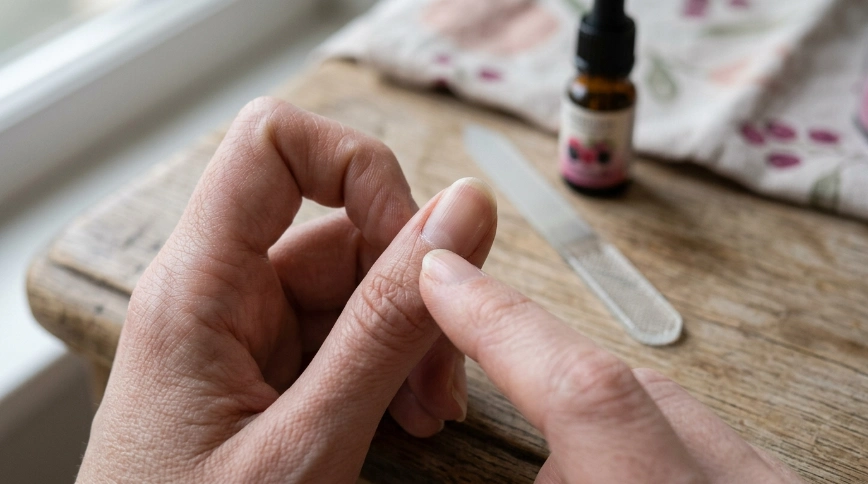
SaveBefore you can understand what damages nail growth, you need to know where growth actually happens. Your nails don’t grow from the tip — they grow from the nail matrix, a small pocket of specialized cells hidden under your cuticle and the base of your nail. Those cells divide, harden, and push forward to form the nail plate you can see.
When the matrix is healthy, it churns out smooth, firm, evenly-thick nail cells. When it’s repeatedly stressed — by chemicals, trauma, dryness, or poor nutrition — those cells come out thinner, more fragile, or unevenly formed. That’s why damage doesn’t show up instantly; you see it 4–8 weeks later, when the compromised cells finally grow far enough out to be visible.
This delay is also why so many people connect the wrong cause to the problem. You changed your gel brand two months ago, but you’re only noticing weak nails now — so you assume it’s your new hand cream. Understanding the lag time helps you trace damage back to its real source.
The 10 Biggest Things That Damage Nail Growth
1. Prolonged Water Exposure
Water is the single most underestimated nail enemy. Your nail plate can absorb up to 30% of its own weight in water, which causes it to swell. When it dries out, it contracts. Repeat this expansion-contraction cycle dozens of times a week — through dishes, long showers, swimming — and the nail plate literally starts to delaminate, splitting into layers from the free edge backward.
This weakening slows your effective growth because your nails keep breaking off before they get anywhere. If you do dishes without gloves every day, that’s enough repeated soaking to stall your nail goals entirely. Wearing waterproof rubber gloves for cleaning and dishes makes a measurable difference within weeks.
2. Acetone Overuse
Acetone is powerful enough to dissolve nail polish — which is exactly what makes it so damaging to the nail itself. It strips the natural oils from your nail plate and the surrounding skin, leaving the nail dehydrated, porous, and brittle. A dehydrated nail plate is more prone to breakage, which means your growth never gets a chance to show.
Non-acetone removers are gentler for everyday polish changes, but they still dry out the nail over time. The real solution is to limit removal frequency and always follow up with a nail and cuticle oil immediately after any removal session. Jojoba oil is particularly good because its molecular structure is close to the skin’s natural sebum, which helps it actually penetrate rather than just sit on the surface.
3. Picking or Peeling Gel and Acrylic Nails
This one causes the most severe damage of everything on this list. When you peel a gel or acrylic enhancement off without a proper soak-off, you don’t just remove the product — you take the top layers of your natural nail plate with it. Those layers are part of what makes your nail rigid and protective. After a few peeling sessions, you’re left with nails that are so thin they flex when you press them, which makes them vulnerable to breakage and slows the healthy growth cycle significantly.
The matrix can recover, but it takes time. If you’ve been a serial peeler, check out our guide on how to repair damaged, weak nails to speed up the recovery process with the right steps.
Warning
Never peel, pick, or force-remove any nail enhancement. Even one peeling session can strip 2–3 layers of the nail plate, and those layers won’t grow back — your nail has to fully grow out before new, undamaged nail replaces them. This can take 4–6 months.
4. Nutritional Deficiencies
Your nails are made of keratin, a protein, and they need a steady supply of specific nutrients to produce it well. The most common deficiencies that visibly slow nail growth are:
- Biotin (Vitamin B7): Biotin is directly involved in keratin production. A deficiency makes nails thin, brittle, and slow-growing. It’s the nutrient most commonly associated with nail growth supplements, and the research actually supports this one.
- Iron: Low iron means less oxygen delivered to the nail matrix, which slows cell division. If your nails are growing very slowly and you’re also feeling fatigued, iron is worth checking with a doctor.
- Zinc: Zinc deficiency shows up as white spots on nails and slow growth. It plays a role in protein synthesis, which is the process that makes nail cells in the first place.
- Protein: Since nails are protein, consistently low protein intake — common in crash diets — directly slows production at the matrix level.
Before throwing money at supplements, it’s worth looking at what foods genuinely support nail growth — dietary sources are almost always better absorbed than supplements.
Recommended Product
Nail Growth Biotin & Collagen Supplement
★★★★☆ Highly rated on Amazon
A biotin supplement combined with collagen covers the two most common nutritional gaps behind slow nail growth — especially useful if your diet is low in protein or eggs.
As an Amazon Associate, we earn from qualifying purchases.
5. Aggressive Filing and Over-Filing
How you file matters just as much as how often you file. Filing back and forth in a sawing motion creates friction heat at the free edge, which causes tiny cracks in the nail plate. Those cracks spread inward over time, leading to peeling and breakage long before the nail reaches any real length.
You should always file in one direction only, moving from the outer edge toward the center. Use a crystal or glass file rather than a metal or coarse emery board — glass files create a much smoother, sealed edge that resists splitting. Filing your nails when they’re wet is also a mistake; wet nails are softer and more likely to tear during filing.
6. Harsh Household Chemicals
Cleaning products, laundry detergents, dish soaps, and hand sanitizers all contain chemicals that break down the lipid barrier in your nail plate and surrounding skin. That barrier is what keeps moisture locked in. Without it, your nails dry out from within, become brittle, and break before they grow long enough to notice.
The fix isn’t to stop cleaning — it’s to wear gloves consistently. Keep a pair right next to your kitchen sink so there’s no excuse to skip them. Also check your hand sanitizer: gels with very high alcohol concentrations (above 70%) used many times daily will desiccate the nail plate over time just as effectively as acetone.
7. Biting and Picking at Your Nails
Nail biting doesn’t just remove length — it traumatizes the nail matrix. The constant pressure and tearing at the nail base can cause inflammation of the matrix, which disrupts the normal, orderly production of nail cells. Over months and years, this leads to nails that grow out with ridges, uneven thickness, and a generally rougher surface texture.
Picking at the skin around your nails (the proximal nail fold) is equally damaging because that skin forms a protective seal over the matrix. When it’s broken or pushed back too aggressively, bacteria and moisture can get in, causing nail infections that seriously derail growth.
8. Incorrect or Overly Aggressive Cuticle Removal
Your cuticle exists for a reason: it’s a waterproof seal that protects the nail matrix from bacteria, fungi, and moisture. Cutting it away completely — especially with metal nippers — removes that seal and leaves your matrix exposed. The inflammation that follows can temporarily slow or disrupt the growth of new nail cells.
The right approach is to push cuticles back gently with a rubber-tipped cuticle pusher after soaking, and only trim the loose dead skin (the eponychium) rather than cutting the live skin itself. For a complete picture of what’s good and bad for your nails day-to-day, our article on what is true of nail care covers the most common myths and misconceptions.
9. Stress and Health Conditions
Physical and emotional stress both impact nail growth in measurable ways. Under high stress, your body redirects resources away from non-essential processes — and growing nails falls into that category. This is why many people notice slow nail growth during periods of illness, grief, crash dieting, or intense physical stress like surgery or childbirth.
Certain health conditions also directly affect nail growth: thyroid disorders (both hypo and hyperthyroidism), anemia, psoriasis, and fungal infections of the nail bed can all slow or distort growth. If your nails are growing unusually slowly despite good habits and nutrition, it’s worth mentioning to your doctor — nail changes can sometimes be an early indicator of a systemic issue.
10. Wearing Too-Tight Press-On or Acrylic Extensions
Extensions that fit too tightly or are applied with too much pressure can restrict blood flow to the nail bed. Good circulation is what delivers the oxygen and nutrients the matrix needs to produce cells efficiently. When that flow is reduced — even subtly — growth slows. You’ll often notice this as a nail that feels slightly sore at the base after wearing extensions for a few days.
Always make sure enhancements are properly sized and applied with the correct technique. Give your nails regular breaks between enhancement sets, and use those breaks to strengthen your natural nails with a treatment-level base coat that contains hydrolyzed keratin or calcium.
How to Tell Which Culprit Is Affecting Your Nails
Different types of damage leave different visual signatures. Matching what you see to what’s causing it helps you fix the right problem.
- Peeling layers at the free edge → water damage or aggressive filing
- Thin, flexible nails that bend easily → gel/acrylic peeling, or biotin/protein deficiency
- White horizontal lines (Beau’s lines) → recent illness, stress, or nutritional deficiency
- Small white spots → zinc deficiency or minor trauma to the matrix
- Vertical ridges → aging, dehydration, or iron deficiency
- Very slow growth across all nails uniformly → nutritional issue, thyroid, or circulation
- Damage on specific nails only → trauma or a habit affecting those fingers (e.g., a dominant thumb used for peeling stickers)
Understanding what causes weak nails in the first place is the foundation of any effective nail care routine. Our deep-dive on what causes weak nails expands on several of these signs with more detail.
Do’s and Don’ts for Protecting Nail Growth
Do
- +Wear rubber gloves for all cleaning and dish washing — every single time
- +Apply cuticle oil at least once daily, especially after water exposure — jojoba or vitamin E are your best bets
- +File in one direction only with a glass file, on dry nails
- +Eat protein and biotin-rich foods — eggs, salmon, almonds, sweet potatoes
- +Soak off gel and acrylic properly using acetone-soaked foil wraps — never peel
Don’t
- −Pick or peel off gel, acrylic, or press-ons — even if just a corner is lifting
- −Use acetone more than once a week without following up with hydration immediately after
- −Cut your cuticles entirely — push them back instead and only trim the dead loose skin
- −File wet nails — wait until they’re fully dry after washing
- −Skip base coat under nail polish — bare nails left under polish absorb pigments and dry out faster
Pro Tips for Supporting Nail Growth While Avoiding Damage
 Save
SavePro Tip
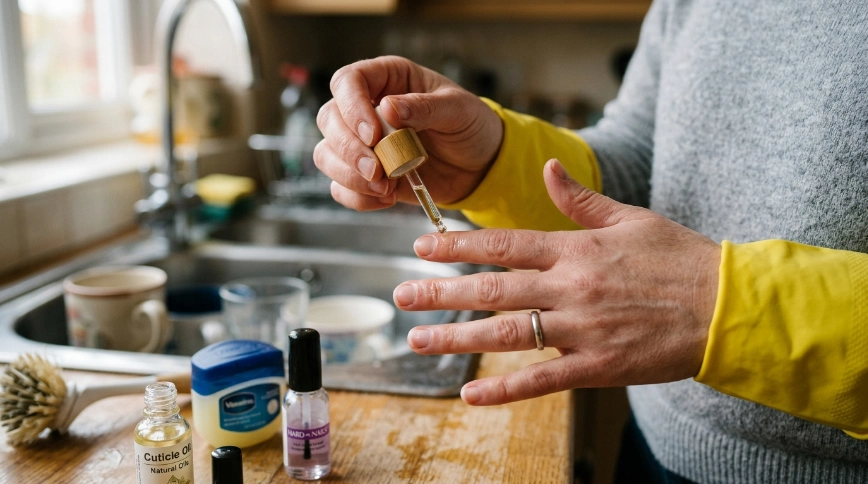
Apply cuticle oil before putting on gloves for cleaning. The heat trapped inside the gloves drives the oil deeper into the nail and cuticle tissue — you get a passive treatment while you do your dishes. Two minutes of contact time under gloves equals about 20 minutes of open-air soaking.
Pro Tip
If you work with your hands in water frequently, apply a thin layer of a petroleum-based barrier cream (like Aquaphor or CeraVe Healing Ointment) around your cuticles before washing up. This creates a physical seal that slows water absorption into the nail plate by 40–50%.
Pro Tip
Use your nails as tools only for what they’re designed to do — gripping and scratching. Opening cans, pulling staples, scraping labels, and typing aggressively with your nail tips all create micro-trauma at the free edge that adds up over weeks. Retrain yourself to use a pen cap, a coin, or the pad of your finger for those tasks.
Pro Tip
If you’re rebuilding after damage, wear a keratin nail strengthener as a base coat every day for 4 weeks rather than leaving nails bare. Bare nails are more porous and dehydrate faster. A strengthener coat acts as a physical shield while new, healthy nail grows in from the matrix.
Frequently Asked Questions
Q: How long does it take to see improvement after stopping the damaging habit?
A: Most people start seeing noticeably healthier nail growth within 4–6 weeks of eliminating the main culprit. Keep in mind that the nail you see today grew from cells produced 2–3 months ago, so full nail recovery (where the damaged portion grows off completely) takes 4–6 months for fingernails and up to 12 months for toenails.
Q: Does nail polish itself damage nail growth?
A: Nail polish alone doesn’t damage growth, but wearing it continuously without breaks can cause yellowing and make nails more brittle over time due to trapped solvents and pigments. The bigger issue is usually the removal process — frequent acetone use is far more damaging than the polish itself. Take a polish-free week every 6–8 weeks and moisturize heavily during that time.
Q: Can stress really stop my nails from growing?
A: Yes, and this is well-documented. Severe physical or emotional stress can cause a temporary halt in nail cell production, which shows up weeks later as a horizontal groove called a Beau’s line running across all your nails. The nail doesn’t stop growing permanently — production resumes once the stressor passes — but you may notice slower growth for several months afterward.
Q: Is gel or acrylic worse for nail growth?
A: Neither is inherently worse if applied and removed correctly. The damage comes from improper removal — peeling either one off causes the same destruction. Acrylic removal requires longer soaking time, which some people try to shortcut by prying, making it statistically more damaging in practice. Gel done with a proper 10–15 minute acetone soak-off, done every 2–3 weeks, can be maintained without significant natural nail damage.
Q: What’s the single fastest change I can make right now to protect my nail growth?
A: Start wearing gloves for dishes and cleaning today. Water exposure is the most constant, daily source of nail damage for most people and it’s the easiest to eliminate completely. Combine that with applying cuticle oil every night before bed, and you’ll notice a difference in nail strength within two to three weeks.
The Bottom Line on What Damages Nail Growth
The vast majority of nail growth damage is entirely preventable. Water, acetone, harsh chemicals, peeling off enhancements, and nutritional gaps account for probably 90% of all cases of slow or weak nail growth. None of these require an expensive fix — they require consistent small habits, like keeping gloves by the sink and cuticle oil on your nightstand.
If you want to build a full routine around protecting and growing your nails, our guide on how to take care of nails daily gives you everything in one place. Start with one change today — gloves, oil, or stopping the peeling — and build from there.
Found this helpful? Save it to your Pinterest nail care board so you can come back whenever you need a reminder of what to avoid!

Hi, I’m Jessica, the creator behind Unique Lash & Nails Katy.
I created this website for anyone who loves beautiful nails as much as I do. Here, I share trendy nail designs, seasonal manicure ideas, easy nail care tips, honest product recommendations, and step-by-step guides to help you create salon-worthy nails at home. Whether you’re looking for everyday inspiration or your next favorite nail trend, I hope you’ll find something you love.