7 Common Nail Diseases Every Woman Should Know (Signs + What To Do)
Quick Answer
The 7 most common nail diseases are onychomycosis (fungal infection), paronychia (nail fold infection), onycholysis (nail separation), psoriatic nails, nail pitting, leukonychia (white spots or lines), and melanonychia (dark streaks). Most are treatable — but early identification is the key to stopping them before they spread or worsen.
Your nails tell you far more about your health than most people realize. In fact, dermatologists routinely check nails during routine exams because nail changes can signal everything from a simple fungal infection to an autoimmune condition. If something looks off — yellowing, separation, dark lines, or white patches — you’re right to look into it now instead of waiting.
This guide covers the 7 most common nail diseases, what each one looks and feels like, what causes it, and what you should actually do about it. No vague advice — just clear, specific information so you can make smart decisions about your nail health.


Why Do Nail Diseases Happen in the First Place?
Your nails are made of keratin — the same protein as your hair — and they’re not sealed off from the outside world. Moisture, bacteria, fungi, trauma, and even your immune system can all disrupt the way your nails look and grow. The nail plate (the hard part you paint), the nail bed underneath it, and the surrounding skin all have their own vulnerabilities.
The most common triggers for nail diseases include prolonged moisture exposure, wearing artificial nails or tight shoes, skin conditions like psoriasis or eczema, nutritional deficiencies, minor trauma that goes unnoticed, and weakened immunity. Understanding the root cause is what separates a fast fix from a recurring problem — which is why each disease below includes its specific cause, not just a description of how it looks.
Before diving in, it helps to know what signs of unhealthy nails look like in general — that broader picture will make it easier to spot the specific diseases below.
1. Onychomycosis — Fungal Nail Infection
 Save
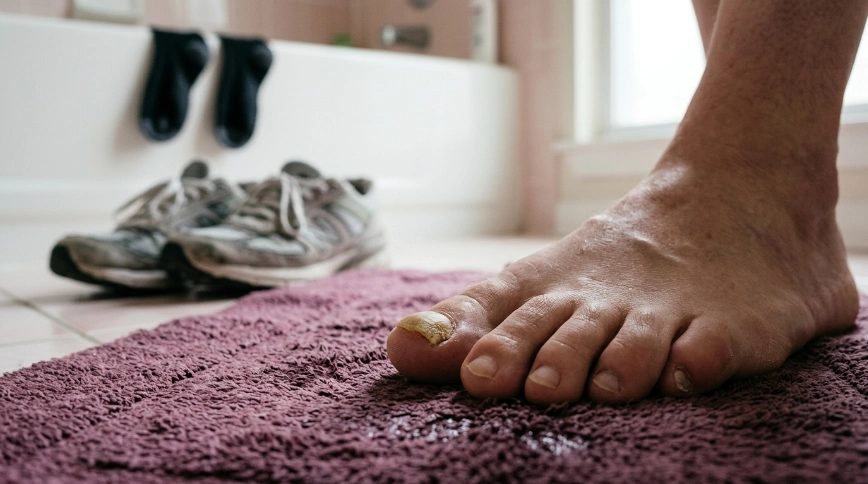
SaveOnychomycosis is the most common nail disease worldwide, affecting roughly 10% of the general population. It’s caused by dermatophyte fungi (and sometimes yeast or mold) that get under the nail plate and feed on keratin. The infection usually starts at the tip or sides of the nail and slowly moves toward the base if left untreated.
What it looks like: The nail turns yellow, brown, or white. It thickens, becomes brittle, and may crumble at the edges. In advanced cases it can separate from the nail bed entirely. Toenails are far more commonly affected than fingernails because shoes create the warm, moist environment fungi love.
What causes it: Walking barefoot in public showers or pools, wearing damp socks or tight shoes, sharing nail tools, and having a prior athlete’s foot infection (which spreads from skin to nails) are all common entry points.
Warning
Fungal nail infections don’t resolve on their own. Without treatment, they spread to neighboring nails and the surrounding skin. If you’re diabetic or immunocompromised, see a doctor before attempting any home treatment — untreated fungal infections can lead to serious complications.
What to do: Mild cases can respond to over-the-counter antifungal treatments applied daily for months. Severe or persistent cases need prescription oral antifungals like terbinafine. A dermatologist can confirm the diagnosis with a nail scraping — which matters because not all yellow, thick nails are fungal.
Recommended Product
Antifungal Nail Treatment Solution
★★★★☆ Highly rated on Amazon
A topical antifungal nail solution works best when applied consistently to clean, filed-down nails — look for formulas with undecylenic acid or tolnaftate as the active ingredient.
As an Amazon Associate, we earn from qualifying purchases.
2. Paronychia — Nail Fold Infection
Paronychia is an infection of the skin directly surrounding the nail — the nail fold. It can be acute (sudden, usually bacterial) or chronic (slow-developing, usually fungal or caused by repeated irritation). Acute paronychia is painful and appears quickly, often after a small cut, hangnail, or nail biting. Chronic paronychia develops over weeks and is more common in people whose hands are frequently wet.
What it looks like: The skin around the nail becomes red, swollen, and tender. Acute paronychia may develop a pocket of pus under the skin. Chronic paronychia causes the cuticle to pull away from the nail, creating a gap where bacteria and yeast can enter repeatedly.
What causes it: Nail biting, picking at cuticles, improper manicure techniques (like cutting the cuticle completely off), prolonged water exposure, and dishwashing without gloves are the most frequent culprits.
What to do: Mild acute cases often respond to warm water soaks 3–4 times daily. If pus forms, see a doctor — you may need it drained and a course of antibiotics. Chronic paronychia requires keeping hands dry, applying a topical antifungal or corticosteroid, and stopping whatever is irritating the skin. Never cut your cuticles — push them back gently instead, because your cuticle is the seal that keeps pathogens out.
3. Onycholysis — Nail Separation from the Bed
Onycholysis is when the nail plate separates from the nail bed, starting at the free edge and moving backward toward the cuticle. The separated area looks white or yellowish because you’re seeing the air gap rather than the pink nail bed. It’s not painful in early stages, which is exactly why people tend to ignore it too long.
What it looks like: A growing white or pale patch under the nail that starts at the tip. The nail may look like it’s lifting away. The gap can collect debris, moisture, and bacteria — which can lead to secondary infections that cause a greenish or black discoloration.
What causes it: Trauma from acrylic nails or aggressive manicures, excessive water exposure, psoriasis, thyroid disorders, certain antibiotics (especially tetracyclines when combined with sun exposure), and reactions to nail products are all common causes. It can also happen simply from using your nails as tools.
Pro Tip
If you have onycholysis, trim the separated portion short, keep it dry, and avoid wearing artificial nails over it — trapping moisture under a lifted nail speeds up bacterial overgrowth dramatically. A cotton-wrapped toothpick can gently clear debris from the gap without forcing the nail further away from the bed.
What to do: Trim the separated nail back as far as you can without pain, keep the area dry, and stop any products that may be irritating it. If the cause is a medical condition like thyroid disease or psoriasis, treatment needs to address the root issue — the nail won’t reattach until the trigger is resolved. Reattachment can take 6–12 months of consistent care.
Learning how to repair damaged and weak nails while you recover from onycholysis will help you rebuild nail strength and prevent the separation from worsening.
4. Nail Psoriasis
Up to 90% of people with plaque psoriasis will experience nail involvement at some point. But nail psoriasis can also appear without any visible skin psoriasis at all — meaning your nails can be the first or only sign of the condition. This makes it one of the most frequently misdiagnosed nail diseases because it’s often mistaken for a fungal infection.
What it looks like: Nail psoriasis has several classic presentations. You might see tiny pits or dents on the nail surface (pitting), a yellowish-orange spot under the nail that looks like a drop of oil (the “oil drop” sign), thickening and crumbling of the nail, or onycholysis. In more severe cases the entire nail turns brown, thickens, and detaches.
What causes it: Psoriasis is an autoimmune disease where the immune system speeds up the skin cell cycle. When this happens in the nail matrix (where the nail grows), it produces abnormal nail cells that create the characteristic pitting and separation.
What to do: See a dermatologist if you notice pitting combined with oil drop spots — that combination is highly specific to psoriasis. Treatment options include steroid injections into the nail fold, topical steroids, vitamin D analogs, and biologic medications for severe cases. You can’t resolve nail psoriasis with salon treatments or home remedies alone.
5. Nail Pitting
Nail pitting is exactly what it sounds like — tiny depressions or holes in the surface of the nail plate. It’s often the first visible nail symptom to appear in psoriasis, but it can also be associated with alopecia areata (an autoimmune hair loss condition) and reactive arthritis. The pits form because the nail matrix isn’t producing normal, cohesive nail cells, so cells fall out in small clusters as the nail grows forward.
What it looks like: Small, irregular dents scattered across the nail surface. Sometimes just a few pits, sometimes dozens. They’re shallow — not deep holes — and may be more obvious when you look at the nail from a low angle in good light.
What causes it: Most commonly psoriasis, but also alopecia areata, eczema affecting the nail matrix, and reactive arthritis. Isolated pitting without other symptoms can sometimes be idiopathic (no clear cause found).
What to do: Nail pitting on its own doesn’t require urgent treatment, but it warrants a dermatologist visit to investigate the underlying cause. Knowing what causes weak and abnormal nails in your specific case will help guide the right approach.
6. Leukonychia — White Spots or Lines on Nails
Most people have had a white spot appear on their nail at some point and assumed it meant a calcium deficiency. Here’s the thing: that’s almost always a myth. True leukonychia is actually caused by minor trauma to the nail matrix, not nutritional gaps. The spot forms when the nail matrix produces imperfect keratin cells after a small knock — and the spot moves forward as the nail grows, eventually reaching the tip and disappearing.
What it looks like: Small white dots (true leukonychia) are the most common form and are almost always harmless. White horizontal lines (Mees’ lines) can indicate arsenic poisoning or kidney disease. White half-moons or full white nails can indicate liver disease, kidney failure, or heart failure — though these are rare and come with other symptoms.
What causes it: True leukonychia (white dots and spots) = minor trauma to the nail matrix. Leukonychia from systemic disease is associated with circulatory, kidney, or liver dysfunction — these require blood tests to investigate properly.
Pro Tip
If your white spots appear weeks after you remember banging or pressing on that nail, they’re almost certainly from that trauma — not a health problem. Spots that appear on multiple nails simultaneously without any trauma history are worth mentioning to your doctor.
What to do: Isolated white spots that slowly grow out don’t need treatment — they’ll disappear on their own in 4–6 months. Mees’ lines or full-nail whitening requires a doctor visit for bloodwork to check liver, kidney, and circulatory markers.
7. Melanonychia — Dark Streaks Under the Nail
 Save
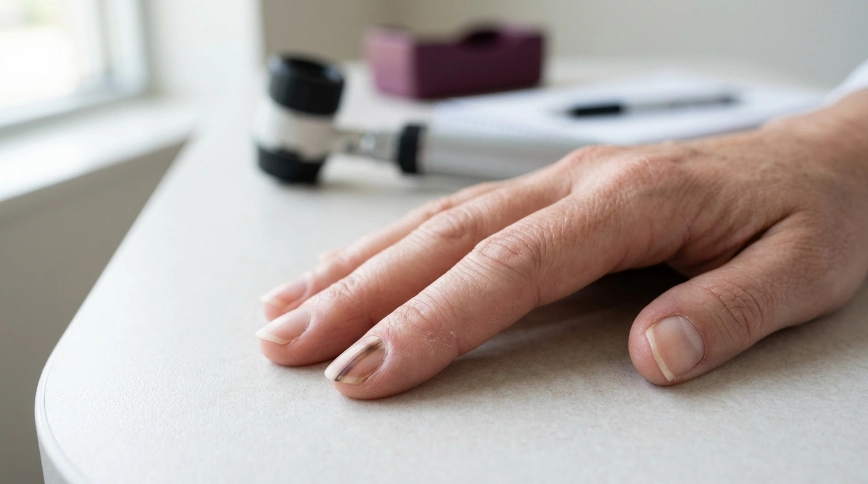
SaveMelanonychia is the medical term for a dark brown or black streak running vertically down the nail from the matrix to the tip. It’s the nail disease that warrants the most attention — because while it can be completely harmless, it can also be an early sign of subungual melanoma, a serious skin cancer that forms under the nail.
What it looks like: A tan, brown, or black band running lengthwise down one nail. It can be narrow or wide. In people with darker skin tones, melanonychia is extremely common and usually benign — multiple nails are often affected. In lighter skin tones, a single new dark streak, especially one that is wider at the base than the tip, or that has irregular coloring, needs immediate medical evaluation.
What causes it (benign): Increased melanin production in the nail matrix triggered by trauma, hormonal changes, pregnancy, certain medications (like some chemotherapy drugs), or simply genetics in people with darker skin tones.
What causes it (serious): Subungual melanoma. This is rare — but it’s the nail condition where timing genuinely matters. Melanoma under the nail is notoriously difficult to diagnose early because it’s hidden, and delays in diagnosis are directly linked to worse outcomes.
Warning
See a dermatologist promptly if you notice: a dark streak that’s new and growing wider, irregular pigmentation within the streak, dark pigment spreading onto the surrounding skin (called Hutchinson’s sign), or a streak on a single nail in someone who is fair-skinned. Don’t wait to see if it “resolves on its own.”
What to do: A dermatologist will evaluate the streak using dermoscopy. Benign cases are monitored; suspicious cases are biopsied. Never cover a new dark streak with nail polish and ignore it — getting it checked takes 15 minutes and could be life-changing.
Do’s and Don’ts for Preventing Common Nail Diseases
Do
- +Keep nails trimmed short and filed smooth to prevent catching and trauma that leads to separation or pitting
- +Wear rubber gloves when washing dishes or cleaning — prolonged moisture is the number one environmental trigger for both fungal infections and paronychia
- +Apply cuticle oil daily to keep the nail fold supple and sealed — a dry, cracked cuticle is an open door for bacteria and fungi
- +Sanitize nail tools between uses with 70% isopropyl alcohol — or keep a personal set you never share
- +Change socks daily and alternate shoes to allow drying — damp footwear is the primary reason toenail fungus keeps coming back
Don’t
- −Cut your cuticles — this removes the protective seal and opens the nail fold to infection every single time
- −Walk barefoot in public gyms, pools, or showers — the fungi that cause onychomycosis thrive in these environments and can enter through micro-cracks in your skin
- −Use your nails to open packages, peel stickers, or pry things — this creates trauma to the nail bed that can start onycholysis
- −Ignore a new dark streak, unexplained thick nail, or nail that keeps separating — these are your body’s early warning signs
- −Cover nail problems with gel or acrylics without treating the underlying issue — this traps moisture and bacteria and almost always makes the condition significantly worse
What You Can Put on Your Nails to Support Recovery
While you’re addressing any of the conditions above, your nail’s structural health matters. A strong, well-nourished nail resists infection and damage better than one that’s brittle or dehydrated. Understanding the healthiest things to put on your nails during recovery will accelerate how quickly you see improvement.
Recommended Product
Nail Strengthening Treatment with Keratin & Biotin
★★★★☆ Highly rated on Amazon
A nail hardener with keratin helps rebuild the nail plate structure during recovery from onycholysis or paronychia — apply to bare nails every other day rather than daily, which can actually over-harden nails and cause brittleness.
As an Amazon Associate, we earn from qualifying purchases.
Recommended Product
Cuticle Oil Pen with Jojoba & Vitamin E
★★★★☆ Highly rated on Amazon
Daily cuticle oil is one of the most underrated preventive tools for paronychia and onycholysis — keeping the nail fold sealed and flexible stops bacteria from getting underneath.
As an Amazon Associate, we earn from qualifying purchases.
Frequently Asked Questions About Nail Diseases
Q: Can nail diseases spread to other people?
A: Fungal nail infections (onychomycosis) and acute bacterial paronychia can spread through shared tools, surfaces, or direct contact with infected skin. Psoriasis, nail pitting, onycholysis, leukonychia, and melanonychia are not contagious — they’re caused by internal factors. Always use personal nail tools and avoid sharing even emery boards.
Q: How can I tell if my nail problem is fungal or psoriatic?
A: This is genuinely hard to tell apart by eye — even dermatologists do nail scrapings because the two conditions can look nearly identical. The biggest clue is pitting: psoriatic nails almost always show surface pitting, while fungal nails typically don’t. But a lab test is the only way to be certain before committing to months of antifungal treatment that won’t work on psoriasis.
Q: Are white spots on nails actually from calcium deficiency?
A: Almost never. The calcium deficiency myth is extremely widespread, but the scientific evidence doesn’t support it. Those small white spots are almost always caused by minor trauma to the nail matrix — a knock, a tight jar lid, pressing too hard on the nail — that you probably don’t remember. They’ll grow out completely within a few months and don’t need any treatment.
Q: How long does it take for a diseased nail to fully recover?
A: Fingernails grow roughly 3–4mm per month and toenails much slower at about 1–2mm per month. A full fingernail takes about 4–6 months to replace itself; a toenail takes 12–18 months. This means even after successful treatment, you won’t see a completely clear nail until the diseased portion has fully grown out and been replaced. Patience is genuinely required.
Q: Can I get nail art or gel polish if I have a nail disease?
A: It depends on the condition. With onychomycosis, onycholysis, or paronychia, applying artificial products traps moisture and worsens the infection — hold off on all enhancements until fully treated. With leukonychia or minor pitting, polish is generally fine. With melanonychia, you should leave the nail bare so you and your doctor can monitor the streak until it’s been evaluated and confirmed benign.
The Most Important Thing to Take Away
Most nail diseases are very treatable — but they rarely resolve without some form of intervention, and they almost always get worse when covered up or ignored. The single most valuable habit you can build is maintaining a consistent nail care routine that keeps your nails clean, dry, moisturized, and properly trimmed. That one habit prevents the vast majority of the conditions listed here.
If something looks off — especially a new dark streak, a nail that keeps separating, or thick yellow nails that aren’t responding to anything — book that dermatologist appointment. Your nails are worth it. Save this guide to Pinterest so you always have it handy when you need it.

Hi, I’m Jessica, the creator behind Unique Lash & Nails Katy.
I created this website for anyone who loves beautiful nails as much as I do. Here, I share trendy nail designs, seasonal manicure ideas, easy nail care tips, honest product recommendations, and step-by-step guides to help you create salon-worthy nails at home. Whether you’re looking for everyday inspiration or your next favorite nail trend, I hope you’ll find something you love.