Which Chemicals Do Nail Professionals Use ? Salon Nail Prep Explained
Quick Answer
Professionals don’t rely on one chemical to “clean” nails. Alcohol-based nail cleansers are commonly used to remove surface oil and residue, acetone removes polish and soak-off products, and nail dehydrators remove temporary surface moisture and oil before gel or acrylic application. Separate salon disinfectants are used for reusable tools and work surfaces—not directly on your natural nails.
That sharp salon smell doesn’t come from one mysterious nail-cleaning liquid. A professional nail desk usually contains several solvents and prep products because each one has a different job.
One removes old polish. Another wipes away surface oil. A dehydrator prepares your nail for an enhancement, while an entirely different chemical disinfects the metal tools afterward.
Once you understand those differences, professional nail prep becomes much less confusing—and you’ll know why copying a salon routine with random household chemicals is a bad idea.
What Does “Cleaning Nails” Actually Mean in a Professional Salon?
Before choosing a chemical, you need to know what the nail technician is trying to remove. “Cleaning” can mean at least four different things during a manicure.
- Removing dirt and everyday debris: usually handled with handwashing, gentle soap, and careful physical cleaning.
- Removing old polish or enhancement material: this requires a compatible solvent such as acetone or a nail-polish remover.
- Removing surface oils and residue before polish: this is where alcohol-based nail cleansers are commonly used.
- Dehydrating the natural nail before gel, acrylic, or another enhancement: a dedicated nail dehydrator may be used.
These jobs aren’t interchangeable. If you’re mainly interested in everyday nail hygiene rather than salon prep, follow this gentle guide to cleaning nails at home instead of reaching immediately for strong solvents.
Which Chemicals Do Professionals Use on the Nail Plate?
 Save
Save1. Isopropyl Alcohol — For Surface Cleansing and Degreasing
Alcohol-based nail cleansers are one of the most recognizable professional prep liquids. Many formulas use isopropyl alcohol, or IPA, because it evaporates quickly and helps remove oil, dust, fingerprints, and light surface residue from the nail plate.
A technician may saturate a lint-free wipe and thoroughly wipe each nail after shaping and cuticle preparation. The goal isn’t to soak your nail. It’s to leave a clean surface without oily residue before the next product goes on.
Isopropyl alcohol is also used with some gel systems to remove the sticky inhibition layer after curing. However, not every gel requires this step. No-wipe top coats are specifically formulated so that you don’t need a final alcohol wipe.
Pro Tip
Use a lint-free nail wipe rather than a cotton ball during final prep. Loose cotton fibers can stick to the nail plate and become trapped beneath polish, gel, or base coat.
If you want a deeper comparison of prep liquids, this guide to the best liquids for cleaning nails explains how alcohol, acetone, and everyday washing differ.
2. Acetone — For Removing Polish, Gel, Dip, and Some Enhancements
Acetone is one of the most common solvents you’ll see at a nail salon, but technically its main job is removal rather than routine cleaning.
It dissolves traditional nail lacquer quickly and is commonly used during removal of soak-off gel and other removable nail systems. Professional technicians control where it goes and how long your nails and surrounding skin are exposed.
Acetone works fast, which is useful, but frequent exposure can leave your nails and surrounding skin feeling dry. That’s why a good removal service doesn’t end when the polish disappears. Moisturizer or cuticle oil usually belongs in your aftercare routine once the new application is finished.
Warning
Don’t assume stronger or longer acetone exposure gives you a safer removal. Once product softens, it should be removed according to that nail system’s instructions rather than aggressively scraped, peeled, or pried from your natural nail.
3. Ethyl Acetate and Butyl Acetate — Common Alternative Solvents
If a bottle says “non-acetone nail polish remover,” that doesn’t mean it’s solvent-free. Formulas may use solvents such as ethyl acetate or butyl acetate instead.
These chemicals can dissolve traditional lacquer, although a non-acetone remover may work more slowly than pure acetone. They’re also found in some professional prep and dehydrating formulas.
The advantage isn’t that one solvent is universally “healthy” and the other is “bad.” Your best choice depends on what you’re removing, the product manufacturer’s instructions, your nail condition, and how frequently you’re doing removal services.
4. Professional Nail Dehydrators — For Gel and Acrylic Prep
A nail dehydrator is easy to confuse with a cleanser because both products are applied before an enhancement. Their purposes overlap, but they aren’t always identical.
Professional dehydrators are designed to temporarily remove surface moisture and oil so gel, acrylic, builder gel, or another coating can adhere more consistently. Depending on the brand, the ingredient list may combine solvents such as isopropyl alcohol, ethyl acetate, or related acetates.
A dehydrator is normally applied in a very thin layer and allowed to air-dry. You don’t need to flood the cuticle or surrounding skin.
This matters most when you’re doing an enhancement service where lifting is a concern. For a basic natural-nail manicure, a separate dehydrator isn’t automatically necessary.
Which Chemical Is Best for Each Nail-Cleaning Job?
| Job | Typical Professional Choice | Main Purpose |
|---|---|---|
| Everyday dirt | Soap and water | Basic hygiene |
| Surface oil before polish or gel | Alcohol-based nail cleanser | Degreases and removes residue |
| Regular polish removal | Acetone or non-acetone remover | Dissolves lacquer |
| Soak-off enhancement removal | Acetone when specified by the system | Softens removable product |
| Gel/acrylic preparation | Dedicated nail dehydrator | Temporarily reduces surface moisture and oil |
| Reusable tools and work surfaces | Approved professional disinfectant | Salon infection-control procedures |
What Does a Professional Nail-Cleaning Sequence Look Like?
A professional doesn’t simply keep wiping your nails with stronger chemicals until they “feel clean.” Each stage has a purpose.
- Remove the existing coating with the remover designed for that product.
- Wash or prepare the hands according to the salon’s hygiene protocol.
- Shape the nails and perform appropriate cuticle preparation.
- Remove filing dust with a clean brush or lint-free method.
- Clean the nail plate with the prep liquid recommended for the system.
- Apply dehydrator if the gel, acrylic, or enhancement system calls for it.
- Use primer or bonding product only when required by that particular system.
If you’re building your own maintenance routine between salon appointments, the simple nail care routine for healthy nails is a better everyday framework than repeatedly using professional-strength prep liquids.
Are Salon Disinfectants Used Directly to Clean Your Nails?
No—tool disinfection and nail-plate cleaning are two different things.
Professional salons use disinfectants to reduce microorganisms on reusable hard, nonporous tools and appropriate work surfaces. Clippers, metal pushers, and other reusable implements need to be cleaned and disinfected according to local salon regulations and the disinfectant label.
That doesn’t mean the same disinfectant belongs on your nail plate or in a manicure soak.
If you see a container used for instrument disinfection at a salon, don’t copy that solution as a DIY nail-cleaning bath. Professional disinfectants have specific dilution, surface, contact-time, rinsing, and safety instructions.
Warning
Don’t apply salon instrument disinfectant, household bleach, concentrated cleaning chemicals, or surface disinfectant directly to your nails or skin unless a product is specifically labeled for that use. “Kills germs” doesn’t automatically mean “safe for your manicure.”
Which Salon Chemicals Are Not Actually Nail Cleaners?
Nail Primer
Primer is an adhesion product, not a general cleaner. Depending on the system, primers may be acid-based or acid-free and are designed to improve bonding between your natural nail and an enhancement.
Using extra primer won’t make a dirty nail cleaner. More product can simply increase unnecessary skin exposure and may interfere with the service if you ignore the manufacturer’s directions.
Cuticle Remover
Cuticle remover helps soften nonliving tissue around the nail plate so it can be removed more easily during preparation. It isn’t a replacement for an alcohol cleanser, polish remover, or handwashing.
Don’t leave it sitting indefinitely simply because the product feels mild. Follow the bottle’s timing and removal instructions.
Gel, Acrylic Liquid, and Adhesion Products
Products used to build artificial nails aren’t cleaning chemicals either. Acrylic monomer, gel base, bonder, and similar products belong to the enhancement system itself.
The distinction sounds obvious, but it’s one reason copying isolated steps from short nail videos can cause problems. Professional nail systems work as a sequence rather than a collection of interchangeable liquids.
How Can You Use Nail-Prep Chemicals More Safely at Home?
Do
- +Follow the exact product-system instructions
- +Keep solvent bottles capped when you’re not using them
- +Work with good ventilation and avoid unnecessary skin contact
Don’t
- −Mix acetone, disinfectants, or household cleaners together
- −Flood broken, irritated, or freshly cut skin with prep liquids
- −Assume stronger chemicals automatically create longer wear
Frequent manicures also make aftercare more important. If your nails begin peeling or feeling unusually dry, this guide explaining whether nails are healthier without polish can help you decide whether a short break makes sense.
Professional Tips That Make Nail Cleaning More Effective
Pro Tip
Keep moisturizer away from the nail plate immediately before polish. Hand cream and cuticle oil are excellent aftercare products, but applying them directly before a manicure can leave an oily film that works against adhesion.
Pro Tip
Match your prep liquid to your nail system. A gel brand may recommend a specific cleanser, dehydrator, bonder, or primer sequence. Following that system is usually more reliable than combining unrelated products because they all say “professional.”
Pro Tip
Don’t touch your nails after final prep. Running a finger over the nail to check whether it feels smooth can immediately put skin oils back onto the surface you just cleaned.
Useful Products for Professional-Style Nail Prep at Home
SaveRecommended Product
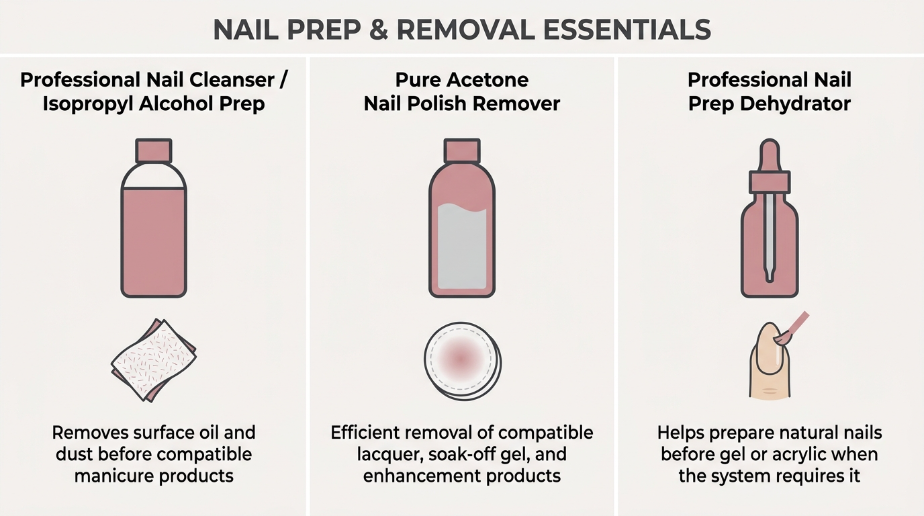
Professional Nail Cleanser / Isopropyl Alcohol Prep
A simple alcohol-based prep product is useful for removing surface oil and dust immediately before compatible manicure products.
As an Amazon Associate, we earn from qualifying purchases.
Recommended Product
Pure Acetone Nail Polish Remover
Pure acetone is practical when you need efficient removal of compatible lacquer, soak-off gel, or enhancement products rather than everyday nail cleaning.
As an Amazon Associate, we earn from qualifying purchases.
Recommended Product
Professional Nail Prep Dehydrator
A dedicated dehydrator can help prepare the natural nail before gel or acrylic when your chosen system specifically includes this step.
As an Amazon Associate, we earn from qualifying purchases.
Frequently Asked Questions
Q: What do nail salons wipe your nails with before polish?
A: Many salons use an alcohol-based nail cleanser or another prep liquid recommended by the polish or gel manufacturer. It removes surface oil, dust, and residue so the next coating has a cleaner surface to bond to.
Q: Is acetone what professionals use to clean nails?
A: Acetone is mainly a removal solvent. Professionals use it to dissolve compatible nail polish, gel, and enhancement products, while alcohol-based cleansers or dedicated prep solutions are more commonly used for the final surface-cleaning stage.
Q: Can you use rubbing alcohol instead of professional nail cleanser?
A: Isopropyl alcohol is used in many professional nail-cleaning formulas, but branded cleansers may contain a specific solvent blend designed for their nail system. For gel, acrylic, or builder products, follow the manufacturer’s prep instructions instead of assuming every alcohol concentration works identically.
Q: Do professionals use hydrogen peroxide or bleach to clean nails?
A: They aren’t routine nail-plate prep liquids for a manicure. Household bleach and professional surface or instrument disinfectants shouldn’t be substituted for nail cleanser simply because they disinfect other surfaces.
Q: Is nail dehydrator the same as nail cleanser?
A: Not always. A cleanser primarily removes surface contamination such as oil and dust, while a dehydrator is formulated to temporarily reduce moisture and oil before an enhancement. Some professional products combine both functions, so always check the label.
So, Which Chemicals Do Professionals Actually Use?
Professional nail cleaning is less about finding the strongest chemical and more about matching the product to the job. Alcohol-based cleansers handle final surface prep, acetone and other solvents remove existing coatings, and dehydrators help prepare natural nails for certain gel and acrylic systems.
Tool disinfectants belong in a separate category entirely. Keep those products on the implements and surfaces they’re labeled for rather than treating them like stronger nail cleanser. Save this guide to Pinterest before your next manicure so you can tell exactly what each bottle on a professional nail desk is designed to do.

Hi, I’m Jessica, the creator behind Unique Lash & Nails Katy.
I created this website for anyone who loves beautiful nails as much as I do. Here, I share trendy nail designs, seasonal manicure ideas, easy nail care tips, honest product recommendations, and step-by-step guides to help you create salon-worthy nails at home. Whether you’re looking for everyday inspiration or your next favorite nail trend, I hope you’ll find something you love.